Author name: Saniya@

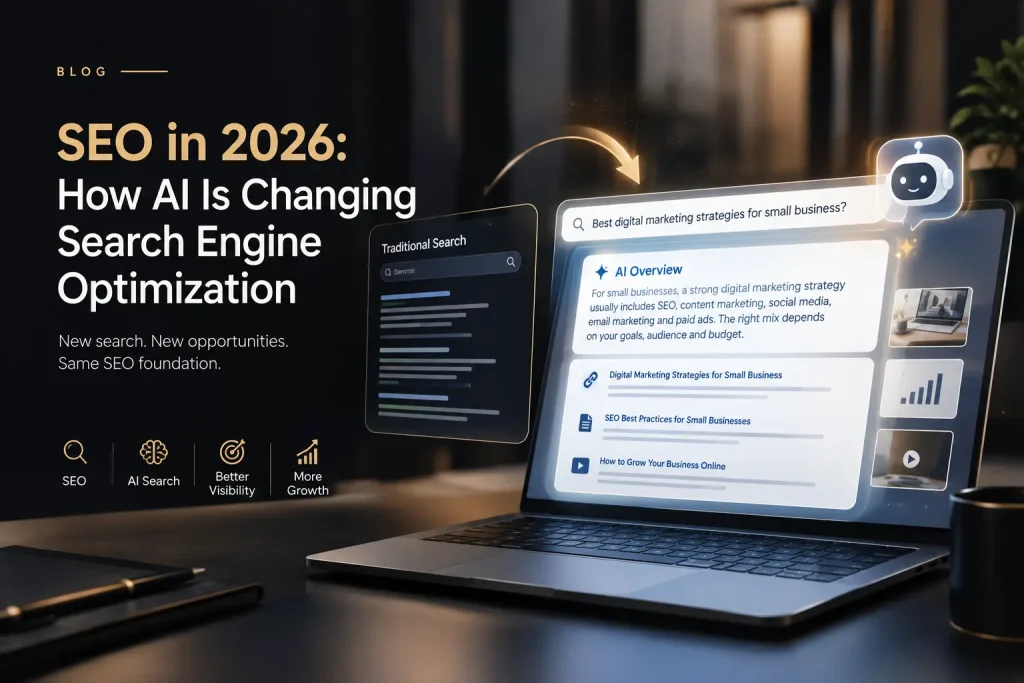
SEO in 2026 with AI search and a laptop.
Digital Marketing

How AI is Changing Search Engine Optimization : In 2026

Introduction: SEO Is Changing, Not Disappearing Search engine optimization has changed over time. In the past, SEO was about keywords, backlinks, rankings, and optimizing for a traditional search. Now search is becoming more conversational and more driven by artificial intelligence. Individuals can ask more conversational questions, make searches with natural language, and engage with AI-powered searches which give summaries and links to relevant webpages. Google’s latest SEO guidance highlights the importance of SEO for generative AI searches. SEO practices shouldn’t be ignored by businesses now because search engines can use generative AI to power their search functions. It’s a must that companies build on their SEO strategy. Now let’s see what’s changing. What Is SEO in 2026? SEO, or search engine optimization, refers to the set of activities that improve a website’s visibility in search engines. This could involve making it discoverable, understandable, and indexable by search engines, as well as ranking higher for relevant queries. The basics are still the same: • Technical website health, • Search intent, • Website content, • Internal linking, • Website structure, • Crawling and indexing, • Page experience, • Relevant authority and references, • Information architecture. However, the ways in which people search and the ways in which search results are presented are changing — and with them, the role of SEOs and agencies. One way to think about it now is that AI is becoming part of the search experience — and queries are no longer just a search term, something like: “digital marketing agency” but rather questions, such as: “What should a small business look for when choosing a digital marketing agency?”

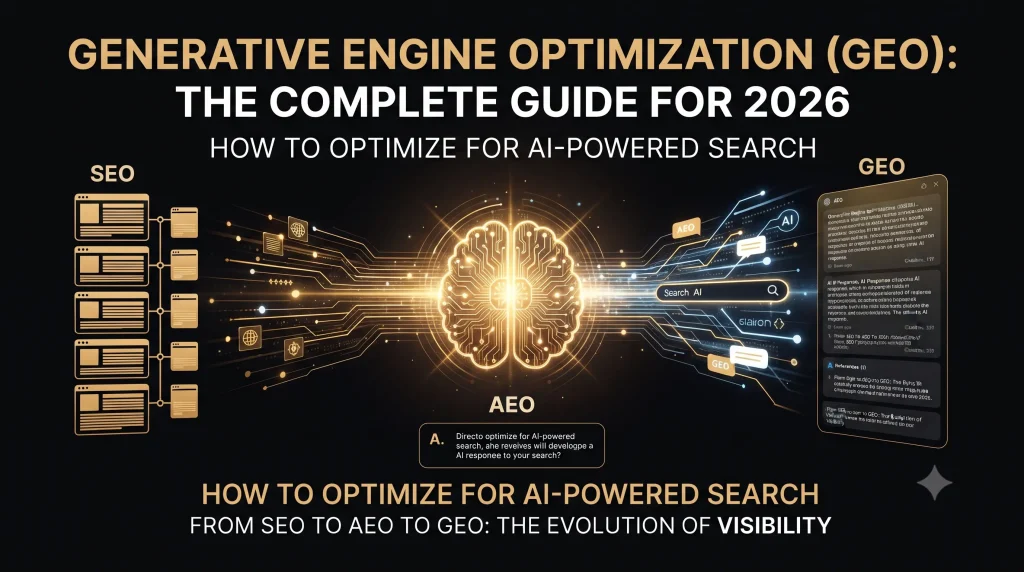
GEO guide showing SEO, AEO, and AI-powered search.
Digital Marketing

Generative Engine Optimization (GEO)

Generative Engine Optimization (GEO): The Complete Guide For 2026 Introduction: Search Is Changing How we search for information is rapidly changing. Traditional search engines have primarily been about delivering a list of web pages for users to sift through. With the rise of AI, new search experiences can understand questions, pull relevant information from various sources, and provide more direct answers. Google’s recently launched AI Overviews and AI Mode open up new avenues for websites to be surfaced in these new, generative search experiences. Google also insists that many of the SEO best practices currently exist in the space of its generative AI search results, so businesses should continue to apply traditional SEO practices since Google Search still relies heavily on its foundational search and ranking systems when it comes to the generative AI solutions. But what does that mean for SEOs? What does it mean for businesses? SEOs and businesses alike are left asking: What are GEOs and AEOs? What do they mean for SEO? And how are they different from “traditional” SEO? Let’s dive into the deep end. What Is Generative Engine Optimization (GEO)? Generative Engine Optimization (GEO) is the practice of generating content in such a way that it is more likely to be found, indexed, or referenced by AI search and answer tools. While SEO typically focuses on surfaces — getting a page to show up, GEO works at the deep level of information, making it useful, understandable, and therefore more likely to be surfaced by AI. For example, a search for something like “What are the best digital marketing strategies for a small business?” would previously have resulted in a Google SERP (search engine results page) — a list of blue links. However, a search using an AI system might produce an answer (think of it like a Google Answer) generated from information found across multiple websites. With that in mind, while businesses may have in the past concerned themselves with simply being found for a given query or set of queries, modern SEO necessitates going one step further — ensuring that the information is there and that it is organized in a logical, comprehensive, trustworthy, and unique way that can be most effective leveraged by AI search tools to best serve the needs of the question asker. Google’s advice for doing that right now is focused on useful, original content, technical SEO, and solid traditional SEO practices — not “GEO hacks.” Why Is GEO Becoming Important? AI-powered search is changing how users discover information. Users are asking more conversational questions and relying less on short search terms. For example: Traditional search: “digital marketing agency India” Conversational search: “What should a small business look for when choosing a digital marketing agency?” The second query has more context and may need an answer that synthesizes multiple ideas. It also presents an opportunity for businesses to share information that directly addresses user questions. GEO can be seen as an extension of a company’s overall search strategy: SEO → Search visibility AEO → Answer visibility GEO → Visibility in generative AI experiences The various strategies are overlapping and not necessarily distinct. Difference Between SEO Vs AEO Vs GEO SEO vs AEO vs GEO Table SEO vs AEO vs GEO Comparison Factor SEO (Search Engine Optimization) AEO (Answer Engine Optimization) GEO (Generative Engine Optimization) Main Goal & Focus Improve visibility in standard search engine results pages (SERPs). Provide direct answers and target featured snippets, voice search, and snippets. Improve visibility and brand citations in AI-generated search responses. Content Style Comprehensive, keyword-optimized web pages and long-form articles. Clear, concise answers structured specifically around direct user questions. Useful, highly contextual, original, and easy-to-understand multi-angle information. Keyword Focus Traditional keywords and matching user search intent. Natural questions and conversational long-tail queries. Broader topics, entities, contextual background, and deep user intent. Example & Strategy Ranking for high-volume keywords like “SEO services” by building authority. Answering “What is SEO?” clearly to win the top featured snippet. Being cited when AI answers complex prompts like “How can small businesses improve GEO?” How GEO Works Generative search systems require information that they can discover, process, and comprehend. A simplified GEO process looks like: User Question → AI Understands Intent → Search/Processing Sources → Select Relevant Information → Generate → May Cite Sources This means that your content needs to include information that helps it stand on its own. Instead of using broad statements, such as: “We offer the best SEO services.” You may want to consider generating more informative content, such as: “Technical SEO refers to the process of optimizing a website’s infrastructure to improve its visibility in search engine results. This may include optimizing site architecture, page speed, mobile responsiveness, indexing, and structured data implementation.” The latter provides more information that would be useful to someone searching for the topic, rather than a vague promise of quality service. 7 Strategies To Improve Your GEO 1. Create Original and Helpful Content One of the most crucial guidelines is to create information that can genuinely help the reader. Do not create content just because a particular keyword has search volume. Instead, ask yourself: • What does the reader want to know? • What problem do they want solved? • Can I explain it better than others? • Can I give examples? • Can I bring new perspectives from my own experience? Google’s guidelines emphasize the importance of creating unique, useful and trustworthy content rather than content created with the sole intention of manipulating search engine results. 2. Answer Specific Questions AI search is most capable of answering questions in a conversational interface. Therefore, create content with questions in mind such as: ➜ What is GEO? ➜ How does GEO work? ➜ Is GEO different than SEO? ➜ How can businesses optimize for AI search? ➜ Does SEO matter for AI search? ➜ How does AI search select information? Question-answer formats are easier for users to consume and are more understandable by search engines. 3. Focus on

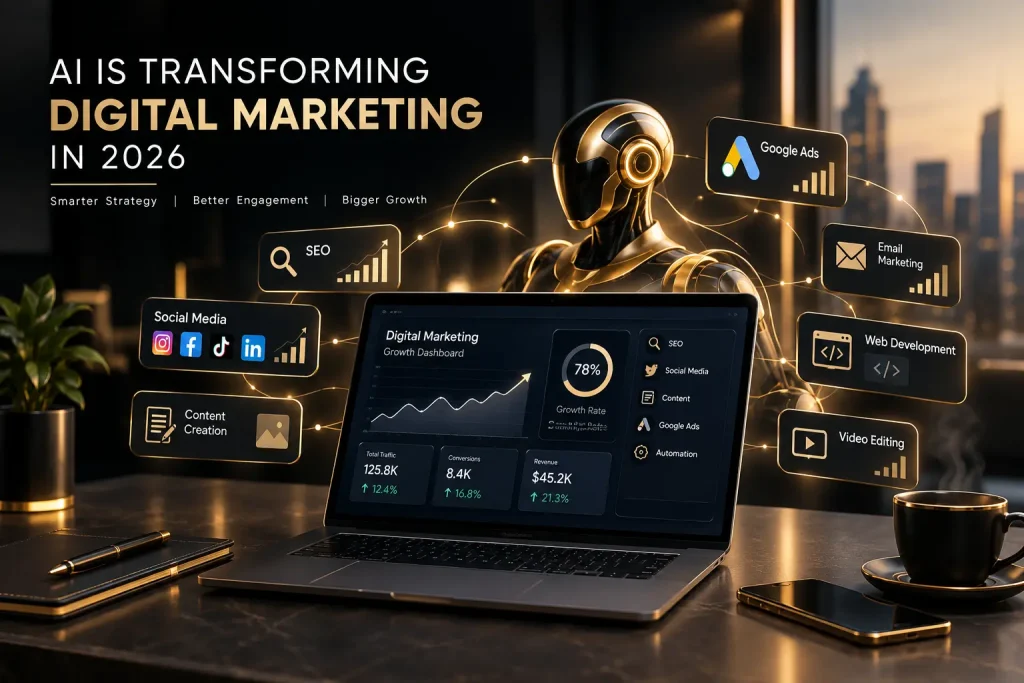
AI transforming digital marketing in 2026
AI Search

How AI Is Transforming Digital Marketing in 2026: Strategies Every Business Should Know

The Rise Of AI In Digital Marketing Artificial intelligence (AI) is transforming the way companies design and manage their digital marketing operations. From understanding customers’ preferences to automating writing, AI can facilitate the effective utilization of vast amounts of data by digital marketers. In 2026, AI will continue to permeate key areas of digital marketing, including search, advertising, social media, content creation, personalization, and automation. Google, for instance, continues to experiment with AI-driven Search features, such as AI Overviews and AI Mode, and, in the process, reimagining how information is retrieved on the web. That said, websites, blogs, SEO, social media engagement, email marketing, ads, and brand building will remain critical areas of focus. However, businesses must leverage AI to make these processes more data-driven, individualized, and efficient. Like with all technological innovations, businesses need to embrace AI strategically and selectively. The ultimate aim should be to rely on AI to resolve specific marketing challenges while continuing to prioritize human-centered approaches to marketing. This includes investing in creative content, brand development, and strategic decision-making that requires human judgement. What is AI Marketing? AI marketing refers to the application of artificial intelligence technologies in marketing processes. These technologies enable artificial intelligence to analyze, recognize patterns, learn, collect and create ideas, individualize, and help humans to make decisions more quickly. For instance, an AI can scan through customer interactions to help come up with the types of content that may appeal to specific buyers. Besides generating content ideas, artificial intelligence can help market analysts come up with insights regarding the former customers’ behaviors. It can also help in analyzing the marketing mix, organizing consumer data, and recognizing variances. Using artificial intelligence in marketing does not solely involve generating content using an AI-driven tool. Instead, it can be integrated at various stages in the marketing process. For instance, it can be used to target audiences, attract new customers, engage existing buyers, persuade them to purchase, and analyze the results of a marketing campaign. AI Marketing Process- How AI is Changing SEO Search engine optimization is changing as search engines become more AI driven. Traditional SEO focused heavily on ranking webpages for keywords and attracting clicks from search results, but today, businesses also need to think about how their content can be useful in an increasingly conversational and AI-powered search environment. Google has continued to expand AI Overviews and AI Mode, including features that aim to help users discover information and relevant websites and original content. This does not mean that businesses should abandon traditional SEO, but rather that SEO should be focused on useful content, answering questions, relevant topics, website quality, technical SEO, and an overall strong online presence.   Important AI-Era SEO Practices Include- • Creating genuinely useful and original content• Understanding search intent• Answering specific customer questions• Building topical authority• Improving the experience of the website• Using clear headings and constructing content• Keeping important information accurate and updated• Strengthening brand authority and trust• Monitoring changes in search behavior The future of SEO is therefore not just about adding more keywords. It is about creating content that will help people and will be understood in various types of search. Traditional Search → AI Search AI and Social Media Marketing Social media marketing presents an array of essential functions that businesses must handle. These include understanding their target audiences’ desires, crafting and publishing engaging content, and analyzing statistics. AI can assist businesses in a number of these areas. Marketers can employ it to devise new content ideas, detect patterns, examine audience responses, create variations of existing content, suggest captions, and organize social media operations. In addition, the application of AI can enable businesses to recognize the kinds of content that perform best on different platforms. That said, social media marketing still involves a heavy reliance on human creativity. Businesses need to provide their audiences with content that is compelling and relatable, as audiences have come to appreciate human-generated content. As such, companies should use AI to complement their creativity rather than rely solely on the technology to replace human-generated material. AI Can Help With- Content Ideas → Captions → Content Planning → Audience Insights → Performance Analysis → Optimization AI Powered Content Marketing Content remains integral to digital marketing, but the practice is changing. Artificial intelligence can help to brainstorm topics, devise outlines, summarize material, create variations, perform keyword research, and recycle content. For example, one long-form blog can be turned into: • Social media posts • Ideas for short videos • Email text • Infographics • In LinkedIn posts • Scripts for videos • FAQs Therefore, it is easier to repurpose content with the help of AI. However, companies should avoid low-quality AI content that can have no value and waste time. The content should not be generic, fake, inaccurate, or irrelevant. To sum up, the best option is AI-driven content creation with manual editing and optimizations.     How AI is Improving Google Ads Another area where AI is taking over is paid advertising. Google is constantly rolling out new AI-based features in its advertising platforms. In 2026, Google introduced new AI and agentic capabilities in Google Ads and Google Analytics, and extended the scope of AI Max as part of the evolution of Search campaigns. AI can help with: • Campaign optimization• Audience signalsBidding• Creative variations• Performance analysis• Budget decisions• Search campaign expansion• Finding opportunities Google’s Smart Bidding is a good example of how AI can be used for advertising. It uses AI to optimize bids based on conversion-related goals and signals. However, it is important to keep in mind that even AI-powered advertising needs human oversight. Companies have to set up goals and conversion tracking, create compelling creatives and landing pages, and carefully analyze performance data. Manual Optimization → AI-Assisted Optimization → AI + Human Strategy Personalization Through AI Customers are becoming more demanding. They now want digital experiences that are right for them and their needs. Artificial intelligence can help companies with personalized marketing. It can analyze

Scroll to Top