

Introduction
Growing your social media following seems to be a success metric nowadays. The number of followers is growing, your posts get likes, some videos reach thousands of views.
But the burning question for any business is:
Are these people going to become your customers?
Having a big following doesn’t equal to increased sales. In 2026 social media platforms are places where people seek, find, engage, research and shop, but a brand needs to have a good conversion rate from engagement to sales.
If your social media channels have a low number of inquiries, orders, and sales, it could be not your audience’s fault. But it can be your content, targeting, CTR, trust factor, and much more.
Followers Are Not the Same as Customers
A follower has displayed some interest in your content, but that doesn’t always mean that they are ready to buy.
Someone could follow your account because:
- They liked a post
- Found your content helpful
- Liked your video
- Want to see more content
- Are researching your category
- Or they just found you
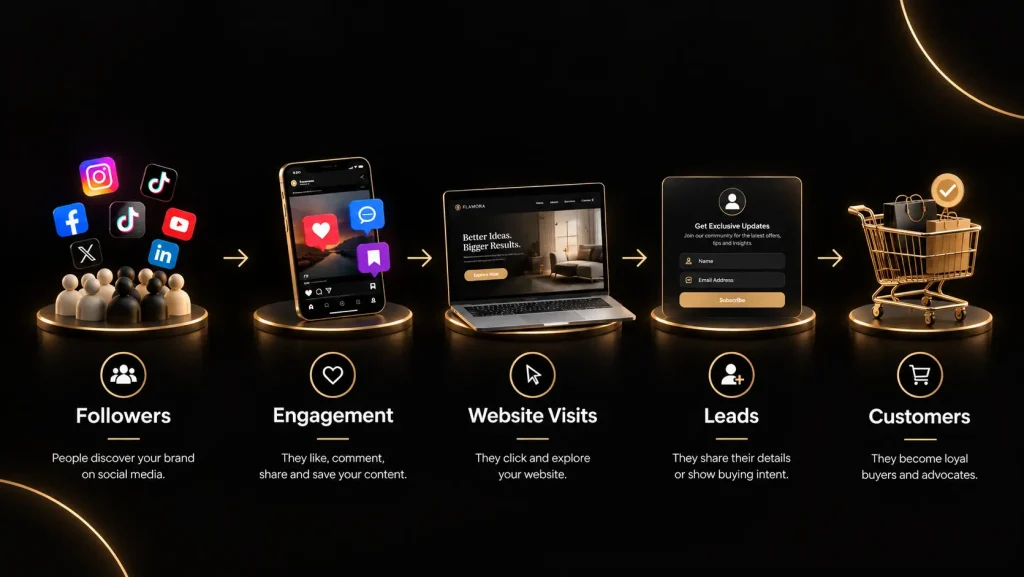
The transition from a follower to an interested visitor to a lead and eventually a customer requires more than just posting.
Modern social feeds are increasingly focused on relevance and recommendations beyond just content from those you already follow.
Your Content Gets Attention but Doesn’t Create Intent
One of the biggest mistakes is creating content that is easy to consume, but hard to act on.
Attention-grabbing content:
“5 Marketing Tips You Need to Know”
Conversion-focused content:
“5 Reasons Your Google Ads Are Getting Clicks but No Leads”
While the first type of post may get engagement, the second speaks directly to a business owner’s pain point and can attract followers further down their buyer journey.
Your content should not only answer the question of “Will people like this?” but also “Will this help the right person take the next step?” of their buyer’s journey.
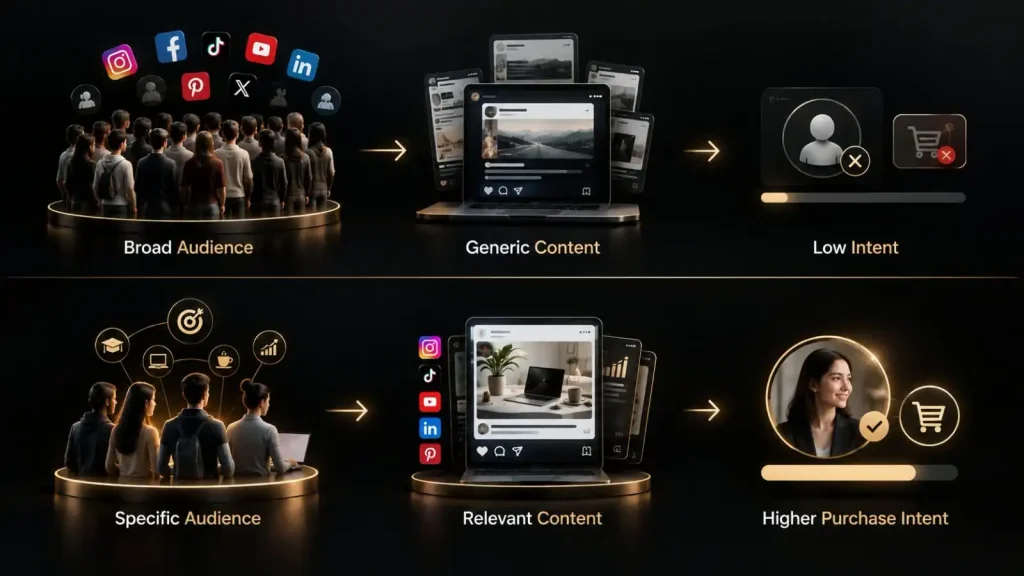
You’re Talking to Everyone
If you write content that is meant to appeal to everyone, you could be alienating your entire following.
Your business should know who its ideal customer is, what problems they have, what they hope to achieve, what is stopping them from buying from you, and what they need to know before they can take action.
Your social media content should reflect answers to these questions.
Instead of writing about “business owners,” for example, write about local service businesses that struggle to get leads from Instagram.
Your Profile Is a Baffling Follow-Up To Someone’s Reel View
Your target buyer scrolled your Reel to its end, followed your link to your profile and now has no idea what to do next. You need them to get off your profile and go to your website but how?
- Your profile needs to tell the story of
- what you do & who you help
- why it matters to get involved with you
- where they can start right now.
They should also be complemented by your website and highlight your main offer. A compelling call-to-action can turn passive viewers into active prospects.
Examples:
Request a consultation
Get a quote
Go to the website
Check out the shop
Send a message
Download your guide
Explore your service
The purpose is to build a clear action path & take away ambiguity.
You’re Over-Promoting Before The Buyer Is Ready
Continually posting offers or promotional content confuses your audience and can drive potential customers away.
While selling is good, it’s important to realize most customers require information and assurance before they’re ready to buy.
One way to do that is to intersperse your promotional content with content that informs, assists and engages your audience, such as:
educational content (to solve their problems)
proof content (to convince them you’re the right choice)
engagement content (to get them talking)
behind the scenes (to give them insight)
offer content (to give them a reason to act)
Building an effective marketing mix will help you create a social selling strategy that blends commerce and community building. Doing these things together can help you sell more by providing value.
You’re Not Providing Enough Social Proof
Most customers want and need proof that you can really help them. Instead of telling them how great you are, let your testimonials do the talking.
Examples of social proof include:
client testimonials & reviews
- case studies
- success stories
- before & after content
- direct quotes from clients
- video reviews & product reviews
- how-to content
- project completions
Social proof can eliminate objections and accelerate the path from a visitor to a buyer.
Your Social Media Doesn’t Complement Your Web Presence
Let’s say someone follows the link on your Instagram post to your website and they don’t see any connection to the post. That wastes their time and reduces the chances you’ll get another client
Social Post -> Profile -> Landing Page -> Offer -> Contact or Buy
In other words, what you’re saying on social doesn’t match up with the offer on your website.
From Followers to Customers
Turn social media attention into trust, conversions and long-term customer relationships.
DISCOVER
ENGAGE
TRUST
VISIT
CONSIDER
CONVERT
RETAIN
should feel like one connected journey.
If your post promises one thing but the landing page talks about something completely different, potential customers may leave before converting.
Followers vs Customers: What's the Difference
Follower-Focused vs Customer-Focused
The difference between chasing social metrics and building meaningful business results.
| Follower-Focused Approach | Customer-Focused Approach |
|---|---|
|
Chases follower growth
|
Builds qualified audience
|
|
Focuses on likes
|
Tracks meaningful actions
|
|
Creates content for reach
|
Creates content around customer problems
|
|
Promotes products frequently
|
Builds value and trust first
|
|
Measures views
|
Measures leads, sales and enquiries
|
|
Generic messaging
|
Specific audience messaging
|
|
Strong social presence
|
Connected social-to-website journey
|
|
Goal: More followers
|
Goal: Business growth
|
I think that follower counts are still valuable indicators, but they shouldn’t be the sole metric by which one judges the success of their social media efforts. Website traffic, leads, conversions and revenue are much better ways to assess social media’s value to the business.
Turn Your Followers Into Customers
There are more things to consider than just “post more.”
Your social media approach should be geared towards connecting interest with an action on your business’s journey.
Think about:
Creating content with a purpose
Every post you make should be for a certain purpose like educating, establishing credibility, interacting, showcasing, or calling your audience to action
Making your call-to-action clear
Do not make people guess what you want them to do. Tell them.
Establish credibility before a sale
Use testimonials, reviews, cases studies, show-offs, and other methods to help your audience connect and trust you before asking for a sale.
Make it clear what you are selling and who should buy it
Your target market should instantly know what you are offering and what it is that they stand to gain from engaging with your brand.
Measuring the business impact
Instead of focusing on likes and followers, think about reach, engagement, profile views, website clicks, leads, and sales.
Frequently Asked Questions
Elaborate on why the followers do not translate into paying customers
My audience does not have purchasing intent, or my message is not compelling enough to encourage someone to make a purchase.
Can increasing the number of followers boost the sales?
It depends, since a high number of irrelevant followers will hardly have any influence on sales. Instead, the concentration on building a relevant audience that is interested in the message is likely to increase sales.
What social media content format helps convert the followers into customers?
There is no specific format that is suitable for all businesses. However, educational, demonstrative, testimonial, case study, user-generated content, and problem-related posts are great at converting.
How can one convert Instagram followers into customers?
By optimizing the profile, posting relevant content, including the call-for-action, providing social proof, making the link in the bio relevant and short, and making the process of buying something or requesting information easier.
What social media metrics should a business owner track?
It depends on the business objective. However, some metrics that are significant for businesses are audience reach, engagement rate, profile views, link clicks, leads generated, conversions, and revenue.
Does every social media post need a call for action to turn the followers into customers?
Not every post should have a CTA. Some social media posts aim to nurture the audience. Moreover, a great campaign will have posts that will accomplish different objectives, such as education, entertaining, and promoting.
Conclusion
A big following on social media may make the profile page look impressive, but attention is not enough to build a business.
Focus on getting the attention of the right people and influencing their behavior.
The best way is to ensure that your audience knows precisely what you are selling, trusts that they can count on you, and what they should do next.
That way, instead of asking yourselves how to get more followers, you need to focus on turning them into customers.
Such a change in perspective can radically change the approach to social media marketing.