Artificial Intelligence & Search

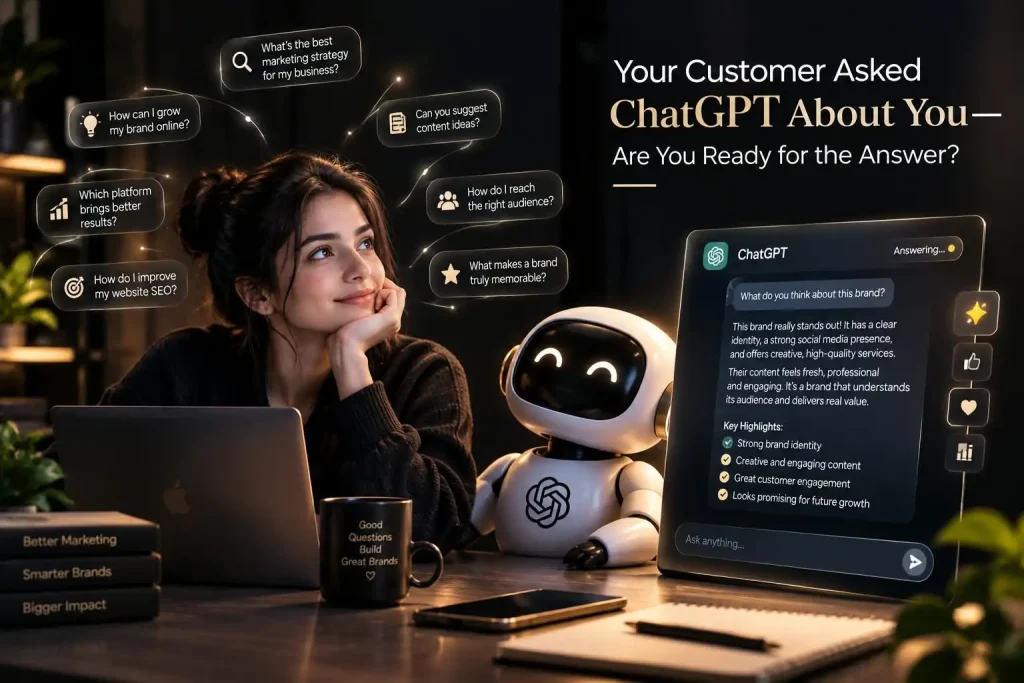
Customer asking ChatGPT about a brand and receiving an AI-generated brand evaluation.
Artificial Intelligence & Search

Your Customer Asked ChatGPT About You—Are You Ready for the Answer?

Your Customer Asked ChatGPT About You—Are You Ready for the Answer? Imagine someone asking ChatGPT, “Is Flamora a good digital marketing agency for a growing business?” They may not visit your website; they may want ChatGPT to explain what you do, compare you to similar agencies, summarize reviews about your company, or help them determine whether you are worth investing in. You should know you are competing not only in the search engine but also in the space of artificial intelligence. Because AI search is now a critical component of the consumer journey and has the potential to fundamentally change how brands engage with their audiences. For example, 44% of consumers who are using AI search say it is their preferred way to research products and services, compared to 31% for traditional search, according to McKinsey. Consumers are turning to AI to help them navigate an overwhelming array of choices, identify products that meet their needs and wants, and get past the noise. But brands should also recognize that they must begin to think of generative AI as a distribution channel for their goods and experiences.
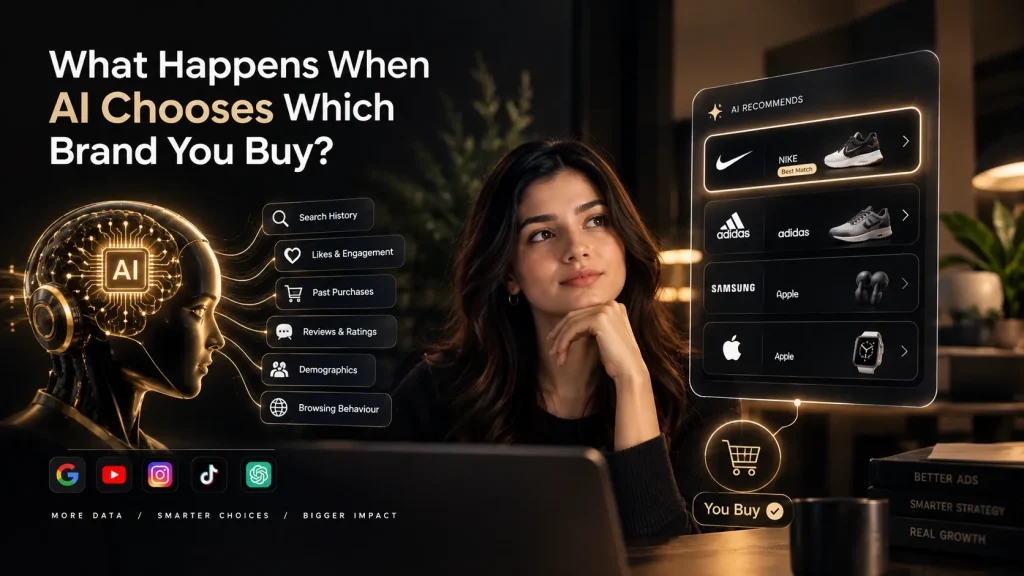

AI recommending brands based on consumer data and behavior.
Artificial Intelligence & Search

What Happens When AI Chooses Which Brand You Buy?

What Happens When AI Chooses Which Brand You Buy? Imagine a customer asking, “Hey, find me the best laptop under 80000 for video editing.” Google search, open various sites, read reviews, compare the prices, and research — all this can be eliminated by an AI assistant. AI researches and compares different options based on certain criteria, summarizes reviews, and shortlists products for the customer. AI doesn’t finalize the purchase but is used to shortlist the options for the customers. This is the dawning of the era of AI-powered shopping and agentic commerce.

AI citation strategies for ChatGPT, Gemini, and Perplexity.
Artificial Intelligence & Search

How to Get Your Website Cited by ChatGPT, Gemini, and Perplexity in 2026

Introduction Search is evolving from “find a website” to “get an answer.” In the past someone might type something into Google, open up a bunch of links, compare the information, and then make a determination on the best source. AI powered search experiences offer the ability to summarize information, answer follow up questions, and provide links to supporting sources. ChatGPT Search can show citations and links to web sources, Gemini can provide related sources, and Perplexity is built around cited answers. That’s a huge shift for SEOs and content marketers: it’s a new visibility opportunity. Your website doesn’t need to just rank in traditional search results, it needs to answer and be able to be understood, evaluated, and referenced by AI powered search experiences. But there isn’t some secret button that makes a website get cited. It’s about building content around usefulness, relevance, clarity, authority, accessibility, and strong search fundamentals.

AI and human thinking in digital marketing.
Artificial Intelligence & Search

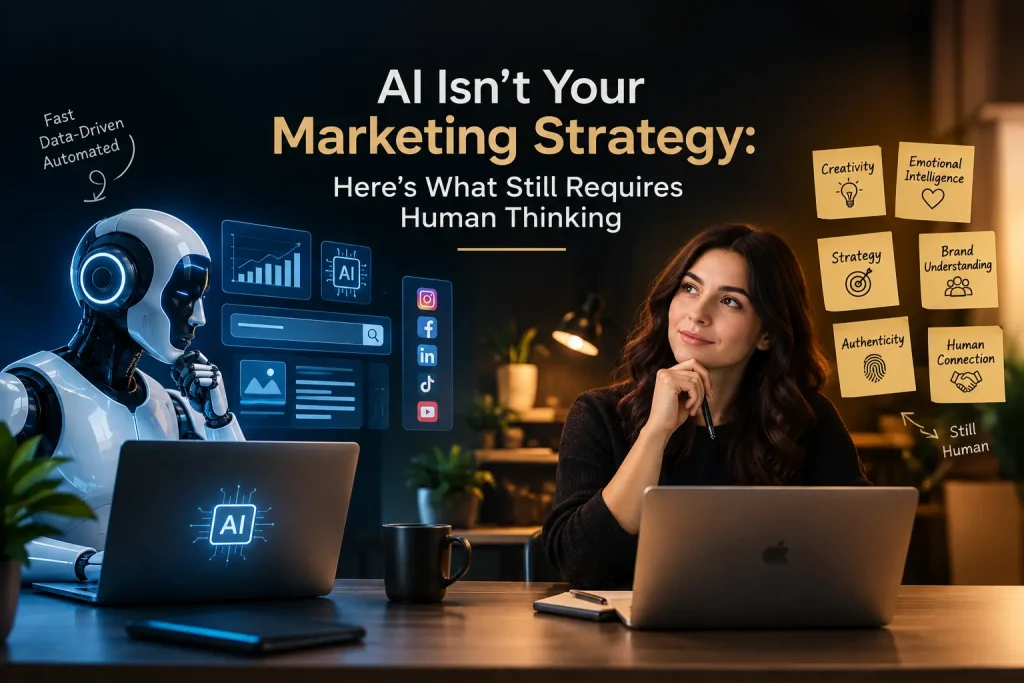
AI Isn’t Your Marketing Strategy: Here’s What Still Requires Human Thinking

Introduction AI changed digital marketing for the better within a short period of time. Nowadays, marketing professionals are using artificial intelligence to find content ideas, create drafts, analyze data, design visual elements, automate repetitive tasks, personalize communication and support conversations with customers. As a result, marketing became more productive and, in many cases, more efficient. There is 1 thing that many businesses fail to consider. AI is simply a tool that helps with marketing Giving an AI a prompt and publishing its output doesn’t immediately result in a marketing success. In fact, there is no marketing strategy behind it at all. A good marketing strategy is always focused on specific customers, addresses their problems, defines the brand’s position, differentiates it from competitors, sets marketing goals and decides which channels to use. While AI can help with some of these points, humans are ultimately responsible for most of them. The future of marketing doesn’t have to be about AIs replacing humans; it’s rather about the best ways of combining automation and human efforts.

GIVE ME ALTERNATIVE TEXT
Artificial Intelligence & Search

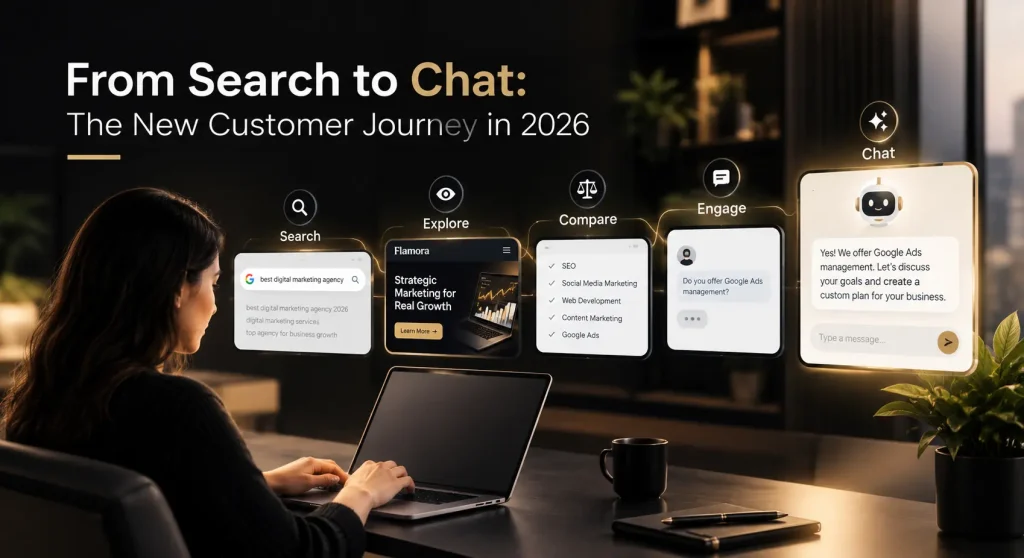
From Search to Chat: The New Customer Journey in 2026

Introduction: The Customer Journey Is Changing For years, the customer journey often began with a Google search. Someone would search for something, visit several websites, compare things and eventually make a decision. In 2026, that journey is becoming more conversational. People are able to ask more complex and follow-up questions and engage with AI-powered search experiences to research, compare and explore information. Google has implemented AI Overviews and AI Mode into a more conversational search experience while ChatGPT Search lets people ask questions and continue exploring through conversation. The journey is shifting from: Search → Website → Research → Decision toward: Question → AI Answer → Exploration → Brand Discovery → Decision What Does “Search to Chat” Mean? Search to chat refers to the transition from standard keyword-based search, to conversational questioning through artificial intelligence-powered search and chat tools. Rather than searching: “best digital marketing agency” a customer may ask: “Which digital marketing agency can help a small business improve SEO, social media and Google Ads?” The second example suggests more intent and context. Through AI-powered search, users can engage in a dialogue to further explore the topic, ask additional questions and uncover relevant information. This highlights the need for businesses to move beyond single keywords and think on the questions, problems and decisions their customers are seeking to solve. The New Customer Journey  The Customer Has a Question In many cases, the journey begins with the presentation of a problem before the solution. For example: “Why is my website getting traffic, but no leads?” Your content should focus on answering the real questions of the customers. AI Helps the User Research the Question AI-powered search can summarize information and help the user find more information on the subject. Google announced that its AI Mode is meant to handle more complex questions and conversation-like queries. This suggests that customers may have multiple questions or want to further develop the conversation.  Customer Compares Options Once the customer has done their research, they will begin to compare options based on: ✦ Brands ✦ Products ✦ Services ✦ Pricing ✦ Reviews ✦ Features ✦ Experiences At this point, content that compares features, provides case studies, FAQs and honest information can help your brand stand out.  The Customer Discovers Your Brand’s Content via AI A customer’s first discovery of your brand may not be clicking on a link or searching directly for your company. The customer may instead see your content discovered by the AI, follow the suggestions provided by the AI or perform a more in-depth search. Google has stated that “its AI Search experiences continue to drive traffic to websites and to content, including articles, videos and more”.  The Customer Converts Ultimately, the customer will convert. This may include visiting your website, contacting your business, requesting a quote or even making a purchase. Your website’s role is essential at this point in the journey. AI may have presented a customer with your content, but your website must provide the information and the trust to encourage the conversion. Traditional Search vs Conversational Search The New Search Journey Traditional Search vs Conversational Search 01 Traditional Search Keyword User enters a search query ↓ Search Results Search engine displays results ↓ Multiple Websites User visits different sources ↓ Comparison User compares information ↓ Decision User chooses an option 02 Conversational Search Question User asks naturally ↓ AI Answer AI provides a direct response ↓ Follow-Up Questions User continues the conversation ↓ Brand Discovery Relevant brands can enter the conversation ↓ Website User explores the selected brand ↓ Decision User takes the next action Search is evolving from link discovery toward AI-assisted conversations and brand discovery. How Businesses Can Adapt Create Content Around Real Questions Diversify beyond short tail keywords. Create content that answers real questions. For example: “How can a small business improve Google Ads performance?” is more actionable than simply creating content around the keyword: “Google Ads.”  Build Topic Authority Produce useful content around your core services and topics. For a digital marketing agency, this might include: SEO → AI SEO → GEO → Google Ads → Performance Marketing → Social Media → Content Marketing This is an interconnected ecosystem of content.  Make Content Easy to Understand Utilize: ● Headings ● Short paragraphs ● FAQs ● Comparisons ● Examples ● Statistics ● Original research Make it easy for both humans and search engines to consume the information.  Strengthen Your Brand Presence Search visibility is not just about publishing more content; it also has to do with building a digital footprint of trust and authority through useful content, great websites, customer experiences, reviews and brand image. AI Search Does Not Mean Websites Are Dead The rise of conversational search does not signal the death of websites. While AI search experiences offer users the ability to find links and get directed towards websites and sources, your website is still the place where your customers can: Come to learn about your services See your work Read the case studies Contact your business Compare solutions Take action The aim is not to make a choice between AI search and your website. Rather, it is about making your website so valuable that it can be found both through traditional and AI-assisted means SEO, AEO and GEO in the New Customer Journey The Evolution to AI Visibility The Search Evolution From Keywords to AI Visibility How the digital discovery landscape is transforming 01 🔍 SEO Search Engine Optimization Focuses on keywords, backlinks, and climbing traditional search engine result pages (SERPs). 02 🗣️ AEO Answer Engine Optimization Optimizes content for direct answers, voice search, and featured snippets used by assistants. 03 🌐 GEO Generative Engine Optimization Tailors content to be cited and recommended within AI-generated summaries and multi-source engines. FINAL GOAL ✨ AI Visibility Omnipresent Brand Authority Ensuring your brand is referenced, trusted, and visible across all generative AI models and touchpoints. 💡 The customer journey no longer follows standard queries—it requires full spectrum AI Visibility. The Future of the

AI-powered digital marketing dashboard for a small business.
Artificial Intelligence & Search

AI Marketing for Small Businesses: A Complete Guide

AI Is Changing Small Business Marketing Marketing is one of those areas that can be pretty difficult for small businesses to navigate. A tiny budget, limited resources and lack of free time can combine into a serious challenge for small business owners trying to do their marketing. That’s where AI marketing comes in handy. Artificial intelligence can lend a hand in content creation, customer research, social media planning, SEO, advertising and marketing automation in general. That’s why more and more companies are turning to artificial intelligence to help them out with their marketing needs. However, the point is not to replace human marketers, but rather to help them become more efficient and take over some of the routine tasks.

SEO in 2026 with AI search and a laptop.
Artificial Intelligence & Search

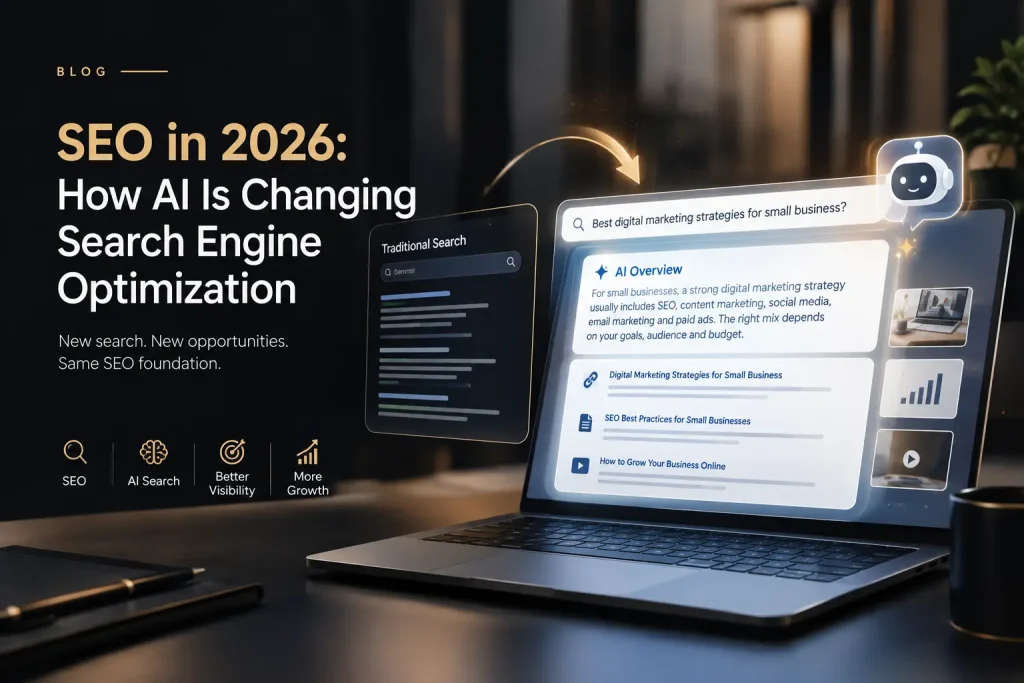
How AI is Changing Search Engine Optimization : In 2026

Introduction: SEO Is Changing, Not Disappearing Search engine optimization has changed over time. In the past, SEO was about keywords, backlinks, rankings, and optimizing for a traditional search. Now search is becoming more conversational and more driven by artificial intelligence. Individuals can ask more conversational questions, make searches with natural language, and engage with AI-powered searches which give summaries and links to relevant webpages. Google’s latest SEO guidance highlights the importance of SEO for generative AI searches. SEO practices shouldn’t be ignored by businesses now because search engines can use generative AI to power their search functions. It’s a must that companies build on their SEO strategy. Now let’s see what’s changing.

AI transforming digital marketing in 2026
Artificial Intelligence & Search

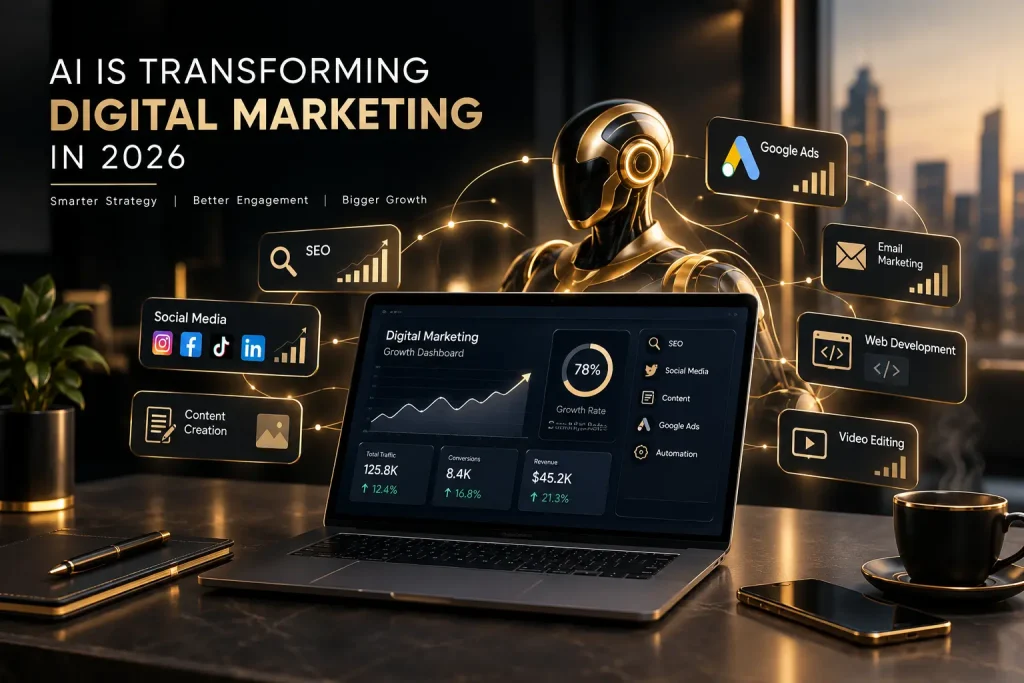
How AI Is Transforming Digital Marketing in 2026: Strategies Every Business Should Know

The Rise Of AI In Digital Marketing Artificial intelligence (AI) is transforming the way companies design and manage their digital marketing operations. From understanding customers’ preferences to automating writing, AI can facilitate the effective utilization of vast amounts of data by digital marketers. In 2026, AI will continue to permeate key areas of digital marketing, including search, advertising, social media, content creation, personalization, and automation. Google, for instance, continues to experiment with AI-driven Search features, such as AI Overviews and AI Mode, and, in the process, reimagining how information is retrieved on the web. That said, websites, blogs, SEO, social media engagement, email marketing, ads, and brand building will remain critical areas of focus. However, businesses must leverage AI to make these processes more data-driven, individualized, and efficient. Like with all technological innovations, businesses need to embrace AI strategically and selectively. The ultimate aim should be to rely on AI to resolve specific marketing challenges while continuing to prioritize human-centered approaches to marketing. This includes investing in creative content, brand development, and strategic decision-making that requires human judgement. What is AI Marketing? AI marketing refers to the application of artificial intelligence technologies in marketing processes. These technologies enable artificial intelligence to analyze, recognize patterns, learn, collect and create ideas, individualize, and help humans to make decisions more quickly. For instance, an AI can scan through customer interactions to help come up with the types of content that may appeal to specific buyers. Besides generating content ideas, artificial intelligence can help market analysts come up with insights regarding the former customers’ behaviors. It can also help in analyzing the marketing mix, organizing consumer data, and recognizing variances. Using artificial intelligence in marketing does not solely involve generating content using an AI-driven tool. Instead, it can be integrated at various stages in the marketing process. For instance, it can be used to target audiences, attract new customers, engage existing buyers, persuade them to purchase, and analyze the results of a marketing campaign.

Scroll to Top