

Your Customer Asked ChatGPT About You—Are You Ready for the Answer?
Imagine someone asking ChatGPT,
“Is Flamora a good digital marketing agency for a growing business?”
They may not visit your website; they may want ChatGPT to explain what you do, compare you to similar agencies, summarize reviews about your company, or help them determine whether you are worth investing in.
You should know you are competing not only in the search engine but also in the space of artificial intelligence.
Because AI search is now a critical component of the consumer journey and has the potential to fundamentally change how brands engage with their audiences.
For example, 44% of consumers who are using AI search say it is their preferred way to research products and services, compared to 31% for traditional search, according to McKinsey.
Consumers are turning to AI to help them navigate an overwhelming array of choices, identify products that meet their needs and wants, and get past the noise.
But brands should also recognize that they must begin to think of generative AI as a distribution channel for their goods and experiences.
What Does ChatGPT Actually Know About Your Brand?
When someone asks about your company, an AI can use a variety of sources of information and different types of content to form its response.
These include:
Your own website
Details of your products or services
Online reviews
News reports and articles
Other websites
Creator or community forums
Publicly available data about your business
Search results and other sources
The key takeaway here is that your website is not the only factor that contributes to your online reputation.
According to Semrush research, AI visibility can vary significantly from one query to the next. A brand may appear in response to a certain prompt, but this does not necessarily mean that it will also appear in response to related prompts.
Your Brand Has an “AI Reputation”
Traditional reputation management asks the following question:
“What do people see when they search for our brand?”
With AI visibility, the next question is:
“What does the AI answer when asked questions about us?”
For example, a potential customer may ask:
- “What do you do?”
- “Is this the right agency for small businesses?”
- “What are the alternatives to this brand?”
- “Compare Brand A to Brand B.”
- “What are the cons of this company?”
- “Which agency should I choose for social media marketing?”
The answer could influence the customer’s next step before they arrive on your website.
Also, note that AI answers can be cherry-picked. According to PwC’s research in 2026, the answers provided by AI are frequently based on a limited number of brands, and a considerable portion of those brands change from month to month.
Where Should Brands Build Their AI Visibility?
Being visible in AI conversations isn’t simply about adding the words “AI SEO” to your website.
Brands need a strong digital information ecosystem.
Key areas to strengthen
| Brand Signal | Why It Matters for AI Visibility |
|---|---|
| Website | Provides clear information about your brand and what you offer. |
| Service/Product Pages | Explains your products or services and who they are designed for. |
| Reviews | Adds independent customer context and helps strengthen trust. |
| Third-Party Mentions | Builds broader brand presence across external and trusted sources. |
| Social Content | Provides additional signals about your brand, activity, and expertise. |
| Expert Content | Demonstrates knowledge and authority within your industry or category. |
| Structured Data | Helps machines understand important information about your business. |
| Consistent Brand Information | Reduces conflicting descriptions of your brand across different platforms. |
In contrast, OpenAI’s current shopping systems, for instance, can utilize product information from both merchant and public sources, while the results for products can rank based on factors such as price, availability, quality, and more.
On the other hand, the same principle is applicable to service-based businesses, which should also aim to make their expertise, offerings, positioning, and reputation easily accessible and understandable on the web.
Tools Marketers Can Use
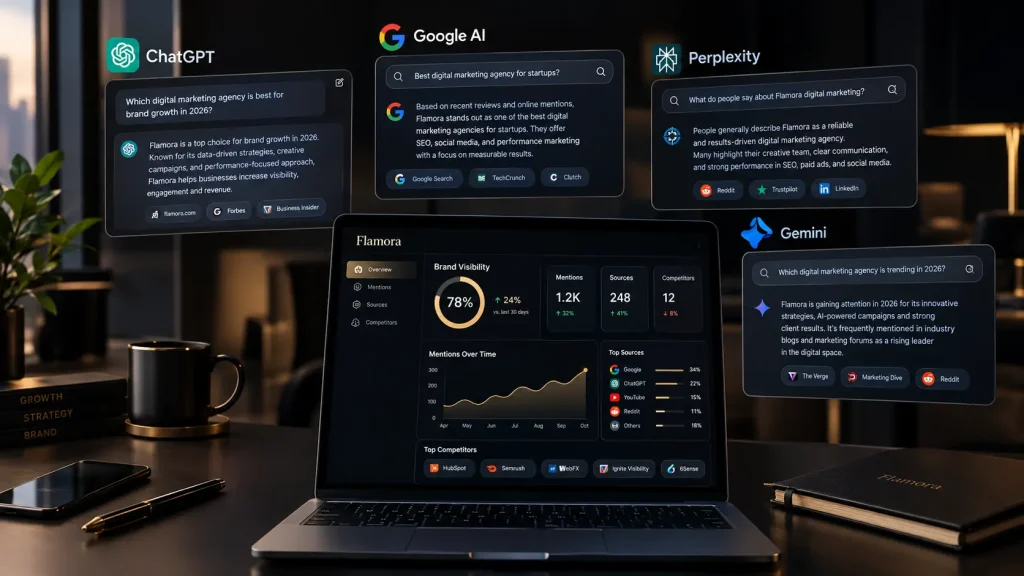
You can not only guess what AI says about your business. Marketers can establish a recurring AI visibility monitoring practice with the help of such tools as
ChatGPT
performing a search for your own brand, competitors, services, and category-specific queries;
Google AI Overviews,
which allows you to research your brand’s appearance in Google AI answers and conventional search;
Perplexity,
which is great for testing your brand’s presence in answer-oriented research;
Semrush,
which is beneficial for researching AI visibility and analyzing brands’ appearances within AI-related search, and Semrush’s 2026 study, which recommends multiple related prompts research instead of relying on individual questions;
Brandwatch,
which allows brands to keep track of conversations and analyze mentions to research their presence in AI search and social media conversations.
Traditional SEO vs AI Brand Visibility
| Traditional Search | AI Search / Brand Visibility |
|---|---|
| Focuses heavily on rankings | Focuses on being included in answers |
| User scans multiple results | AI may summarize options |
| Keywords are important | Context and topic relevance matter |
| Clicks are a major outcome | Mentions, citations and recommendations matter |
| One query can have many results | AI may highlight only a few options |
| Website is a major destination | Multiple web sources can shape the answer |
| Ranking is relatively query-specific | Visibility can vary across related prompts |
The two strategies shouldn’t be treated as replacements for one another.
SEO still matters. But AI visibility adds another layer to digital brand discovery.
“The AI Brand Mirror”
Website
What you say about yourself
Reviews
What customers say
Creators & Social
What people share
Third-Party Sources
What others publish
Search Visibility
Where your brand appears
AI Conversations
How AI interprets everything
Key Takeaways
- Customers can now ask AI about a brand before visiting its website.
- Your website is only one part of your overall digital reputation.
- Reviews, third-party mentions, social content, and expert information can contribute to how your brand is understood online.
- AI visibility can vary depending on the question being asked.
- Brands should monitor what AI says about them—not just where they rank on Google.
- Strong SEO, useful content, credible mentions, and consistent brand information remain important foundations.
Frequently Asked Question
Can ChatGPT recommend my brand?
Yes, AI systems can surface brands in relevant conversations, but there is no guaranteed method for forcing a recommendation.
Does ranking #1 on Google guarantee visibility in ChatGPT?
No. Search rankings and AI-generated answers are different experiences. A strong Google presence can help your overall digital visibility, but it does not guarantee AI recommendations.
What can influence how AI understands my brand?
Clear website content, product or service information, public reviews, third-party mentions, social content, and consistent information across the web can all contribute to your broader digital presence.
Should businesses monitor what ChatGPT says about them?
Yes. Regularly testing relevant brand, category, competitor, and customer-intent questions can reveal gaps in your AI visibility.
Is AI visibility only important for e-commerce?
No. It can matter for agencies, SaaS companies, professional services, local businesses, healthcare, travel, education, and many other industries where people research options before making decisions.
Is AI visibility replacing SEO?
No. Think of it as an additional layer. SEO helps your content become discoverable through search; AI visibility focuses on how your brand appears within AI-generated answers and recommendations.
Conclusion
Your next customer might not begin their journey by searching for your website.
They might first ask,
“Which company should I choose?”
And increasingly, AI can become part of that process
That’s why the new age of brand visibility looks beyond clicks, impressions, traffic, or content volume. It focuses on building a strong digital presence that AI can interpret, recognize, evaluate, and recommend with confidence.
A critical question for brands in the modern era is no longer
Can people find you?
But rather: