
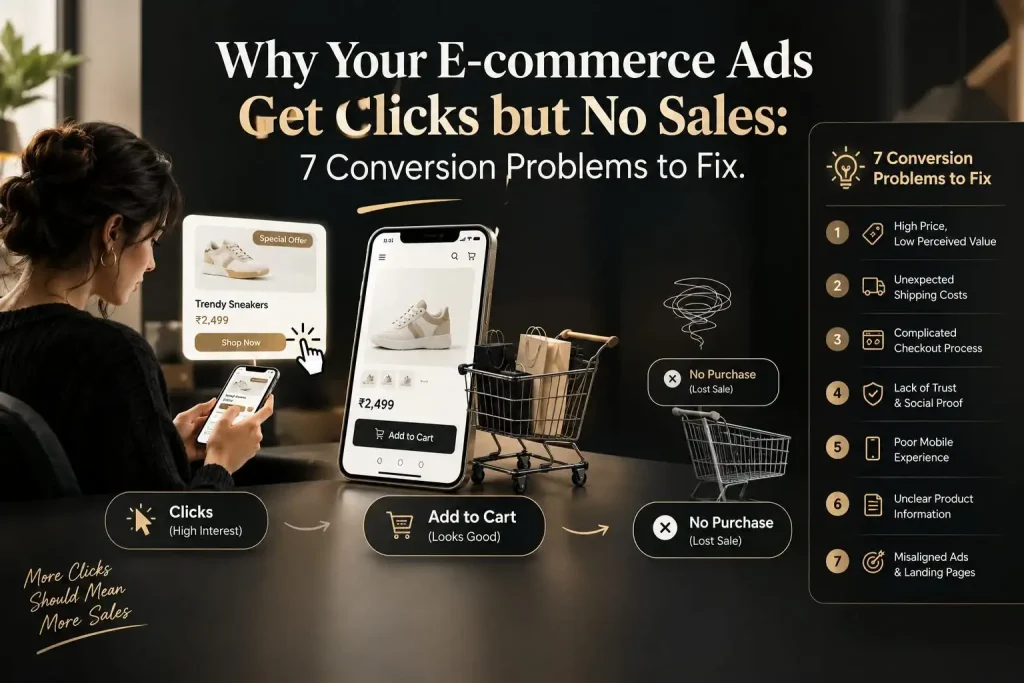
Why Your E-commerce Ads Get Clicks but No Sales: 7 Conversion Problems to Fix
Getting clicks on an e-commerce ad may seem like the ultimate success, but they may not actually bring profits. A click campaign can drive a plenty of traffic to your page and get you nothing if your product page, promotion, trust factors, checkout process, or even the customer’s expectations are not properly shaped.
In other words, there are plenty of ways to get someone to your page, but conversions – actual purchases – will only happen if everything is set up to deliver on the promise of the advertisement.
Therefore, clicks are simply the number of opportunities, while conversions are what brings profits.
Your Ad Promises More Than Your Product Page Delivers
Someone clicked on your ad because it promised a certain product, price, offer, etc.
If they land on a page that has nothing to do with the ad, you’re confusing them
Example:
Ad: “Premium Sneakers – 30% Off”
↓
Landing Page: Regular homepage with dozens of products
That’s a bridge too far.
Match your ad and your landing page
- Product
- Price
- Offer
- Usability
- Content
- Aesthetics
- Call-to-Action
Your Product Page Doesn't Build Enough Trust
A customer may be interested in your product, but he/she may still ask: “Can I trust this store?” The absence of reviews, return policy, bad picture quality, unavailable payment types, and lack of product information may turn a potential buyer away. Let’s fix that!
Customer reviews
Ratings
High-quality product images and videos
Return policy
Refund information
Delivery time
Indicators of secure payments
Product specifications
Your Offer Isn't Strong Enough
A click does not always mean a customer is ready to buy.
Customers will research prices, compare shipping costs, discounts, and alternatives before making a purchase.
Your product/service may be great, but the value may not be there.
Instead of “Buy Now”, try enticing customers to buy with these calls to action.
Free Shipping
Limited Time Offers
Bundling
Easy Returns
Unexpected Costs Kill Conversions
One of main reasons for high cart abandonment rate is last minute addition of extra costs.
Baymard’s latest research shows that average cart abandonment rate is at 70% while additional costs such as shipping, taxes and fees are still one of the biggest reasons for cart abandonments
Fix:
Display major additional costs as early as possible
Product → Price → Shipping → Final price
Do not force customers to learn about total price at the end of the ordering process
Your Checkout Has Too Much Friction
Even customers who are willing to buy may be deterred by a complicated purchasing process.
According to Baymard’s research, 17% of customers abandon their purchase at checkout due to a complicated or lengthy process.
How to fix it: Keep checkout simple, quick, and clean.
Do not ask for information that is not necessary and remember to offer a guest checkout option if available.
You're Targeting the Wrong Audience
Not every click denotes a buying opportunity.
Someone searching for
“best running shoes”
is likely to be in research mode
while
“buy Nike running shoes size 9”
indicates a clear buying intention
Fix:
Group your campaigns according to intent.
| Intent | Example | Ad Approach |
|---|---|---|
| Awareness | “Best running shoes” | Educational |
| Consideration | “Nike vs Adidas running shoes” | Comparison |
| Purchase | “Buy Nike running shoes” | Product + Offer |
| Retargeting | Viewed product | Reminder + Incentive |
You're Measuring Clicks Instead of the Full Funnel
CTR can be high while sales are low
Ecommerce marketers need to focus on the entire conversion path
from ad impression to product views, adding to cart, checkout and purchase
Google Analytics 4 tracks ecommerce events like view_item, add_to_cart, begin_checkout and purchase so you can see where users are dropping off.
The wrong question to ask is
How many people clicked?
The right question is
Where did people fall off?
📊 5-Year E-commerce Cart Abandonment Data
Cart abandonment has been a persistent problem in the e-commerce space for years. Published benchmarks have a range, because they’re derived from various studies, so it’s not something that can be compared on a linear scale from year to year. That said, Baymard has aggregated a number of these studies over the years, so we’ve got a decent overview of how cart abandonment rates have evolved.
Cart Abandonment Rate
Reported abandonment rate by year
Important: these are not directly comparable year-over-year measurement since different studies and data sets have been used. The main conclusion is that site abandonment remains persistently high.
What This Means for Advertisers
More traffic does not always mean more revenue.
Say, if you have a web store:
10,000 visits = 300 sales
and you get an offer that helps you reach 20,000 visits, you might think that 600 sales would follow. However, in reality, you would only get 400.
Therefore, it is better to increase the conversion rate of your existing traffic rather than focus on getting more visits.
Where Your E-commerce Customers Drop
From Impression to Purchase
Every stage of the customer journey can make or break a sale.
🛠️ Tools to Find Where Customers Drop
Google Analytics 4
Track product views, add-to-cart, checkout and purchase events.
Google Ads
Compare ad clicks, conversions and campaign performance.
Meta Ads Manager
Understand which audiences and creatives bring valuable traffic.
Microsoft Clarity
Use session recordings and heatmaps to find out UX issues.
Shopify Analytics
Monitor traffic, conversion rates and sales at a store level.
🔑 Key Takeaways
- Clicks are not the same as conversions.
- Your landing page should match the promise made in the ad.
- Product pages need strong trust signals and clear information.
- Unexpected shipping and other costs can cause major abandonment.
- Simplifying checkout can remove significant conversion friction.
- High CTR doesn’t necessarily mean a profitable campaign.
- Track the complete journey from ad click to purchase.
- Before increasing ad spend, find and fix the biggest funnel leak.
Frequently Asked Questions
1. Why are my e-commerce ads getting clicks but no sales?
In most cases, it is connected to the page where users are redirected after clicking on the ad. The reasons for this may be insufficient relevance of the landing page, product description, price, lack of trust, checkout page complexity, low purchase intent.
2. Is a high CTR good for e-commerce?
A high CTR is a good indicator of the success of your ads, but it is not a complete metric. To get a realistic perspective, it should be evaluated along with CPA, conversion rate, revenue, and ROAS.
3. What is a good e-commerce conversion rate?
There is no specific standard for measuring a good conversion rate for e-commerce. This metric depends on many factors: industry, products, traffic sources, price range, and customer behavior. In addition, the numbers vary for different methodological approaches.
4. How can I reduce cart abandonment?
The first step is to revise the pricing policy. Then, optimize the checkout process and make it available to guests, clarify the delivery conditions, and build trust.
5. Should I increase my ad budget if I’m getting a lot of clicks?
Not right away. First of all, you need to analyze the traffic and identify at which stage of the funnel users are abandoning the carts. After that, fix the problems in the flow so that the current traffic brings more conversions.
6. Which metric should e-commerce brands care about the most?
It is a mistake to focus only on one metric when evaluating the performance of an e-commerce site. In reality, each stage of the sales funnel must be analyzed. This includes CTR, CPC, conversion rate, CPA, average order value, revenue, and ROAS.
Conclusion
E-commerce advertising is not only about attracting clicks.
It is about what happens next.
The traffic that does not convert into sales makes you pay more for your ads. And the traffic that converts brings you new customers. So, not only should you focus on acquiring more visitors to your page but also on influencing their behavior so they become your paying clients.
The more conversions happen on your website, the more sales of your products or services you will get.
🚀 Ready to Turn More Clicks Into Customers?
At Flamora, we help brands build digital marketing strategies focused not just on traffic, but on visibility, engagement and conversions.
Connect with Flamora and build an e-commerce marketing strategy designed to turn attention into measurable growth.