Digital Marketing

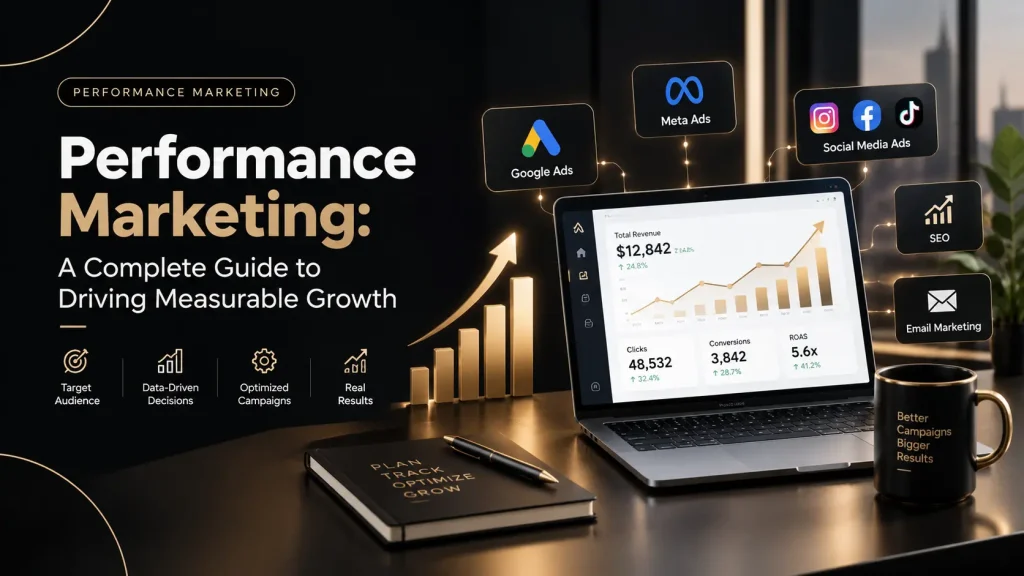
Performance marketing driving measurable growth.
Digital Marketing

Performance Marketing: A Complete Guide to Driving Measurable Growth

Introduction: Marketing With Measurable Results Businesses invest in marketing activities in order to obtain a particular result. This result may be an increase in website traffic, obtaining leads, phone calls, application downloads, sales, or revenue. However, spending money on any kind of marketing activity without guarantees and control of the results is short-sighted and unwise. Performance marketing is a form of data-driven marketing in which the marketing campaign is developed and optimized according to certain metrics. These metrics can include the number of clicks, leads, sales, purchases, and other actions that can be measured. Google Ads offers a conversion tracking tool that allows you to track the effectiveness of your ads by analyzing the campaigns’, ads’, and keywords’ contribution to conversions. By using performance marketing, businesses are focused on the actual conversion rather than just the number of impressions or page views. In addition, instead of asking the question: “How many people saw my ad?” I prefer to ask the following: “What did people see my ad do?” What Is Performance Marketing? Performance marketing is a type of digital marketing which focuses on making measurable actions and using them for campaign planning, optimization and analysis of results. Depending on the business model, the metric could be any of these:• Website purchases• Qualified leads• Form submissions• Phone calls• App downloads• Product inquiries• Bookings• Sign-ups• Online sales The main idea is to have a certain goal which would be achieved through a marketing campaign.For example, e-commerce businesses would typically track website purchases and revenue, while a company offering services would rather focus on generating qualified leads and arranging meetings. The important thing is to have a clear objective which will later be used as a metric. How Does Performance Marketing Work? Performance Marketing typically involves in a continual cycle of: Goal → Audience → Campaign → Click → Landing Page → Conversion → Measurement → Optimization 1. Set Goal The first thing that has to be decided is the purpose that the advertisement needs to serve. E.g., the generation of 100 qualified leads. 2. Audience Define the target audience that is most likely to become a customer. Consider their location, interests, searches, and demographics. Think of prior interactions and purchase intent. 3. Channel Choose the channel/s on which the advertisements will run based on the target audience and specific business goal/s. 4. Campaign The advertisements are then built along with the strategy, targeting options, budget, and landing page experience. 5. Conversion Tracking It is essential to track each conversion that occurs on the landing page, from phone calls and purchases to any desired subscription or lead generation form. 6. Measure & Analyze Evaluate the campaign’s performance and understand how it drives conversions. 7. Optimize Optimize the advertisements, targeting, landing pages, budget/s and overall campaign structure for continual improvement. Instead of a one time advertisement, this makes for a never ending campaign of continual optimization. Traditional Marketing vs. Performance Marketing Traditional Marketing vs. Performance Marketing Traditional Marketing Performance Marketing Often focused on reach and awareness Focused on measurable outcomes Results can be harder to attribute Results can be tracked using conversion data Limited real-time optimization Campaigns can be adjusted regularly Examples include print, TV and billboards Examples include Google Ads, Meta Ads and paid digital campaigns Broad audience targeting is common Audience targeting can be more specific Measurement may rely heavily on estimated reach Uses metrics such as conversions, CPA and ROAS Campaign changes can be slower Digital campaigns can be tested and optimized quickly Major Performance Marketing Channels — Major — Performance Marketing Channels Performance marketing can use multiple digital advertising channels.[cite: 5] 1 Google Ads Google Ads can help businesses reach people when they are actively searching for products, services or solutions. Businesses can measure actions such as purchases, sign-ups, calls and other conversions.[cite: 5] Search & Intent Capture Preview Useful for: Capturing existing demand Connecting relevant searches 2 Meta Ads Meta advertising can help businesses reach audiences across platforms such as Facebook and Instagram. Creative testing is especially important because users interact with visual content quickly.[cite: 5] It can be used for: Lead generation & traffic Product sales & retargeting Brand discovery 3 YouTube Advertising Video advertising can be used to introduce products, explain services, demonstrate solutions and support conversions by combining video creative with audience targeting.[cite: 5] Video Creative & Targeting Useful for: Product introductions Solution demonstrations Video conversions 4 LinkedIn Ads LinkedIn can be particularly relevant for businesses targeting professional audiences[cite: 5]. It supports industry-specific campaigns and professional services. B2B & Professional Network It can support: B2B lead generation SaaS & software growth Professional recruitment 5 Remarketing Remarketing focuses on people who have already interacted with a website, product or brand. Campaigns help bring interested visitors back to complete conversions.[cite: 5] Visitor Recall & Retention Useful for: Re-engaging past visitors Recovering cart drop-offs Increasing conversions Right channel. Right audience. Better results. 1. Google Ads Google Ads can help reach customers when they are looking for products, services or solutions. Businesses can measure actions such as purchases, sign-ups, calls and other conversions. Google Ads can therefore be useful for capturing existing demand and connecting relevant searches with business offerings. 2. Meta Ads Meta advertising can help businesses reach audiences across platforms such as Facebook and Instagram. It can be used for objectives such as: • Lead generation • Website traffic • Product sales • Retargeting • Brand discovery Creative testing is especially important because users interact with visual content quickly. 3. YouTube Advertising Video advertising can be used to introduce products, explain services, demonstrate solutions and support conversions. Businesses can combine video creative with audience targeting and measurable campaign objectives. 4. LinkedIn Ads LinkedIn can be particularly relevant for businesses targeting professional audiences. It can support: • B2B lead generation • Professional services • Software businesses • Recruitment • Industry-specific campaigns 5. Remarketing Remarketing focuses on people who have already interacted with a website, product or brand. For example, someone may visit an online store without purchasing. A
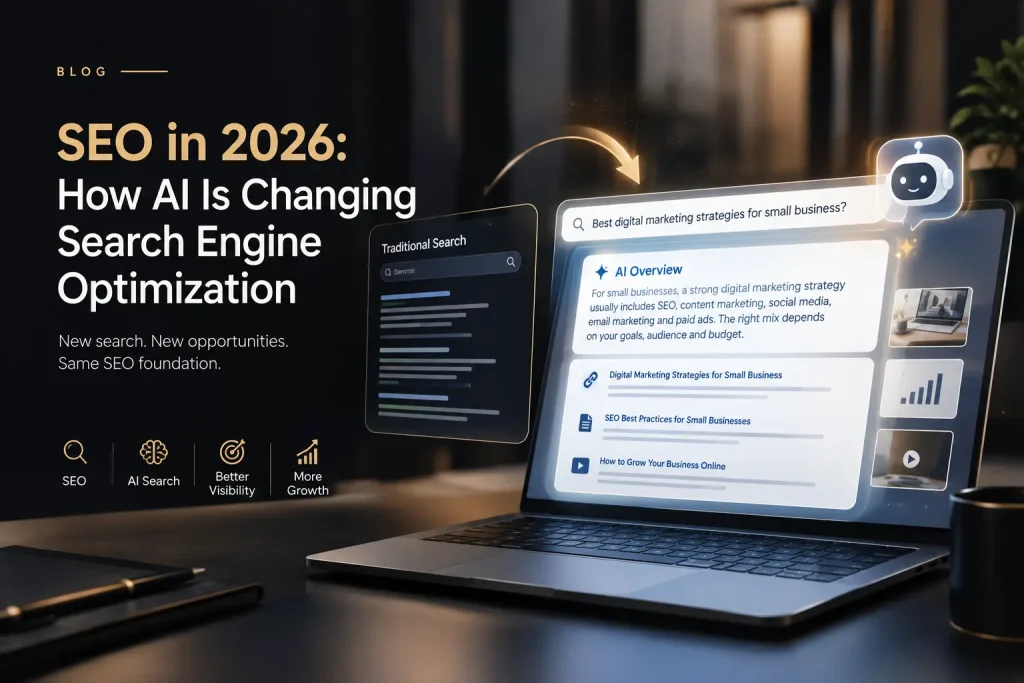
SEO in 2026 with AI search and a laptop.
Digital Marketing

How AI is Changing Search Engine Optimization : In 2026

Introduction: SEO Is Changing, Not Disappearing Search engine optimization has changed over time. In the past, SEO was about keywords, backlinks, rankings, and optimizing for a traditional search. Now search is becoming more conversational and more driven by artificial intelligence. Individuals can ask more conversational questions, make searches with natural language, and engage with AI-powered searches which give summaries and links to relevant webpages. Google’s latest SEO guidance highlights the importance of SEO for generative AI searches. SEO practices shouldn’t be ignored by businesses now because search engines can use generative AI to power their search functions. It’s a must that companies build on their SEO strategy. Now let’s see what’s changing. What Is SEO in 2026? SEO, or search engine optimization, refers to the set of activities that improve a website’s visibility in search engines. This could involve making it discoverable, understandable, and indexable by search engines, as well as ranking higher for relevant queries. The basics are still the same: • Technical website health, • Search intent, • Website content, • Internal linking, • Website structure, • Crawling and indexing, • Page experience, • Relevant authority and references, • Information architecture. However, the ways in which people search and the ways in which search results are presented are changing — and with them, the role of SEOs and agencies. One way to think about it now is that AI is becoming part of the search experience — and queries are no longer just a search term, something like: “digital marketing agency” but rather questions, such as: “What should a small business look for when choosing a digital marketing agency?” How AI Is Changing Search AI is transforming search in a number of different ways. Search engines are becoming more capable of understanding the intent behind a query rather than just focussing on keywords. Google’s guidelines on AI powered search reveal that their new generative AI features make use of techniques like retrieval-augmented generation and query fan-out to pull out relevant results from their Search index and answer more involved queries. What this means for SEOs is that optimising around a keyword might not have as much impact as it used to since there’s a shift towards providing information that fulfills the intent of whoever is searching. Traditional search funnel: Keyword → Search results → Website → Information AI assisted search funnel: Question → AI understanding → Relevant sources → Generated response → Supporting links This doesn’t mean websites are losing out though. In fact, Google state that in order to appear in their generative AIs search results, pages first need to be indexed and eligible to appear in Search. AI-Assisted Search Journey Funnel AI-Driven Search Architecture WE DON’T JUST RANK LINKS WE BUILD FUNNELS That Convert Intent Into Insight User Query Input Natural Language Prompt 1. QUESTION Stage 01 Top of Search Funnel Intent & Context Analysis Vector & Semantic Parsing 2. AI UNDERSTANDING Cognitive Core Disambiguating Meaning Vetted Domains & Data RAG Retrieval Layer 3. RELEVANT SOURCES Authority Match High E-E-A-T Sources Synthesized AI Answer Direct Multi-Source Synthesis 4. GENERATED RESPONSE Zero-Click Value Instant Comprehension Citations & Deep References High-Intent Traffic Channel 5. SUPPORTING LINKS Conversion Zone Qualified Lead Traffic 1. Question User Query Input / Natural Language Prompt 2. AI Understanding Intent & Context Analysis / Semantic Parsing 3. Relevant Sources Vetted Domains & Data / RAG Retrieval Layer Traditional SEO vs AI-Driven SEO Traditional SEO vs. AI Search Era Comparison Dimension Traditional SEO Focus SEO in the AI Search Era Core Focus Keywords Search intent and topics Queries Individual queries Broader conversational questions Rankings & Visibility Ranking webpages Visibility across different search experiences Optimization Strategy Keyword optimization Context and relevance Content Formats Text-focused content Text, images, video and other useful formats Backlinks Backlink quantity Quality, relevance and authority Phrase Style Short keyword phrases Natural-language and complex queries Performance Metrics Traffic and rankings Visibility, engagement and conversions Research Method Manual research AI-assisted research and analysis SERP Environment Traditional SERPs Traditional results + AI-powered experiences Important: AI-driven SEO does not replace traditional SEO. It builds on many of the same foundations. 1. Search Intent Matters More Than Ever One of the key trends in modern SEO is the rising role of search intent. Search intent is the reason behind the search. For example, a search of “SEO” could be seeking a definition. A search of “SEO agency for small business” could be searching for an offer. Finally, a search of “How to improve SEO rankings” is seeking educational information. Instead of focusing on keywords, companies should be focusing on the goals of the searcher. A strong SEO strategy asks: • What question is the user asking?• What problem does the user need solved?• What information does the user need?• In what way would an answer be helpful?• What should the user do next? 2. AI Is Changing Keyword Research AI tools can help keyword researchers to make their job faster by identifying for them: • Related topics• Search questions• Content gaps• Search intent• Topic clusters• Related entities• Long-form questions• Content ideas But AI can not fully replace the strategic thinking of a keyword researcher. For example, in the case of targeting keywords, it does not mean that a marketer will target only: “SEO services” a company can develop content on similar questions: • What does an SEO agency do?• How much do SEO services cost?• How long does SEO take?• What is technical SEO?• How does local SEO work?• What is AI SEO? This way, you will get a set of content pieces covering the topic from different angles. 3. Content Quality Is Becoming More Important AI enables to create content rapidly. That said, there is a risk that the web will be flooded with similar articles. Moreover, simply generating a large quantity of new pieces does not guarantee a solid SEO strategy either. Google spam policies now include a specific category of scaled content abuse, meaning creating multiple pieces of content at scale that are

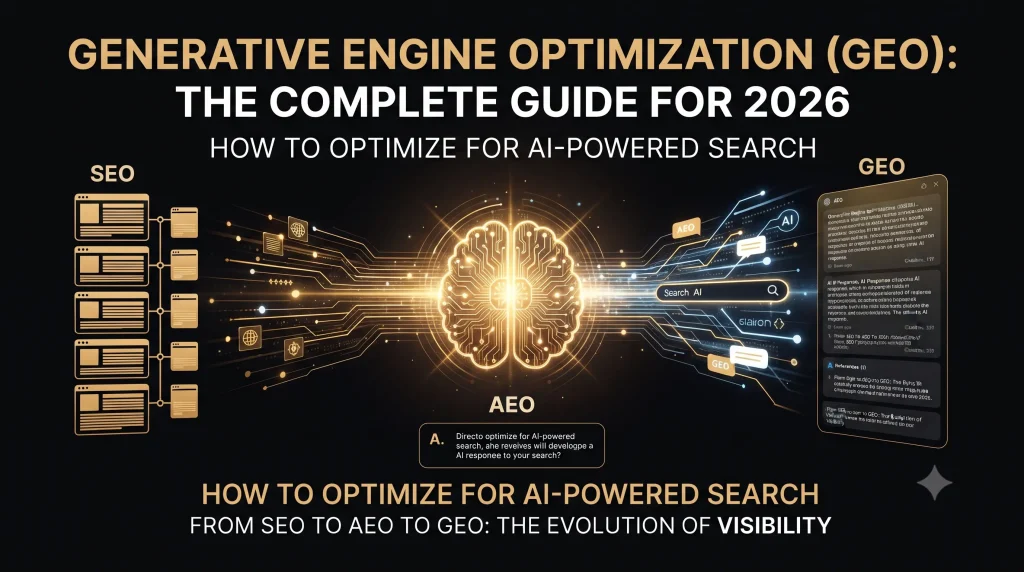
GEO guide showing SEO, AEO, and AI-powered search.
Digital Marketing

Generative Engine Optimization (GEO)

Generative Engine Optimization (GEO): The Complete Guide For 2026 Introduction: Search Is Changing How we search for information is rapidly changing. Traditional search engines have primarily been about delivering a list of web pages for users to sift through. With the rise of AI, new search experiences can understand questions, pull relevant information from various sources, and provide more direct answers. Google’s recently launched AI Overviews and AI Mode open up new avenues for websites to be surfaced in these new, generative search experiences. Google also insists that many of the SEO best practices currently exist in the space of its generative AI search results, so businesses should continue to apply traditional SEO practices since Google Search still relies heavily on its foundational search and ranking systems when it comes to the generative AI solutions. But what does that mean for SEOs? What does it mean for businesses? SEOs and businesses alike are left asking: What are GEOs and AEOs? What do they mean for SEO? And how are they different from “traditional” SEO? Let’s dive into the deep end. What Is Generative Engine Optimization (GEO)? Generative Engine Optimization (GEO) is the practice of generating content in such a way that it is more likely to be found, indexed, or referenced by AI search and answer tools. While SEO typically focuses on surfaces — getting a page to show up, GEO works at the deep level of information, making it useful, understandable, and therefore more likely to be surfaced by AI. For example, a search for something like “What are the best digital marketing strategies for a small business?” would previously have resulted in a Google SERP (search engine results page) — a list of blue links. However, a search using an AI system might produce an answer (think of it like a Google Answer) generated from information found across multiple websites. With that in mind, while businesses may have in the past concerned themselves with simply being found for a given query or set of queries, modern SEO necessitates going one step further — ensuring that the information is there and that it is organized in a logical, comprehensive, trustworthy, and unique way that can be most effective leveraged by AI search tools to best serve the needs of the question asker. Google’s advice for doing that right now is focused on useful, original content, technical SEO, and solid traditional SEO practices — not “GEO hacks.” Why Is GEO Becoming Important? AI-powered search is changing how users discover information. Users are asking more conversational questions and relying less on short search terms. For example: Traditional search: “digital marketing agency India” Conversational search: “What should a small business look for when choosing a digital marketing agency?” The second query has more context and may need an answer that synthesizes multiple ideas. It also presents an opportunity for businesses to share information that directly addresses user questions. GEO can be seen as an extension of a company’s overall search strategy: SEO → Search visibility AEO → Answer visibility GEO → Visibility in generative AI experiences The various strategies are overlapping and not necessarily distinct. Difference Between SEO Vs AEO Vs GEO SEO vs AEO vs GEO Table SEO vs AEO vs GEO Comparison Factor SEO (Search Engine Optimization) AEO (Answer Engine Optimization) GEO (Generative Engine Optimization) Main Goal & Focus Improve visibility in standard search engine results pages (SERPs). Provide direct answers and target featured snippets, voice search, and snippets. Improve visibility and brand citations in AI-generated search responses. Content Style Comprehensive, keyword-optimized web pages and long-form articles. Clear, concise answers structured specifically around direct user questions. Useful, highly contextual, original, and easy-to-understand multi-angle information. Keyword Focus Traditional keywords and matching user search intent. Natural questions and conversational long-tail queries. Broader topics, entities, contextual background, and deep user intent. Example & Strategy Ranking for high-volume keywords like “SEO services” by building authority. Answering “What is SEO?” clearly to win the top featured snippet. Being cited when AI answers complex prompts like “How can small businesses improve GEO?” How GEO Works Generative search systems require information that they can discover, process, and comprehend. A simplified GEO process looks like: User Question → AI Understands Intent → Search/Processing Sources → Select Relevant Information → Generate → May Cite Sources This means that your content needs to include information that helps it stand on its own. Instead of using broad statements, such as: “We offer the best SEO services.” You may want to consider generating more informative content, such as: “Technical SEO refers to the process of optimizing a website’s infrastructure to improve its visibility in search engine results. This may include optimizing site architecture, page speed, mobile responsiveness, indexing, and structured data implementation.” The latter provides more information that would be useful to someone searching for the topic, rather than a vague promise of quality service. 7 Strategies To Improve Your GEO 1. Create Original and Helpful Content One of the most crucial guidelines is to create information that can genuinely help the reader. Do not create content just because a particular keyword has search volume. Instead, ask yourself: • What does the reader want to know? • What problem do they want solved? • Can I explain it better than others? • Can I give examples? • Can I bring new perspectives from my own experience? Google’s guidelines emphasize the importance of creating unique, useful and trustworthy content rather than content created with the sole intention of manipulating search engine results. 2. Answer Specific Questions AI search is most capable of answering questions in a conversational interface. Therefore, create content with questions in mind such as: ➜ What is GEO? ➜ How does GEO work? ➜ Is GEO different than SEO? ➜ How can businesses optimize for AI search? ➜ Does SEO matter for AI search? ➜ How does AI search select information? Question-answer formats are easier for users to consume and are more understandable by search engines. 3. Focus on

Scroll to Top