
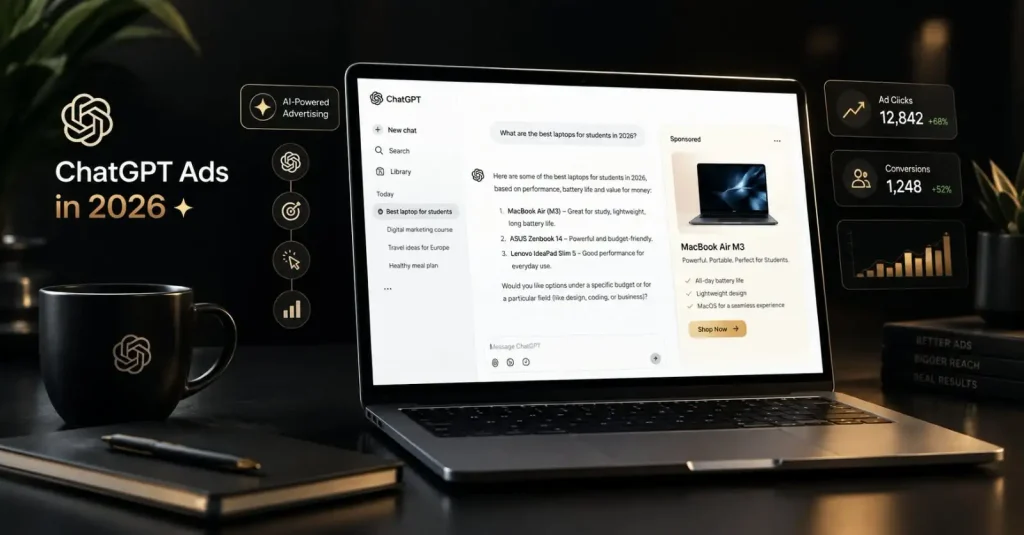
ChatGPT Ads in 2026: The New Frontier of Digital Advertising
Digital advertising is entering a new phase. Consumers are no longer searching for a link on the Internet, but asking questions, comparing products, investigating services, and making decisions via AI conversations.
This is where ChatGPT Ads create a new opportunity for brands.
While being discovered next to a generic keyword search, ads can appear inside the conversational environment of ChatGPT to reach people while they are exploring options, comparing alternatives, and making a decision about what to do.
What Makes ChatGPT Ads Different?
Traditional advertising platforms are largely focused on keywords, audiences, placements, or browsing behavior.
ChatGPT adds another layer – conversations and intent.
For instance, a user could ask:
“What is the best laptop for video editing under $1,500?”
Instead of searching for a keyword, the user is expressing their intent and providing context about their preferences and what they are searching for.
ChatGPT Ads are intended to use signals such as conversation context, ad relevance, landing-page information and advertiser-provided context hints to indicate where ads may be relevant.
This makes ChatGPT an interesting venue for intent-based advertising.
How ChatGPT Ads Work
ChatGPT Ads currently appear below ChatGPT responses and can include the following elements:
- Advertiser name
- Logo/favicon
- Headline
- Description
- Image creative
- Landing page
You can create a campaign in the Ads Manager Beta and select a campaign objective that best fits your business needs. With a Campaign, you can select from the following objectives:
Views (CPM): For maximizing exposure and brand awareness.
Clicks (CPC): For maximizing traffic.
Conversions: For maximizing conversions to a specific conversion event such as purchases, leads, or sign-ups.

ChatGPT Ads vs Traditional Search Ads
The biggest difference is the environment.
A traditional search ad may answer a short query like:
“Best running shoes”
A ChatGPT conversation could have much more context:
“I run five days a week, mostly outdoors, and I need comfortable shoes for my long-distance training.”
This opens the door to more context-aware advertising.
But brands can’t just copy/paste their Google Ad strategy into ChatGPT
The creative should be:
- clear
- specific
- benefit focused
- relevant to the user’s need
- and helpful rather than overly promotional
OpenAI’s current creative guidance specifically recommends clear, specific, benefit-focused messaging and multiple distinct creative variations.
| Traditional Search Ads | ChatGPT Ads |
|---|---|
| Keyword-focused | Conversation and context-focused |
| Short search queries | Detailed user intent |
| Search results environment | Conversational environment |
| Strong emphasis on keyword relevance | Strong emphasis on contextual relevance |
| Text-heavy search creative | Headline + copy + creative image |
| Click-focused strategies are common | Views, clicks and conversion objectives |
| Landing page is important | Landing page + conversational relevance |
| User searches for an answer | User explores, compares and decides |
The key shift is from “What keyword did someone type?” to “What is this person trying to accomplish?”
What Brands Need to Prepare
ChatGPT advertising is not something that can be done by launching one more ad campaign. Here are some things to consider.
Landing Pages
Whatever you promise in the ad, make sure it is there on the landing page.
Variations
You can try different headlines and descriptions in the ad to highlight different benefits or values.
Conversion Tracking
Make sure you track conversions with OpenAI’s Pixel and Conversions API so that you can measure performance and attribute sales, leads, and registrations.
Intent-Based Language
Rather than something vague like
“Best in Digital Marketing Services — Contact Us Today!”
you might want to use more intent-based language like
“More Qualified Leads Needed — Let’s Discuss Performance Marketing.”

The New AI Advertising Journey
From User Intent to Conversion
How conversational advertising can connect intent with action
Tools Brands Can Use
For ChatGPT Ads, the primary advertising processes are increasingly concentrated within the OpenAI Ads Manager.
Among other utilities, the following measurement instruments are considered useful:
OpenAI Ads Manager – creating, setting budgets, and tracking campaign objectives, as well as analyzing statistics.
OpenAI Pixel – measuring website conversions.
Conversions API – server-side conversion measurement.
Google Analytics 4 – additional analysis and comparison of other statistics and attribution capabilities.
UTM Parameters – tracking traffic for other analytical systems.
Additionally, the Ads Manager currently provides a range of statistics such as impressions, clicks, spending, click-through rates (CTR), average cost-per-click (CPC), average cost-per-thousand impressions (CPM), and conversions when set up for conversion tracking.
Key Takeaways
ChatGPT Ads are ushering in a new era of advertising — one that revolves around conversations, contextual information and decision-making.
The opportunity for brands is not just another digital ad placement — it is a chance to appear when somebody is actively:
Exploring→Comparing→Evaluating→Deciding
Brands that utilize strong messaging, optimized landing pages, relevant creative and reliable conversion tracking will be best positioned for success as AI-driven advertising evolves.
Frequently Asked Question
1. What are ChatGPT Ads?
ChatGPT Ads are paid advertisements that appear within the ChatGPT experience, and that allow brands to connect with users who are exploring options, comparing and making decisions.
2. How are ChatGPT Ads different from Google Ads?
Google Ads is primarily search-query-driven, whereas ChatGPT Ads may leverage intent and conversation to inform relevance and targeting.
3. Can ChatGPT Ads drive conversions?
Yes. ChatGPT Ads includes conversion action reporting, and advertisers may install conversion event tracking for purchases, leads and other actions.
4. What should a ChatGPT Ad look like?
Ads should include clear, value-benefit messaging, and multiple variations allow brands to highlight different features or use cases for their product or service.
5. Are ChatGPT Ads going to be available to each advertiser?
ChatGPT Ads and Ads Manager are currently in beta and availability may change and scale across accounts and markets.
6. Should businesses begin preparing for ChatGPT Ads?
Yes. Even if a brand is not advertising immediately, preparation of high-quality landing pages, conversion tagging, product catalogues and intent-benefit-driven messaging copy may facilitate readiness to capitalize on early adopter momentum.
Conclusion
ChatGPT Advertising Represents A New Frontier For Digital Advertising
The real revolution in chatbot advertising lies not only in the channels but rather in the environments where users interact with products and find information.
When it comes to search advertising the question is: “What did the user search for?” However, with the rise of AI the paradigm begins to shift to: “What is the user trying to accomplish?”
Leading brands that embrace intent, context, relevance & trust are well positioned to capitalize on this next frontier in marketing where conversations help drive decisions.
ChatGPT advertising may still be in its infancy however it seems pretty evident that the future of digital advertising will be increasingly conversational.