

What Happens When AI Chooses Which Brand You Buy?
Imagine a customer asking,
“Hey, find me the best laptop under 80000 for video editing.”
Google search, open various sites, read reviews, compare the prices, and research — all this can be eliminated by an AI assistant.
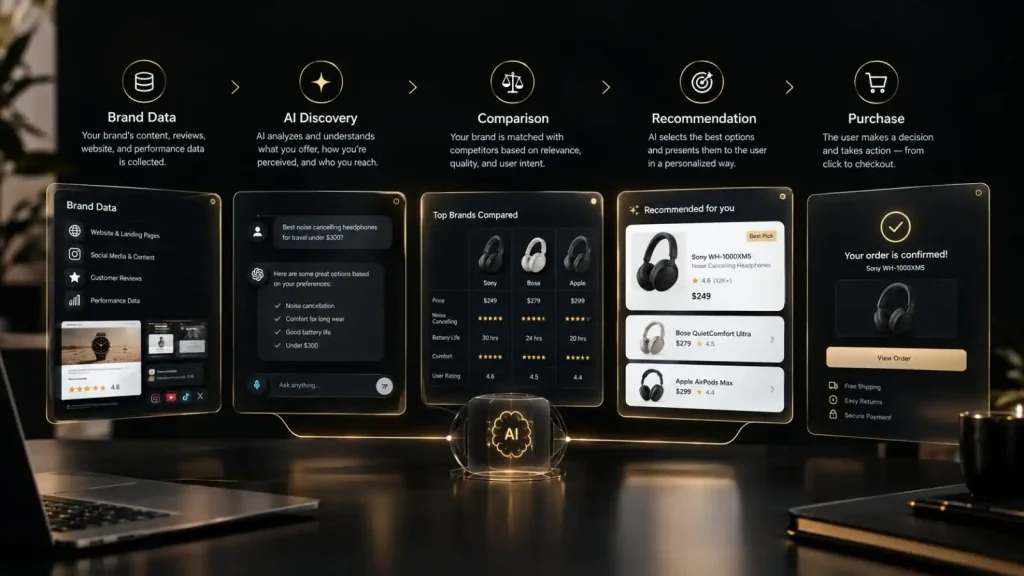
AI researches and compares different options based on certain criteria, summarizes reviews, and shortlists products for the customer.
AI doesn’t finalize the purchase but is used to shortlist the options for the customers. This is the dawning of the era of AI-powered shopping and agentic commerce.
AI Is Becoming Part of the Buying Decision
Artificial intelligence is no longer just a way to answer questions.
Consumers are engaging with artificial intelligence in order to find, compare, evaluate and research products. McKinsey research found that 63% of surveyed European consumers use AI-driven tools to compare products: brand, model, price, reviews etc.
That changes the question in marketing from:
How do we get the customer to take notice?
to
How do we become the choice of the AI?
What Does AI Look At?
AI-powered shopping experiences may use information like the following to power their recommendation engines:
Product descriptions
Price
Availability
Reviews
Features
User preferences
Product images
Merchant information
Context of the conversation
For example, ChatGPT’s shopping experience uses user intent and context, as well as information about products and merchants, to determine what products to show.
This means that product information becomes marketing information.
If your information is incomplete, out-of-date, unclear, or challenging for AI systems to understand, you could be losing out on competitiveness in AI-powered discovery.
Data Snapshot
| AI Shopping Signal | Why It Matters |
|---|---|
| Product Information | Helps AI understand what you sell. |
| Price | Enables meaningful product comparisons. |
| Reviews | Builds confidence, context, and trust. |
| Availability | Shows whether the product can actually be recommended. |
| User Intent | Helps AI match products to specific needs. |
| Brand Information | Gives AI context about your business and offerings. |
OpenAI’s Agentic Commerce Protocol, for example, allows merchants to provide structured product information including descriptions, pricing, inventory, media, and fulfillment options.
The Pros and Cons for Brands
✅ Pros
❌ Cons
Higher-intent discovery : Customers asking AI for recommendations are often already researching a purchase.
Better personalization : AI can match products to specific requirements instead of showing everyone the same results.
Less friction : Customers can research and compare without jumping between multiple websites.
New discovery channel : Brands can potentially reach customers through AI interfaces instead of relying only on traditional search and social platforms.
Less control over the customer journey : AI may become the interface between your brand and the buyer.
More competition : Your product can be compared directly against alternatives.
Data quality becomes critical : Incorrect or incomplete product information can affect how your brand is represented.
Brand differentiation gets harder : AI may prioritize measurable product attributes, relevance, price, reviews, and availability—especially in more standardized categories.
What Brands Should Do Now
Brands should consider visibility in artificial intelligence an essential component of their digital marketing strategies.
This entails ensuring the accuracy of product information, allowing for honest reviews, improving the quality of website content, using a structured approach to data, standardizing brand information, and clarifying product attributes.
The objective is to make a brand visible, understandable, desirable, and easy to research by searchers rather than “tricking” the system into promoting a brand.
Key Takeaways
AI is an important layer in between brands and buyers.
Product discovery is shifting away from traditional search results.
Review, price, availability, product information, and context can all influence AI powered recommendations.
Brands should optimize for not only humans and search engines but also consider the rising power of AI discovery systems.
The future may not be about AI replacing the buyer but rather about an AI assisted shortlist.
Frequently Asked Question
Will artificial intelligence replace Google in shopping?
Probably not. Traditional search, marketplaces, social networks, and AI will coexist, but the latter will probably gain more and more importance in the discovery phase.
Can artificial intelligence choose what to buy for me?
It can already help with discovery, comparisons, and suggestions, but decision-making is probably still in the hands of humans, and many want to keep this control.
What should brands do in this environment?
Focus on product data and content, reviews, structured data, and brand building: a solid website is still fundamental.
Only for e-commerce?
No, because the same phenomenon could affect any sector in which a customer researches and compares offerings before buying, such as software, financial services, or travel.
Conclusion
The next battleground for brands may not be found simply on Google, Instagram, or marketplaces.
It may be in AI conversation.
As AI becomes more powerful in understanding needs, evaluating options, and helping people make decisions, brands will need to be more accessible to be understood, evaluated, trusted, recommended by the AI.
The question for marketers will not only be:
Can customers find us?
But will also be: