
Introduction
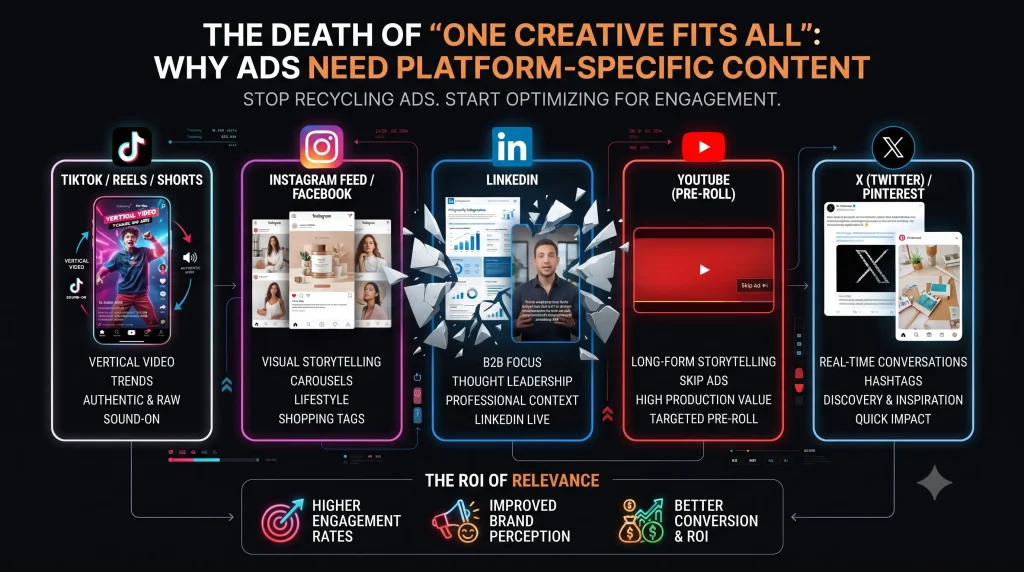
For years now, companies have been creating single advertisement and publishing it everywhere.
The same video can be found on Instagram, Facebook, YouTube, TikTok and other platforms. Same headlines, same images and same CTA are simply adapted to fit different screen sizes.
While it saves time, it doesn’t necessarily provide the best experience since today, different platforms have different audiences and formats. Someone who watches a short Reel is clearly in a different mindset than someone who googled a query and landed on your article or watches a long YouTube video.
Modern advertising now focuses more on “create one core idea and then adapt it for all platforms” rather than the old “build once, deploy everywhere” paradigm.
Google’s official advertising guidelines also reflect this new reality, where different assets are now more important than a single creative, and testing different combinations is now the norm, rather than pushing the same image/video/headline everywhere.
Why One Ad Doesn't Work Everywhere
Imagine that a brand has created a beautiful 30-second product video.
It looks great on an Instagram Reel.
The brand decides to post the same video on YouTube Shorts.
It utilizes the same creative for a Facebook campaign.
And it crops the video for another ad.
The message is the same, but the context is different.
Each social media site has its own:
- Viewership habits
- Content conventions
- Screen sizes
- Audience expectations
- Attention spans
- Creative preferences
- And interaction styles
The message should adapt to these differences.
A brand should not modify its entire value proposition based on the delivery medium.
However, it should update the presentation of its message.
The Core Idea Can Stay the Same
Platform-specific content does not mean developing unique campaigns for each channel.
You can pick a great idea and execute it across multiple channels using different positions and styles.
For example, here is a single campaign idea adapted for different channels:
Campaign idea
Your skincare routine doesn’t need ten products
Adapted into:
A sleek Reel with a simple skincare routine
TikTok
A creator-style video starting with “I stopped using five different products every morning.”
YouTube
An in-depth product demo with an explanation of why the routine was simplified
A benefits-focused video or carousel explaining the product and offer
A search-oriented message that targets the intent behind the search
Same idea — different execution.
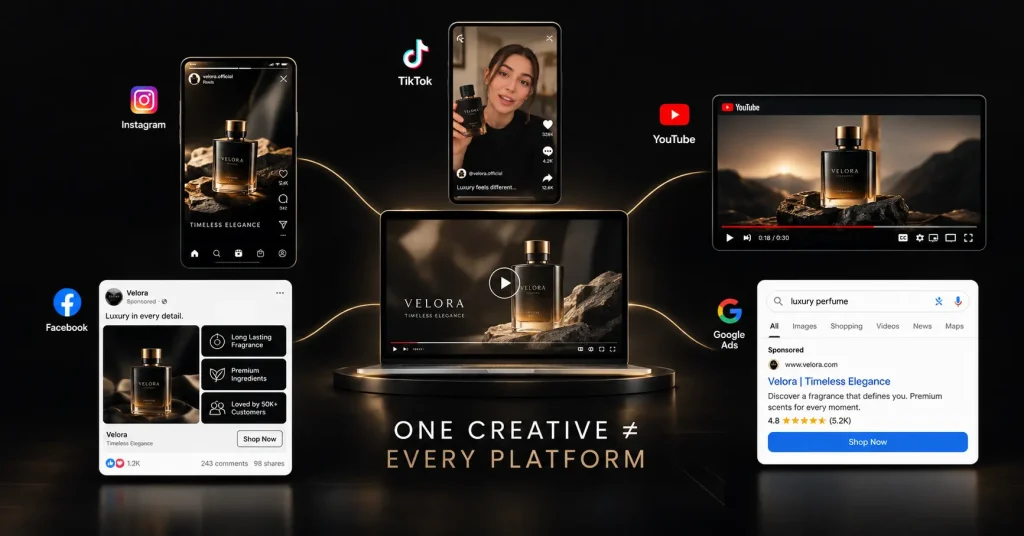
Instagram Needs Scroll-Stopping Visuals
Instagram is very visual.
The first impression, the composition, movement in the frame and the overall look can define whether someone wants to continue watching or not.
With Instagram advertising, brands have the option of experimenting with:
- Reels
- Carousels
- Product demonstrations
- Creator content
- Before and after visuals
- Strong visual hooks
Instead of leading into a long script, the creator can show the product, the problem or transformation right away.
Think visually.
A polished brand can feel authentic on Instagram, without making each advertisement feel like a traditional commercial.
TikTok Needs Native Energy
TikTok-style advertising often needs to feel authentic to what the service is all about.
A creator facing the camera may feel more authentic than a polished, traditional commercial.
For example:
Traditional opening:
“Introducing our new productivity application.”
Creator-style opening:
“Here’s the app I wish I had found six months ago.”
The second option feels a little more like something someone would see on the TikTok platform.
The important lesson is not to blindly follow TikTok trends. The lesson is to understand the communication style of the environment.
YouTube Can Carry More Context
YouTube offers space for formats that can carry more context.
A product can be demonstrated.
A service can be explained.
A customer story can unfold.
A creator can give a review.
That does not mean every YouTube ad needs to be long. It means the platform is able to carry a different relationship with the viewer.
The creative can go beyond:
“Look at this product.”
and move towards:
“Here’s why this product solves your problem.”
Facebook Can Work With More Informational Creative
Facebook audiences can work with a variety of formats, including video, images, carousels and longer-form messaging.
For some campaigns, the creative can be more focused on:
- Benefits
- Social proof
- Offers
- Customer problems
- Testimonials
- Product details
This makes Facebook an option for creative that may need a little more explanation, while still being visually engaging.
The key is that the same Instagram creative should not be assumed to simply become the Facebook creative.
Search advertising is not the same as feed advertising.
Someone searching
“best digital marketing agency for small business”
is already looking for something specific.
The ad must respond to this intent.
Google’s recommendations are now more focused on relevance and diversity of assets and messaging to reflect user intent and context, as well as a close match between the ad and the landing page.
That’s why a pretty lifestyle video may not always be the best choice of creative for your ads.
Sometimes it’s better to go with something simpler, like a clear message, a relevant offer, and a strong value proposition.
The Hook Should Change With the Platform
The campaign message can be the same, while the openings are different.
Let’s take a campaign from the website design industry.
Instagram hook
“Your website looks good, but does it convert?”
TikTok ad hook
“Three things I would change about this website immediately.”
YouTube ad hook
“Let’s break down why this website isn’t converting its visitors.”
Facebook ad hook
“Is your website turning its visitors into customers?”
Google Ad (adsense)
“Conversion-Focused Website Design | Build a Website That Works”
Same business, same issue, different language, different media. This is the essence of platform-specific marketing messaging.
One Campaign. Different Platforms.
Every platform needs its own creative approach, hook and format.
CAMPAIGN Adapt
Your website looks good—but does it convert?
A visual-first hook designed to create curiosity and encourage users to explore.
Three things I would change on this website immediately.
Fast, direct and conversational content designed to stop the scroll.
Let's break down why this website isn't converting visitors.
A storytelling approach that builds context, trust and interest.
Is your website turning visitors into customers?
Lead with a relatable business problem and connect it with a clear benefit.
Conversion-Focused Website Design
Build a website that works — focused on intent, clarity and turning clicks into customers.
One campaign idea can become multiple creative experiences.
Don't Just Resize—Recreate
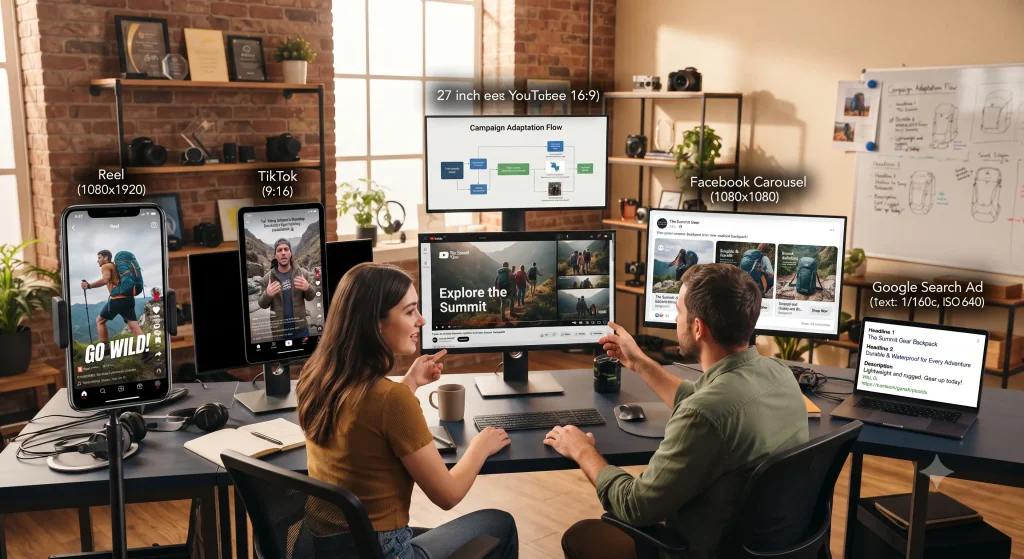
One of the most common mistakes that brands make is to take a horizontal ad, crop it to a vertical view, and call it a day.
A platform specific creative has to consider:
Composition
Where do you want your subject to be?
Pacing
How fast do you want to get your message across?
Text
How much information do you want to convey?
Hook
What do you want to get someone’s attention?
CTA
What action do you want the user to take?
Context
Does it feel native to the medium?
Google’s display guidance also talks about the creation of high-quality assets in different aspect ratios, with a warning against poorly optimized or unnecessarily confined treatments.
Platform-Specific vs One-Size-Fits-All Advertising
| Area | One Creative Everywhere | Platform-Specific Creative |
|---|---|---|
| Concept | Same execution | Same core idea, adapted execution |
| Hook | Usually unchanged | Platform-specific |
| Format | Mostly resized | Recreated for the environment |
| Pacing | Same | Adjusted to content behavior |
| Visual Style | Consistent everywhere | Native while staying on-brand |
| CTA | Often identical | Matched to campaign/platform |
| User Experience | Generic | More relevant |
| Testing | Limited creative variation | Multiple creative variations |
| Production | Faster initially | More strategic |
| Long-Term Value | Can become repetitive | Creates a broader creative library |
The Brand Should Stay Consistent
Platform-specific does not mean that your brand should be unrecognizable across platforms.
Your brand identity should be consistent across all mediums, but certain elements of your brand presentation should be tailored to the target audience.
Specifically, keep your:
Logo
Brand colors
Tone of voice
Visual identity
Core promise
Brand personality
The following brand presentation elements can be adapted to the platform:
Hook
Format
Pacing
Storytelling
CTA
Presentation
It is similar to conveying a message in different languages.
The meaning is the same, but the phrasing and presentation are different for each language.
Testing Makes the Difference
There is no need to guess which version will be more effective, create multiple variations and measure results.
Focus on any metrics relevant to the objective of the campaign (e.g. watch time, engagement, CTR, leads, sales, cost per lead, or sale) and identify which variation of your ad has better performance.
Google’s advice for creating effective ads is iterative testing of varied creative messaging rather than guessing which version will be the most effective and then using one option exclusively.
Key Takeaways
The simplistic thinking behind the “one creative fits all” approach is becoming less relevant as advertising channels become more specialized. A creative that performs beautifully in the Instagram Feed may not communicate its value proposition in the same way in Google Search and YouTube.
The right (and relatively easy) approach is to build upon a solid master concept, adapting the presentation in order to fit various channels — while keeping the essential message intact.
A similar approach can be applied to the creation of assets for different platforms. Not only does it prevent the team from reinventing the wheel every time, but it also helps to expand the advertising library exponentially due to the wide variety of native formats. Most importantly, each change would be motivated by a specific goal of making the specific audience more receptive to the call to action.
Finally, remember that all adaptations are made to improve the relevance and the overall experience of a consumer who engages with your advertisement. There is no point in making channel-specific adjustments just for the sake of diversity.
Frequently Asked Questions
Does every platform need a different ad?
Nope, your idea can stay the same. What changes is the presentation of the ad, such as hook, format, pacing, messaging and CTA.
Why can’t we use the same ad?
Because it will be resized, and resized doesn’t equal the same experience. Different platforms have different user interaction and creative specifications, so sometimes the ad needs to be edited or created from scratch, not simply resized.
Is it more expensive to create platform specific content?
It may need more creative work, but there’s less production workload if you have a master concept and use it as a basis to create different variations, rather than creating separate campaigns from scratch.
Should I change my brand message for different platforms?
Brand message should largely stay the same, only the presentation wording and creative should change so that it fits the feel of the platform and not appear out of place.
How do I know what creative is performing best?
It depends on your campaign objective, but in general you’ll want to look at metrics such as engagement, watch time, clicks, leads or purchases (or cost per lead or action). Experimenting with different hooks and creative formats can indicate what is resonating best with your intended audience for a given objective.
Can an AI help to create platform specific content?
An AI can certainly help to brainstorm variations of a hook, write copy, develop concepts, create images and video, but it’s important to make sure that the AI outputs are relevant and appropriate for the platform and don’t stray from your brand voice or values.
Conclusion
The future of advertising is not about creating one perfect ad and putting it everywhere –
it’s about creating one perfect idea that can be expressed in different ways in different environments.
Instagram may need a visual hook, TikTok – a creator’s voice, YouTube – more context, Facebook – proof and benefits, Google – a direct answer to a search query.
The most clever advertisers are not changing their identities for different platforms but rather changing the way they talk to their audiences.
One brand, one idea, multiple creative expressions – this is the new advertising reality.