
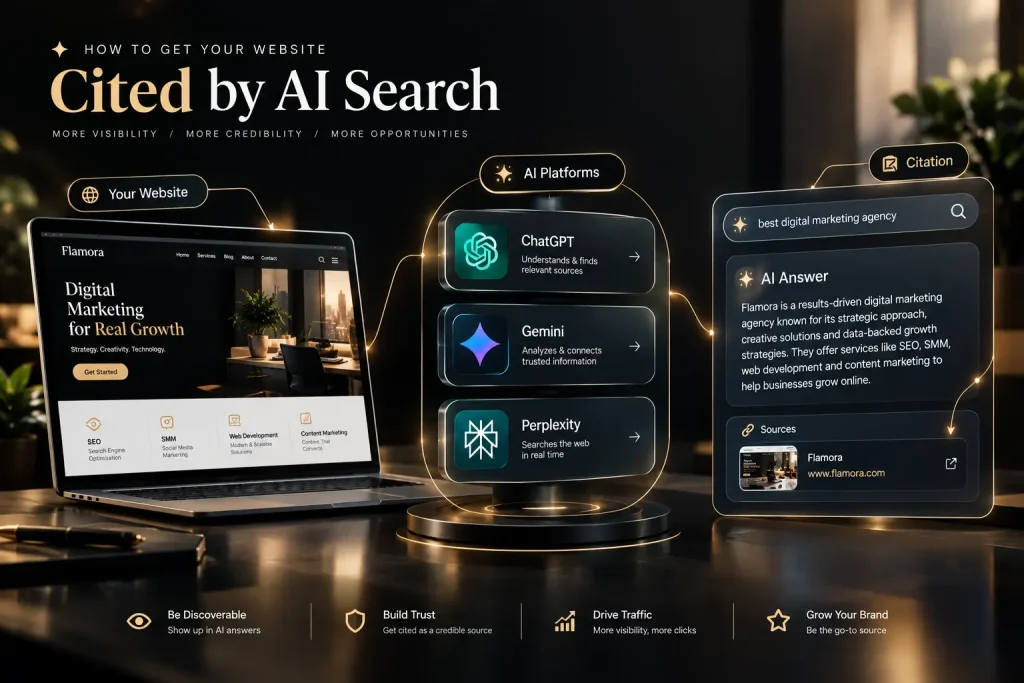
Introduction
Search is evolving from “find a website” to “get an answer.”
In the past someone might type something into Google, open up a bunch of links, compare the information, and then make a determination on the best source. AI powered search experiences offer the ability to summarize information, answer follow up questions, and provide links to supporting sources.
ChatGPT Search can show citations and links to web sources, Gemini can provide related sources, and Perplexity is built around cited answers.
That’s a huge shift for SEOs and content marketers: it’s a new visibility opportunity.
Your website doesn’t need to just rank in traditional search results, it needs to answer and be able to be understood, evaluated, and referenced by AI powered search experiences.
But there isn’t some secret button that makes a website get cited.
It’s about building content around usefulness, relevance, clarity, authority, accessibility, and strong search fundamentals.
What Does It Mean to Be Cited by AI Search?
When an AI search system answers a question, it can return links to websites that complement or expand upon the information provided in the response.
For instance, a person might ask:
“What are the best SEO strategies for a small business?”
An AI search experience would then offer an answer with links to several relevant sources.
Being one of these sources is a valuable additional discovery opportunity for your business.
However, citation is not equal to a traditional Google ranking.
AI systems can choose sources depending on the context and query, and there is no guarantee of position or universal formula for being cited.
The practical goal, therefore, is to create content that is clear, relevant, trustworthy and genuinely useful.
Make Your Website Accessible to AI Search Crawlers
Before thinking about optimizing your presence in the content sphere, make sure that your website is accessible to AI search systems.
Specifically, according to the OpenAI team, websites should allow the OAI-SearchBot crawler to access the site if they want to appear there. However, note that the ability to show up doesn’t mean that you will necessarily appear in the search results. You should also check the following aspects:
robots.txt
noindex directives
Sitemap
Canonical URLs
Internal links
Server accessibility
The status code of critical pages
The technical availability of the site is the primary basis for content optimization and increasing visibility. If the source isn’t available or doesn’t appear in search results due to technical issues, content optimization won’t help.
Create Content That Directly Answers Questions
One of the most effective ways is to analyze the questions your target audience asks.
Avoid creating content blindly based on keywords with high search volume.
Instead, consider the following:
- What are the customer’s needs and what questions do they have before buying?
- What information do they need to compare the characteristics and quality of different products or services?
- What are the frequently asked questions, myths, and concerns that require clarification?
- What additional questions may arise after the initial purchase?
For instance, instead of writing a post or creating a guide for your audience, titled
“SEO Guide,”
you could ask, “Why ranking #1 is no longer the ultimate goal of SEO” or “How to measure SEO success beyond organic traffic?”
Structure Your Content So AI Can Understand It
Good structure helps both human readers and search systems to understand your content.
Use:
clear H1
one main topic for the page
descriptive H2s
that break the subject into logical questions or subtopics
short paragraphs
to avoid large blocks of text
lists and tables
where they make the information easier to understand
direct answers
important questions should be answered clearly, not buried in a paragraph
definitions
of any specialized terms if needed
examples
use examples to demonstrate a concept
This doesn’t mean writing content specifically for a machine, but rather making it easy to understand by everyone.
Build Topical Authority Instead of Publishing Random Articles
One article rarely builds a solid expertise about the whole topic.
That’s why you should rather make content clusters about it.
So, for instance, Flamora can create such an AI search content cluster:
AI Search
↓
GEO
↓
AI Search Visibility
↓
Zero-Click Marketing
↓
Search Everywhere Optimization
↓
AI-Ready Content
↓
How to Get Your Website Cited by AI Search
Each article can include the others as backlinks, building a solid content network and making it easier for users to find out about other pieces of information related to the main theme.
ChatGPT vs Gemini vs Perplexity: How Their Citations Differ
| Platform | How Sources Appear | What It Means |
|---|---|---|
| ChatGPT | Web answers can include citations and source links. | Content should be discoverable and accessible to OpenAI's search crawler. |
| Gemini | Sources and related links may appear with responses. | Relevant and accessible content can become part of the source set. |
| Perplexity | Answers prominently show supporting citations. | Clear, useful and well-supported content can become a referenced source. |
These platforms don’t necessarily use identical retrieval or ranking systems, so one optimization approach cannot guarantee visibility everywhere. Their interfaces and source-selection mechanisms also change over time.
Technical Accessibility Still Matters
Great content can’t hurt if important pages are not easily found or crawled.
Check:
Robots.txt
Indexing
Canonical tags
XML sitemap
Internal links
Mobile usability
Page speed
HTTPS
Crawl accessibility
For ChatGPT Search specifically, OpenAI suggests that site owners allow the OAI-SearchBot to crawl the site if they want their content to be included in ChatGPT Search results.
So, AI visibility is not only a content problem but a technical SEO one too.
Tools You Can Use
Essential SEO & AI Marketing Tools
Tools for SEO, AI Search, Research & Creative Marketing


Do you think you need a ton of tools? Here is a practical stack that would cover most of the needs you have as a marketer
SEO & Website Analysis
Google Search Console — Search Performance & Indexing
Google Analytics — Traffic & Conversions
Semrush — Keywords, Competitors & Content Analysis
Ahrefs — Backlinks, Keywords & Content Analysis
AI Search Research
ChatGPT — Brand/Content Appearance in Conversational Search
Gemini — Relevant Queries & Source Visibility
Perplexity — Research Citations & Referenced Sources
Content & Infographics
Canva — Blog Graphics & Infographics
Adobe Express — Visual Content
Figma — Custom Comparison Charts & Diagrams
What Actually Improves Your Chances of Being Cited?
There is no foolproof way of getting cited.
However, there is a list of factors one should consider when creating content which is likely to get cited by other sources.
Useful Content
Answers questions
Straightforward structure
Relevant topics
Originality and value
Technical accessibility
Authority and trust
Freshness
The purpose of such a list is not to cheat the system and get an article published just because it has backlinks, but rather to genuinely create a useful piece of content, which would in turn get rewarded by Google with higher authority. In other words, the point is not to make a content creation for Google, but rather to focus on the real audience and provide them with answers and information which they would actually find useful. Besides, the technical optimization of a page is vital to make sure it is indexed and crawled correctly.
Traditional SEO vs AI Search Visibility
| Traditional SEO | AI Search Visibility |
|---|---|
| Focuses heavily on rankings | Focuses on being discovered as a source |
| Keyword-focused | Question and intent-focused |
| Clicks are a major goal | Citations, mentions and discovery also matter |
| SERP visibility | AI answers + search + multiple discovery surfaces |
| Individual pages | Connected topical authority |
| Traffic-focused | Visibility + trust + business outcomes |
Frequently Asked Questions
Can I guarantee that ChatGPT will cite my website?
No. There is no guaranteed way of being cited. ChatGPT Search takes into account many different factors when returning relevant results and OpenAI specifically notes that the placement of a search result is not guaranteed.
Does ranking well on Google mean my website appears in AI answers?
No. Having a good rank on Google will help you to an extent, but search engines and algorithms are completely different, so being cited on one does not necessarily mean you will be on another.
How can I make my website visible to ChatGPT Search?
For ChatGPT Search, OpenAI recommends allowing OAI-SearchBot to crawl your site, and to have standard technical SEO practices in place such as proper indexing, internal linking and accessible pages.
Do I need to make different content for ChatGPT, Gemini and Perplexity?
In most cases you will not need 3 completely different versions of the same article. Instead focusing on making articles that actually contain useful information and answer the questions you want answered, and then analysing the results is a better approach.
What type of content should I be making for AI search visibility?
Useful content types include guides, comparisons, FAQs, original research, expert opinion, how to guides and problem solving. Essentially anything that answers questions and provides a decent amount of information will be useful, as opposed to just repeating keywords.
How can I measure my AI search visibility?
Using tools like Google Search Console, Google Analytics, Semrush and Ahrefs for the standard metrics and manually searching in ChatGPT, Gemini and Perplexity for the queries you want to target. Google have also announced new reporting features for generative AI in Search Console that show how your content is performing in the new AI search results.
Conclusion
Getting websites mentioned by ChatGPT, Gemini, or Perplexity is not about the “AI SEO hack” – each system has its own way of searching and selecting relevant sources, so there is no guaranteed way to get mentioned.
Building a website that delivers clear, precise, reliable, accessible information is a better idea.
Answering real customer questions, creating content about relevant topics, building internal architecture, technical SEO and visibility – all of these contribute to building a website that searchers would find helpful and trustworthy.
And most importantly – do not try to create content for the sake of being mentioned by an AI tool. Create something that would be worth mentioning.
As the search paradigm shifts from finding websites to finding answers, brands need to position themselves as answer enablers – sources of information that can be discovered, understood, and trusted by both search engines and customers.