
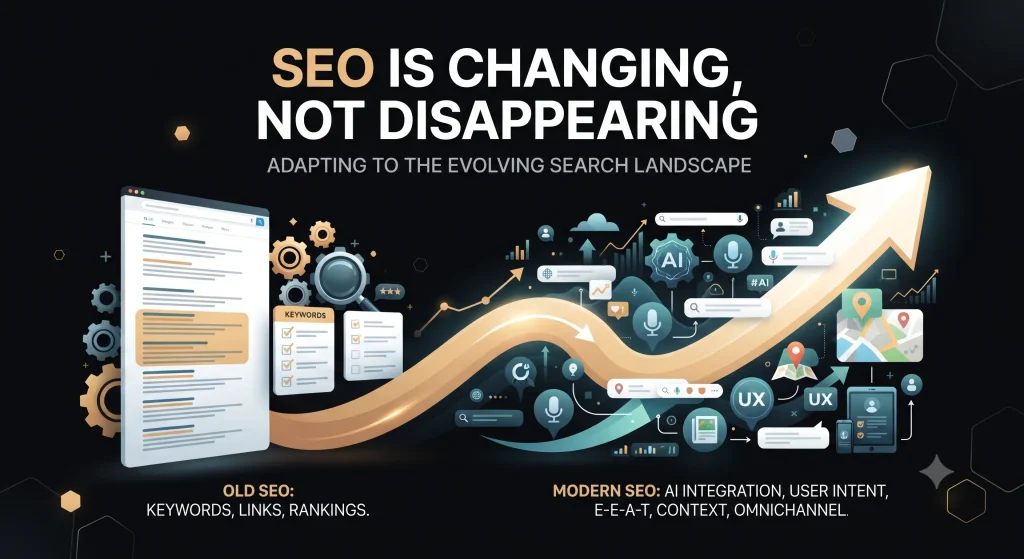
Introduction: SEO Is Changing, Not Disappearing
Search engine optimization has changed over time.
In the past, SEO was about keywords, backlinks, rankings, and optimizing for a traditional search. Now search is becoming more conversational and more driven by artificial intelligence.
Individuals can ask more conversational questions, make searches with natural language, and engage with AI-powered searches which give summaries and links to relevant webpages.
Google’s latest SEO guidance highlights the importance of SEO for generative AI searches.
SEO practices shouldn’t be ignored by businesses now because search engines can use generative AI to power their search functions.
It’s a must that companies build on their SEO strategy.
Now let’s see what’s changing.
What Is SEO in 2026?
SEO, or search engine optimization, refers to the set of activities that improve a website’s visibility in search engines. This could involve making it discoverable, understandable, and indexable by search engines, as well as ranking higher for relevant queries.
The basics are still the same:
• Technical website health,
• Search intent,
• Website content,
• Internal linking,
• Website structure,
• Crawling and indexing,
• Page experience,
• Relevant authority and references,
• Information architecture.
However, the ways in which people search and the ways in which search results are presented are changing — and with them, the role of SEOs and agencies.
One way to think about it now is that AI is becoming part of the search experience — and queries are no longer just a search term, something like:
“digital marketing agency”
but rather questions, such as:
“What should a small business look for when choosing a digital marketing agency?”
How AI Is Changing Search
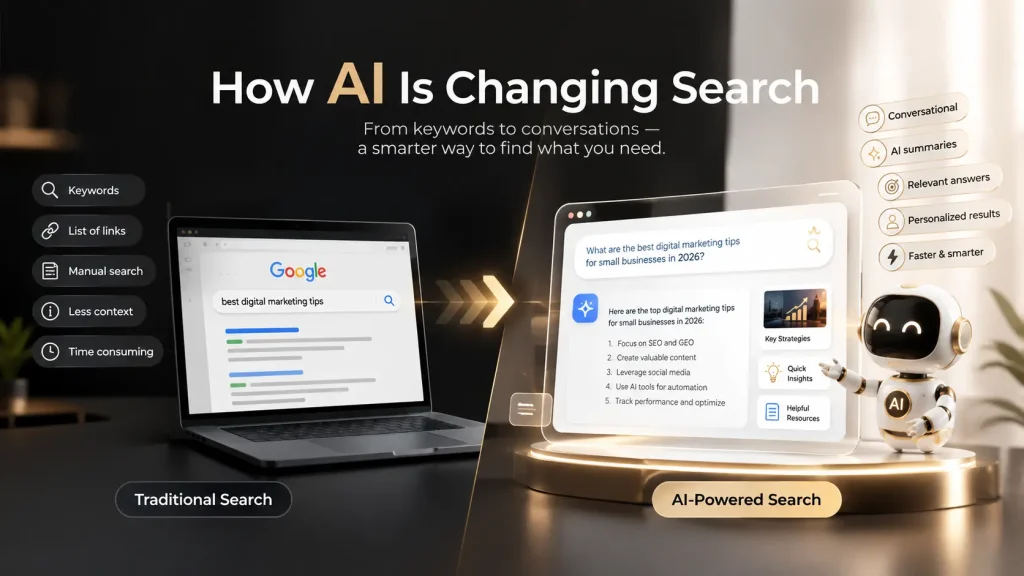
AI is transforming search in a number of different ways.
Search engines are becoming more capable of understanding the intent behind a query rather than just focussing on keywords.
Google’s guidelines on AI powered search reveal that their new generative AI features make use of techniques like retrieval-augmented generation and query fan-out to pull out relevant results from their Search index and answer more involved queries.
What this means for SEOs is that optimising around a keyword might not have as much impact as it used to since there’s a shift towards providing information that fulfills the intent of whoever is searching.
Traditional search funnel:
Keyword → Search results → Website → Information
AI assisted search funnel:
Question → AI understanding → Relevant sources → Generated response → Supporting links
This doesn’t mean websites are losing out though.
In fact, Google state that in order to appear in their generative AIs search results, pages first need to be indexed and eligible to appear in Search.
WE DON'T JUST RANK LINKS
WE BUILD FUNNELS
User Query Input
Natural Language Prompt
Stage 01
Top of Search Funnel
Intent & Context Analysis
Vector & Semantic Parsing
Cognitive Core
Disambiguating Meaning
Vetted Domains & Data
RAG Retrieval Layer
Authority Match
High E-E-A-T Sources
Synthesized AI Answer
Direct Multi-Source Synthesis
Zero-Click Value
Instant Comprehension
Citations & Deep References
High-Intent Traffic Channel
Conversion Zone
Qualified Lead Traffic
User Query Input / Natural Language Prompt
Intent & Context Analysis / Semantic Parsing
Vetted Domains & Data / RAG Retrieval Layer
Traditional SEO vs AI-Driven SEO
| Dimension | Traditional SEO Focus | SEO in the AI Search Era |
|---|---|---|
| Core Focus | Keywords | Search intent and topics |
| Queries | Individual queries | Broader conversational questions |
| Rankings & Visibility | Ranking webpages | Visibility across different search experiences |
| Optimization Strategy | Keyword optimization | Context and relevance |
| Content Formats | Text-focused content | Text, images, video and other useful formats |
| Backlinks | Backlink quantity | Quality, relevance and authority |
| Phrase Style | Short keyword phrases | Natural-language and complex queries |
| Performance Metrics | Traffic and rankings | Visibility, engagement and conversions |
| Research Method | Manual research | AI-assisted research and analysis |
| SERP Environment | Traditional SERPs | Traditional results + AI-powered experiences |
1. Search Intent Matters More Than Ever
One of the key trends in modern SEO is the rising role of search intent.
Search intent is the reason behind the search.
For example, a search of
“SEO”
could be seeking a definition.
A search of
“SEO agency for small business”
could be searching for an offer.
Finally, a search of
“How to improve SEO rankings”
is seeking educational information.
Instead of focusing on keywords, companies should be focusing on the goals of the searcher.
A strong SEO strategy asks:
• What question is the user asking?
• What problem does the user need solved?
• What information does the user need?
• In what way would an answer be helpful?
• What should the user do next?
2. AI Is Changing Keyword Research
AI tools can help keyword researchers to make their job faster by identifying for them:
• Related topics
• Search questions
• Content gaps
• Search intent
• Topic clusters
• Related entities
• Long-form questions
• Content ideas
But AI can not fully replace the strategic thinking of a keyword researcher. For example, in the case of targeting keywords, it does not mean that a marketer will target only:
“SEO services”
a company can develop content on similar questions:
• What does an SEO agency do?
• How much do SEO services cost?
• How long does SEO take?
• What is technical SEO?
• How does local SEO work?
• What is AI SEO?
This way, you will get a set of content pieces covering the topic from different angles.