
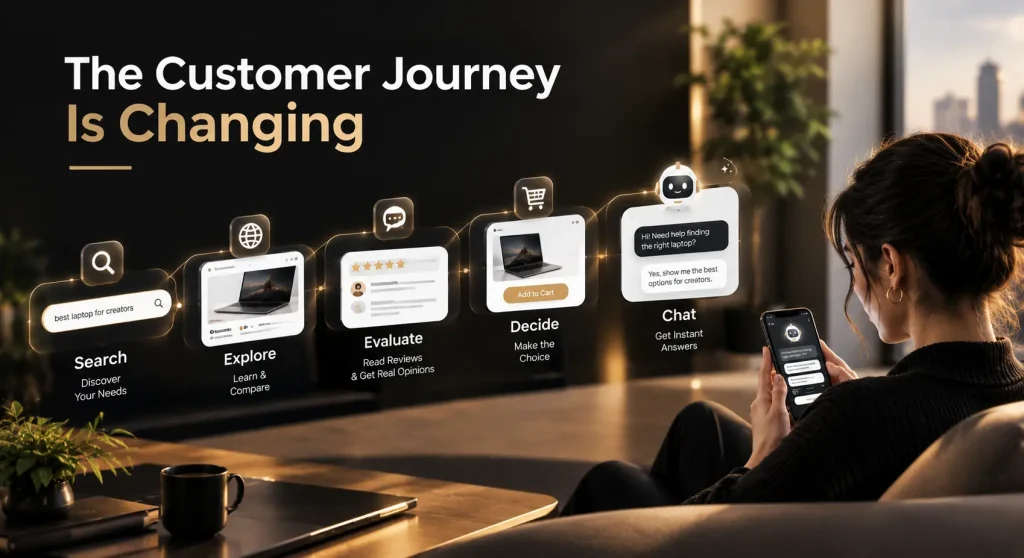
Introduction: The Customer Journey Is Changing
For years, the customer journey often began with a Google search.
Someone would search for something, visit several websites, compare things and eventually make a decision.
In 2026, that journey is becoming more conversational.
People are able to ask more complex and follow-up questions and engage with AI-powered search experiences to research, compare and explore information. Google has implemented AI Overviews and AI Mode into a more conversational search experience while ChatGPT Search lets people ask questions and continue exploring through conversation.
The journey is shifting from:
Search → Website → Research → Decision
toward:
Question → AI Answer → Exploration → Brand Discovery → Decision
What Does “Search to Chat” Mean?
Search to chat refers to the transition from standard keyword-based search, to conversational questioning through artificial intelligence-powered search and chat tools.
Rather than searching:
“best digital marketing agency”
a customer may ask:
“Which digital marketing agency can help a small business improve SEO, social media and Google Ads?”
The second example suggests more intent and context.
Through AI-powered search, users can engage in a dialogue to further explore the topic, ask additional questions and uncover relevant information.
This highlights the need for businesses to move beyond single keywords and think on the questions, problems and decisions their customers are seeking to solve.
The New Customer Journey
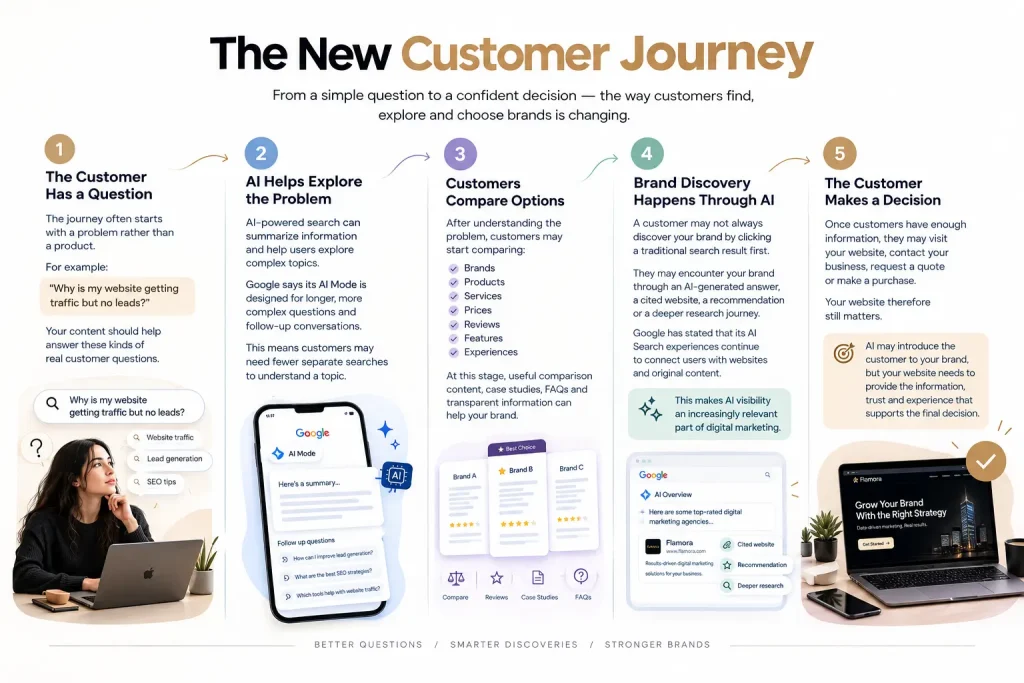
The Customer Has a Question
In many cases, the journey begins with the presentation of a problem before the solution.
For example:
“Why is my website getting traffic, but no leads?”
Your content should focus on answering the real questions of the customers.
AI Helps the User Research the Question
AI-powered search can summarize information and help the user find more information on the subject.
Google announced that its AI Mode is meant to handle more complex questions and conversation-like queries.
This suggests that customers may have multiple questions or want to further develop the conversation.
Customer Compares Options
Once the customer has done their research, they will begin to compare options based on:
✦ Brands
✦ Products
✦ Services
✦ Pricing
✦ Reviews
✦ Features
✦ Experiences
At this point, content that compares features, provides case studies, FAQs and honest information can help your brand stand out.
The Customer Discovers Your Brand’s Content via AI
A customer’s first discovery of your brand may not be clicking on a link or searching directly for your company.
The customer may instead see your content discovered by the AI, follow the suggestions provided by the AI or perform a more in-depth search.
Google has stated that “its AI Search experiences continue to drive traffic to websites and to content, including articles, videos and more”.
The Customer Converts
Ultimately, the customer will convert.
This may include visiting your website, contacting your business, requesting a quote or even making a purchase.
Your website’s role is essential at this point in the journey.
AI may have presented a customer with your content, but your website must provide the information and the trust to encourage the conversion.
Traditional Search vs
Conversational Search
Traditional Search
Conversational Search
Search is evolving from link discovery toward AI-assisted conversations and brand discovery.
How Businesses Can Adapt
Create Content Around Real Questions
Diversify beyond short tail keywords.
Create content that answers real questions.
For example:
“How can a small business improve Google Ads performance?”
is more actionable than simply creating content around the keyword:
“Google Ads.”
Build Topic Authority
Produce useful content around your core services and topics.
For a digital marketing agency, this might include:
SEO → AI SEO → GEO → Google Ads → Performance Marketing → Social Media → Content Marketing
This is an interconnected ecosystem of content.
Make Content Easy to Understand
Utilize:
● Headings
● Short paragraphs
● FAQs
● Comparisons
● Examples
● Statistics
● Original research
Make it easy for both humans and search engines to consume the information.
Strengthen Your Brand Presence
Search visibility is not just about publishing more content; it also has to do with building a digital footprint of trust and authority through useful content, great websites, customer experiences, reviews and brand image.
AI Search Does Not Mean Websites Are Dead
The rise of conversational search does not signal the death of websites.
While AI search experiences offer users the ability to find links and get directed towards websites and sources, your website is still the place where your customers can:
Come to learn about your services
See your work
Read the case studies
Contact your business
Compare solutions
Take action
The aim is not to make a choice between AI search and your website.
Rather, it is about making your website so valuable that it can be found both through traditional and AI-assisted means
SEO, AEO and GEO in the New Customer Journey
The Search Evolution
From Keywords to AI Visibility
How the digital discovery landscape is transforming
SEO
Search Engine Optimization
Focuses on keywords, backlinks, and climbing traditional search engine result pages (SERPs).
AEO
Answer Engine Optimization
Optimizes content for direct answers, voice search, and featured snippets used by assistants.
GEO
Generative Engine Optimization
Tailors content to be cited and recommended within AI-generated summaries and multi-source engines.
AI Visibility
Omnipresent Brand Authority
Ensuring your brand is referenced, trusted, and visible across all generative AI models and touchpoints.
The Future of the Customer Journey
The customer journey is becoming more conversational, contextual and interactive.
People may ask questions, ask further questions, compare using AI and go to your website when they’re ready to make a choice.
Which means, for businesses, the future isn’t just about ranking for keywords.
It’s about being a helpful, trusted resource throughout the customer’s decision making process.
Frequently Asked Questions
What is the search-to-chat customer journey?
The transition from traditional search-journeys towards conversational experiences where the customers can ask questions and get relevant AI-augmented answers and follow up questions.
Is traditional SEO still important?
Traditional search will still be an important discovery channel for customers and businesses need to make sure their content is discoverable and understandable in these AI experiences.
What is AI visibility?
The ability of a brand, website or content to be found or referenced within AI-powered search and conversational experiences.
How can businesses prepare for AI search?
Create quality content that answers common customer questions, establish topical authority, have a well-structured website that helps customers understand what you offer and provides clear information about your products/services.
Conclusion
The customer journey is evolving from one of link seeking to one of conversing with information systems.
Same fundamentals apply, though:
Know your customer.
Answer their questions.
Establish trust and provide value.
Encourage action.
This time around, though, customers have more options for discovering and evaluating your brand.
And the opportunity for businesses is to optimize not for the places people search, but for the ways in which they discover, understand and choose your brand.