
Introduction
For years, Google was once the starting point for online research. Someone wanted to find a product, service, company or an answer to their question so they used search engines, compare several websites and make a decision.
But now, people don’t discover a brand the same way as before.
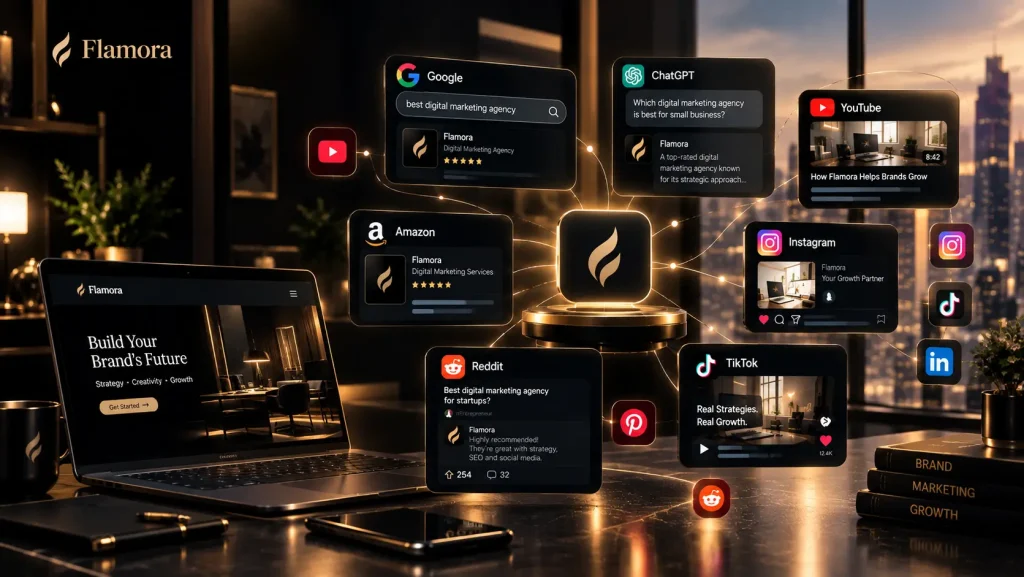
In 2026, the different sources are Google, AI assistants, YouTube, Instagram, TikTok, Reddit, marketplaces, maps, creators, etc. So search is no longer about one particular engine, but rather about visibility in multiple channels.
Google themselves describe the customer journey today as a fluid path with customers searching, scrolling, streaming, shopping and more.
Why Google Is No Longer the Only Discovery Channel
This does not mean Google has ceased being important.
Google and YouTube were in 93 percent of journeys where Indian consumers discovered a new brand, product, service, or retailer/provider, Google/Ipsos insight research found.
But what’s changed is that consumers now have more places to discover and vet a brand.
A person might:
Discover a product on Instagram
Satch a review on YouTube,
Search Reddit for unfiltered opinions,
Ask their AI assistant for Recommendations,
Research on Google Maps or with Search,
Visit the brand’s website,
Compare prices on a marketplace,
Finally make a purchase.
The customer journey is no longer a straight line.
Where Are People Searching for Brands in 2026?
1. Google Search
Google continues to be critical for high-intent queries.
Consumers use it to research and compare products and services, read reviews, find business locations, and discover new products and services.
But Google Search is evolving. With the launch of AI Overviews and AI Mode, Google is betting that search will become more conversational, multimodal and exploratory.
For brands: While SEO will continue to be critical, marketers should also aim to provide answers to specific questions that can be used by AI to satisfy consumer queries.
2. AI Assistants
AI assistants like ChatGPT and Gemini are further accelerating the rise of the “discovery layer” on the internet .
Rather than searching for what they need, users can ask questions such as:
This fundamentally alters the discovery landscape, as brands compete to be regarded as a trustworthy source of information by AI assistants.
In YouGov’s 2026 India research, “online discovery” is increasingly fragmented across search engines, AI assistants, maps, marketplaces and other platforms.
3. YouTube
YouTube is no longer just a destination for video sharing and consumption. It has evolved into a powerful discovery channel for products, services and brands.
People use it to research products, read reviews, watch tutorials, comparisons, unboxings and more.
For certain products and services, YouTube can act as an important trust-building touchpoint prior to a purchase.
Google also continues to blur the lines between YouTube, search, shopping, creators and advertising.
4. Instagram and TikTok
Social platforms are fast becoming “discovery engines” .
Users can discover products and services through Reels, short-form videos, creator content, hashtags, search, comments, trending content and more.
A consumer might not directly search for a brand on a social media platform, but they could stumble across a product or service and then investigate further.
In recent consumer research conducted in 2026, social media was found to play a pivotal role in discovery for everyday products and services.
5. Reddit and Communities
Consumers are spending more time on communities, both private and public, seeking honest conversations about products, services and experiences.
As a result, communities are becoming important discovery channels, particularly for research-intensive purchases.
Individuals will often go to a community forum to ask questions such as:
- “Is this product or service any good?”
- “Has anyone else used this?”
- “What are the alternatives to X?”
- “Which company is the best at Y?”
- “Who should I avoid using because of bad experiences?”
This means that a brand’s “reputation” in such communities can be a critical discovery touchpoint, beyond what a company controls.
6. Maps, Marketplaces & Review Platforms
For local businesses and e-commerce players, discovery often takes place across a range of platforms including Google Maps, marketplaces, review sites and business directories.
Consumers might search for a local business, restaurant, agency, salon, hotel or service provider on a review platform first, prior to engaging with the business’ website.
The New Brand Discovery Journey
Traditional Search vs. Multi-Platform Discovery
| Metric / Focus | Traditional Discovery | Multi-Platform Discovery (2026) |
|---|---|---|
| Platform Focus | Mainly focused on Google | Google + AI + social + video + communities |
| Search Behavior | Keyword-driven searches | Questions, recommendations, visuals and conversations |
| Destination | Website is the primary destination | Brand presence exists across multiple platforms |
| Visibility Signals | Rankings are a major visibility signal | Mentions, recommendations, reviews and citations also matter |
| User Journey | Search → Website → Decision | Discover → Research → Validate → Compare → Decision |
| Strategy | SEO-focused strategy | SEO + GEO + social + video + reputation + content |
What This Means for Digital Marketing
Brands should stop thinking about search as a single channel
rather, think of search visibility as an ecosystem
Your brand should deliver consistent and useful information across the places in which your audience researches.
That includes:
SEO — making sure your website is discovered
GEO / AI SEO — making your brand discoverable for AI systems
Social Media — building visibility and engagement
Video Marketing — answering questions visually
Reviews & Reputation Management — building credibility
Content Marketing — demonstrating expertise
Community — participating and contributing to conversations in relevant spaces
The point is not to have the same content across different channels, but rather to build a brand presence across discovery ecosystems
The Future Is Search Everywhere
The biggest change to this premise in 2026 isn’t that we have stopped being dependent on Google
it’s that we no longer have to rely on one tool to build awareness for our brand.
We can be discovered while consuming YouTube videos, engaging with Instagram, reading Reddit forums, asking questions to an AI assistant, navigating maps, interacting with marketplaces, or even Google itself.
Which begs the new marketing question: “if someone was to search for our category, problem, or solution anywhere on the web, would they find us?”
This is the new definition of Search Everywhere Optimization.
Frequently Asked Questions
1. Are people still using Google to find brands in 2026?
Yes, Google is still an important place to be found. People now tend to ‘move around’ more between search engines, assistants, social platforms, video, maps, marketplaces, and communities — including searching for brands there.
2. Is social media becoming a search engine?
More and more, social media is used to discover things including brands – products, trends, creators, recommendations and reviews, and visual searches.
3. How does AI search impact brand discovery?
AI-powered search makes it possible for people to ask more ‘natural language’ questions – rather than keyword phrases – and get more direct answers such as recommendations. This means more importance is placed on mentions of a brand, as well as ‘authority’.
4. Should businesses stop caring about SEO?
Not at all. However, SEO should no longer be seen as the only way to get a brand discovered online. The key is now to build visibility across all relevant discovery platforms, search engines, AI assistants and AIs, social media, video, communities, and reviews.
5. What are the important platforms for a brand to invest in?
It depends on the audience. It’s important to know which platforms they use to research, discover, compare, review, and make a purchase.
6. What is Search Everywhere Optimization?
Search Everywhere Optimization can be described as an umbrella term for brand discovery and visibility in an increasingly complex ecosystem that goes beyond traditional search engine optimization (SEO).
Conclusion
The search landscape of 2026 is fragmented, conversational, visual, and multi-platform.
Google is still a big part of the discovery puzzle, but customers are also using AI assistants, social media, YouTube, communities, marketplaces, maps, reviews, and creators, among other channels.
It’s the job of marketers to be everywhere their customers are, providing value at every touchpoint along the discovery journey.
Because brands that are future-ready in search will be asking themselves not just “How do we rank on Google?”
But also “Where else are our customers searching — and can we be found there?”