
Introduction
For years, digital marketing was based around a simple cycle:
Search → Click → Website → Explore → Convert
A customer would search for something on Google, click the site, read the content, compare options and make a decision
But the way people find information is evolving
Google is becoming more conversational and answer focused and offers AI-powered experiences such as AI Overviews and AI Mode where users can ask complex questions, receive synthesized answers and continue with follow-up questions while still having links to explore the web.
This poses a challenge for marketers
Your audience may consume information before they visit your website
This means that digital marketing can no longer be based around clicks, website traffic and rankings but rather brands should begin to consider the question of how they can be the brand that people discover, trust and remember when they are looking for answers
This is what digital marketing looks like in the Age of Answers.
What Does the “Age of Answers” Mean?
The Age of Answers is the evolution of search from finding associations to posing questions and getting direct answers.
Instead of using:
“best digital marketing agency”
A user could ask:
“What should a small business look for when choosing a digital marketing agency?”
This second example provides a much more detailed request.
AI-powered search experiences understand questions like this and can synthesize an answer that includes links to websites that address their needs.
For marketers, this means opportunity is no longer about “get the click,” but rather “be part of the answer.”
Search Is Becoming More Conversational
Traditional search is often characterised by short phrases.
Such as
“SEO agency Delhi”
Conversational searches are able to capture much more intent.
“What should I look out for when hiring an SEO agency for my small business?”
This has major implications on what businesses should focus on when creating content.
Beyond creating content around popular keywords, brands need to understand the questions, concerns, comparisons and considerations that their customers are engaging with.
A brand’s content should be answering
what the customer is trying to solve,
the questions they are asking when researching,
the comparisons they are making,
the objections they are overcoming,
and
what information helps them in making their purchase decision.
This allows brands to better serve customers throughout their purchase life cycle.
Your Website Is No Longer the Only Discovery Point
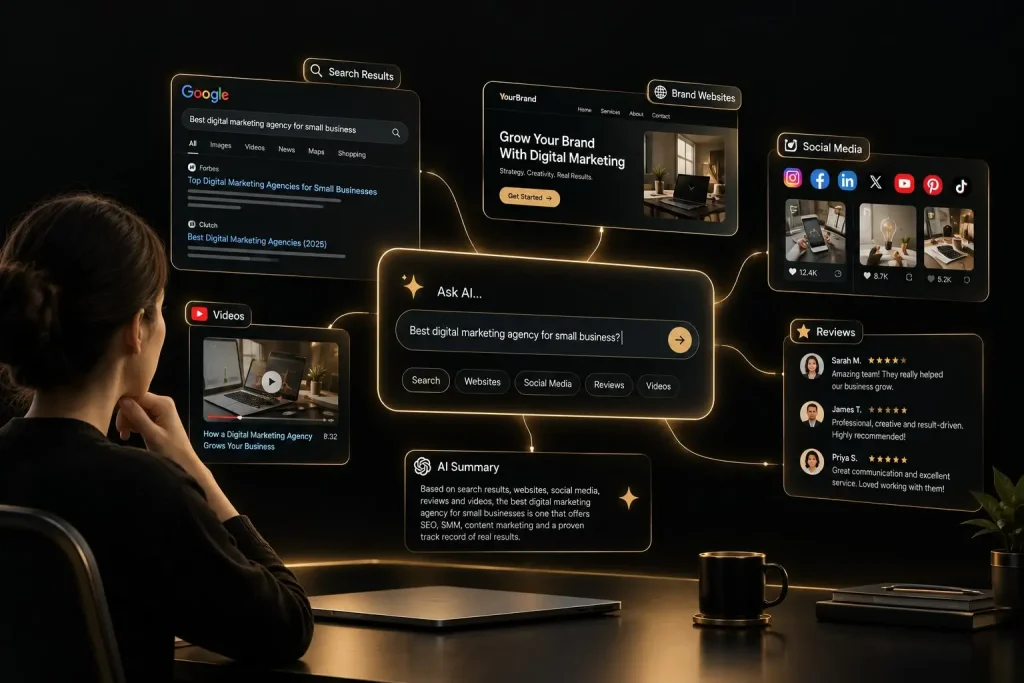
A potential customer could stumble across your brand in a variety of ways before they even get to your website.
Google → AI Answer → YouTube → Instagram → Reviews → Website → Enquiry
While your website remains a vital touchpoint, it is now a subset of the greater digital ecosystem in which your brand operates.
Google themselves describe AI Search as a way to connect people to relevant websites and for users to explore topics across the greater web.
As such, brands need to be discoverable across multiple digital channels, rather than relying on a single channel such as Google.
Traditional Discovery
Keyword
User searches for a specific need or question.
Search Results
Search engines show relevant pages and answers.
Website
The user visits your page to explore the solution.
Decision
The visitor decides whether to take action.
Modern Discovery
Question
AI / Search
Content
Social / Video / Reviews
Website
Trust
Decision
Content Needs to Answer Real Questions
In an answer-driven search environment, generic content becomes useless.
A blog should not be written just to target a keyword, but to solve a problem, such as,
“Why Ranking #1 is No Longer the Only SEO Goal” (vs. “What Is SEO?”).
Content should be
- clear,
- useful,
- original,
- well-structured,
- relevant
- and include
examples and explanations that are easy to follow.
Google’s latest SEO guidance highlights the importance of foundational SEO practices for AI Search while emphasizing the creation of helpful, reliable, and people-first content.
Being Cited or Mentioned Can Become Part of Visibility
Marketers in the past often focused on SEO as a
Rank -> Click -> Traffic
loop
In an answer-driven world, marketers should think about
Question -> AI Answer -> Questioner’s Source Discovery -> Visibility
for Brands
Because AI search results often include links to sites that provide the information used to generate the answer, users can now easily discover the sources behind a given answer.
This has made brand-building, quality content creation, and building expertise more important than ever. However, businesses should not expect there to be an “AI SEO hack” to get listed by Google AI search, as Google has explicitly said that there are no additional technical requirements or special optimization needed to appear in AI Overviews or AI Mode beyond its existing search fundamentals.
Trust Becomes More Important Than Ever
After discovering a brand via an answer, customers will often want to research the brand to answer the question “Can I trust this?”
This is where the value of a strong digital presence is needed, as trust can come from
- original content,
- expertise,
- reviews,
- testimonials,
- case studies,
- clear business information,
- branding,
- author information,
- helpful resources
- and overall
- website experience.
A customer may discover you through an answer, but they must experience the trust before diving deeper into your product/service.
Zero-Click Doesn’t Mean Zero Opportunity
The biggest change in search is, users don’t actually need to click on a website to get an answer.
For informational or basic queries, search features allow the user to get information directly on the results page. For instance, AI Overviews provide a quick summary while also offering to go deeper with links.
This presents a major issue for sites that have relied on purely organic traffic.
However, there is some good news.
A user may stumble upon your brand without clicking, and in turn, search for your company later and click on your site or see your brand in some other way.
Marketers need to start thinking about Visibility → Brand Recall → Trust → Action
instead of only focusing on the click.
SEO & Digital Marketing Are Coming Closer Together
The Age of Answers does not diminish the role of SEO.
In fact, Google has stated that many of the same SEO best practices apply to get noticed in its new generative search features.
SEO’s role is also becoming more intertwined with other marketing disciplines. For instance, a unified inbound marketing strategy could look something like this:
SEO → Finds your content
Content Marketing → Answers their questions
Social Media → Builds brand awareness
Video → Demonstrates expertise
Reviews → Builds trust
Website → Drives deeper research
Conversion Strategy → Turns them into customers
The New Digital Marketing Journey
The traditional marketing journey used to be something like this:
Search → Click → Website → Conversion
The modern marketing journey looks more like this:
Question → Answer → Discovery → Research → Comparison → Trust → Website → Conversion
And often the journey is non-linear. A user may stumble upon your Instagram post, search for your brand on Google the next day, watch your YouTube video and research extensively on your industry vertical before they ever click through to your website.
That is why brands should be looking to provide consistency across marketing channels.
How Brands Can Prepare for the Age of Answers
It is not necessary for companies to completely revise their marketing strategies.
They should rather be adjusted to better address customer needs and provide more comprehensive answers.
Focus on customer questions
Find out what queries potential customers may have before buying your product/service.
Create useful content
Develop blogs, articles, videos, etc., providing answers to the identified questions.
Improve the website
Ensure that it is easy to navigate, contains all the necessary information, and is user-friendly.
Enhance the brand image
Use customer reviews, expert opinions, and other credible sources of information to design informative and engaging content.
Go beyond Google
Identify other platforms where customers may look for information, compare products, and make decisions before buying.
Focus on more than traffic
Monitor additional engagement metrics, such as the number of impressions, branded searches, leads, and conversions, rather than just page views.
Google has announced the launch of Search Console reports about visibility in the results of generative AI searches, thus enabling site owners to track the appearances of their websites in the AI-powered search results.
The New Marketing Goal: Become the Answer
The biggest change is not that search engines are going away
but rather how interactions with them are being reimagined
Customers can now ask more nuanced questions, maintain an ongoing dialog, and even follow along with related supporting information that AI-powered search experiences are able to surface.
This poses an interesting opportunity for brands to expand beyond their current mindset when it comes to search marketing
Rather than asking themselves “How do we rank?”
think about how you can be useful
Instead of focusing on how to get the click
think about how to get the next interaction
And instead of thinking about how to generate traffic
think about how to become a trusted brand across the decision journey
Frequently Asked Questions
What does “Digital Marketing in the Age of Answers” mean?
It means moving from traditional search and click to a more answer focused online world. People can ask more detailed questions and get specific or AI generated answers, but also explore supporting websites. This means marketers should focus on being helpful throughout a customer’s research journey.
Is SEO still important in the age of answers?
Yes. While AI powered search will change some aspects SEO, Google has indicated fundamental SEO principles will continue to be important for making sites discoverable by AI Overviews and AI Mode. Sites should still be crawlable and indexable, provide useful information and be well structured to support users.
How can a brand or business appear in AI powered answers?
There is no guaranteed way to appear in an AI powered answer. Google recommends following its technical and content fundamentals, including building helpful, reliable, people first content. Pages also need to be able to appear in Google Search results.
Will zero-click searches devalue websites?
Not necessarily. While some users may get an answer directly from search, AI Search provides links that let people dig deeper into topics. A website is still important for providing more detail, building trust and capturing visitors who want to explore further.
What kind of content marketing strategy is recommended for answer driven search?
Content that directly addresses customer questions can be effective. This could take the form of comprehensive FAQs, instructions, comparisons, research reports, expert commentary, case studies and problem-solving articles. It’s about delivering value to the user, not just targeting keywords.
What should companies be tracking and measuring in the Age of Answers?
In addition to more traditional metrics like rankings and traffic, businesses should consider measuring search impressions, organic traffic, brand searches, engagement, leads, conversions and revenue. With the right tools such as Search Console, visibility in the context of generative search can also be track.
Conclusion
Digital marketing in the Age of Answers is witnessing a shift that goes beyond the paradigm that each customer journey should start with a keyword and end with a click.
Conversational, artificial intelligence-driven and exploratory search is taking over, where users ask complex questions, receive a synthesized information and follow up with links and further inquiries.
As a result, the scope of your digital visibility requires more than SEO and a strong backlink profile
You need to think about the role of your brand as a source of information and guidance through the decision-making process.
This includes SEO and useful content, brand building, social media engagement, videos, reviews, web design, conversion rate optimization and much more.
Brands that embrace this shift will no longer focus on getting traffic and clicks. They will aim to appear in the minds of customers when they need a recommendation. And in the Age of Answers, this might not always be reflected in the top organic search results.