
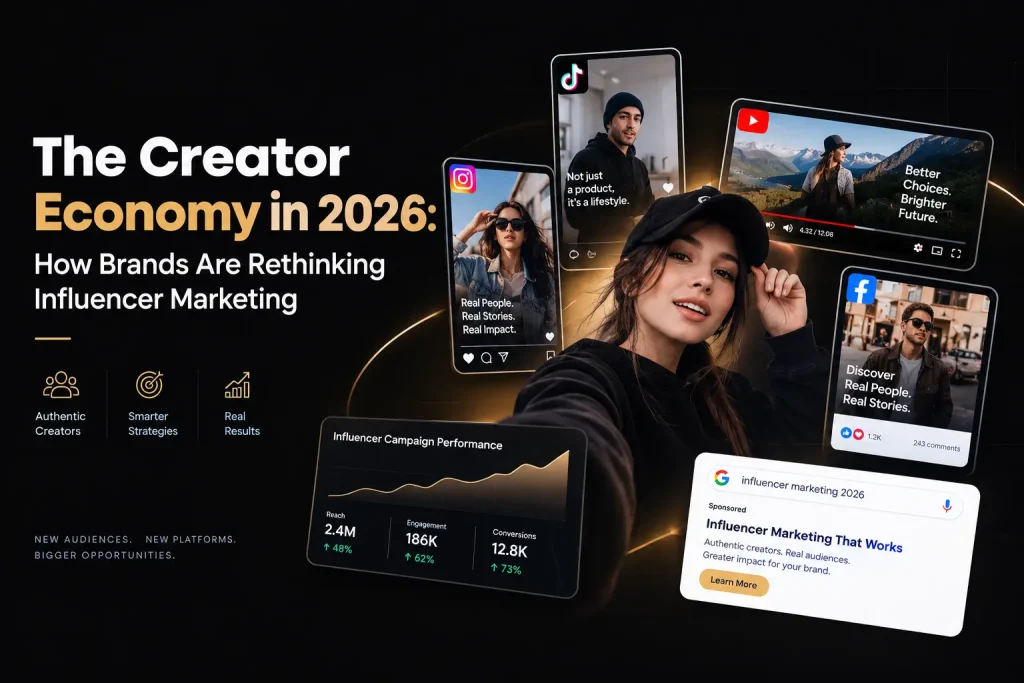
The Creator Economy in 2026: How Brands Are Rethinking Influencer Marketing
Influencer marketing is undergoing a significant transformation. Brands are now prioritizing different criteria when selecting influencers and are no longer focused exclusively on follower counts. In 2026, the emphasis is on trust, relevance, content, community leadership, and business impact.
Moreover, influencers are now integrated into the broader marketing ecosystem of the brand: from social media posts and paid social media marketing (SMM) to product discovery, building trust, and sales.
According to CreatorIQ’s 2026 research report, 48% of companies achieve 3x+ ROI on creator marketing compared to 37% in 2025, with an average annual budget for creator marketing reaching $4.8M, up 33% year-over-year.
What are the key trends and changes in the creator marketing space in 2026? What should brands rethink in 2026?
1. Follower Counts Are No Longer a Priority
In the first decade of the 2020s, influencer marketing was heavily driven by follower counts. The more followers, the better, as it is assumed that a higher number of followers means a bigger potential audience for the brand. Moreover, the bigger the account, the more expensive the cooperation with the creator is.
However, this trend has shifted in 2026, and brands are now more interested in creators who can offer:
• a relevant audience,
• engagement,
• credibility in a certain niche,
• content quality,
• community management and engagement,
• an ability to drive decisions.
And in reality, this shift has occurred because micro- and nanoinfluencers provide superior engagement and community connection. eMarketer predicts that micro- and nano-influencers (with up to 100K and 10K followers, respectively) will receive 45.5% of the influencer marketing budget in 2026.
A creator with 20,000 highly engaged and relevant followers can be more attractive and beneficial to the brand than a famous creator with 1,000,000 followers but with a much bigger audience that is not interested in the niche of the brand.
2. Brands Are Transitioning From Point-Solution Posts to Creator Partnerships
The old influencer marketing playbook was reasonably straightforward:
Identify creator → request product → publish post → campaign over
In 2026 brands are prioritizing long term creator partnerships over one-off posts. According to Northwestern University’s creator marketing research (conducted in 2026), 91% of brands have creator programs with an always-on element, and 80% are allocating more budget to creators.
Long term partnerships allow creators to more thoroughly understand and authentically advocate for a brand, while also providing value beyond a single type of post or message. A creator can deliver a range of content types, including:
- Product demos
- Reels and short videos
- Tutorials
- Reviews
- Testimonials
- Behind the scenes content
- Paid social posts
- Website content
- Product launch posts
The creator’s audience gets to know the creator, and therefore the brand, on a deeper level.
Why Long Term Partnerships Matter
Consistency + familiarity + trust + expanded content library = stronger ROI
Influencer marketing is evolving beyond a transactional “creator rents their audience” paradigm to one where brands are building long term relationships to acquire evergreen content and ongoing advocacy.
3. Creator Content Is Increasingly Being Leveraged As A Performance Marketing Asset
One major trend we saw in 2026 was an increasing number of brands using creator content in multiple marketing channels beyond the creator’s feed.
Northwestern University research shows that 92% of brands are using creator content in social advertising, while also finding that creator content is being leveraged across websites, email, display ads and connected TV (addressable TV).
CreatorIQ’s research also found that, on average, creator content comprises 44% of paid media creative assets for the marketers surveyed.
This marks a fundamental shift in how brands should think about creator content. One piece of content can be used across channels.
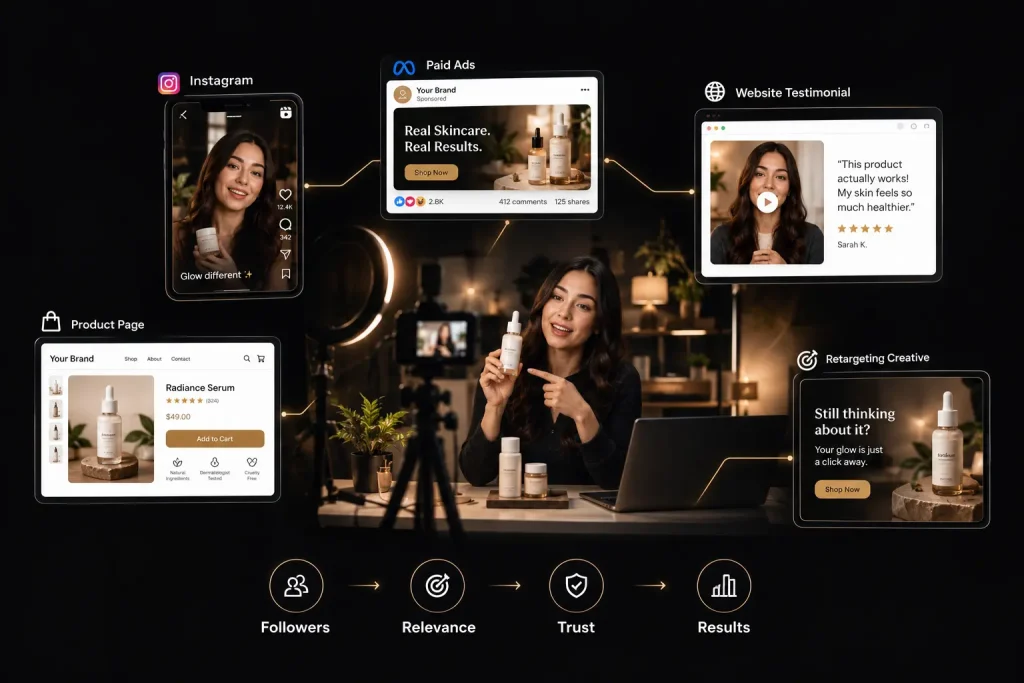
One creator video can be posted on a creator’s story, organic feed, turned into a paid social ad, used on a website, shown in a product page carousel, leveraged for testimonials, and serve as inspiration for retargeting creative.
4. Trust Is Being Displaced by Perfect Promotion
Consumers are becoming increasingly impervious to traditional forms of advertising.
While effective, a polished advertisement may not be enough to gain the trust of consumers.
However, creators can offer something different that traditional brand advertising cannot: experience and context.
According to the 2026 research conducted by Northwestern, 44% of marketers surveyed cited creators as the most trusted source, compared to social media and celebrity endorsements, and the study identified clear product information, disclosure of compensated partnerships, expertise, and honest comparisons as critical influencers of trust in creators. Therefore, brands should invest in giving creators the freedom to relay information to their following in a manner they deem fit.
Instead of saying:
“Say these five sentences verbatim.”
Brands could say:
“Here are the primary benefits of the product. Showcase how and why you would personally use the product to your audience.”
Such considerations could allow creators to broadcast information more organically and, by extension, gain the trust of their audience. Factors Contributing to the Trustworthiness of Creator Content Include:
- Authentic Experience
- Showcasing of the Actual Product in Action
- Disclosure of Any Sponsored Partnership
- Appropriate Expertise
- Honesty in the Presentation
- Removal of Any Unwarranted Optimism
- Provision of Information Aiding Consumer Decision-Making
5. AI Is Transforming the Creator Marketing Landscape
AI is playing an increasing role in all facets of the creator marketing value chain.
Both brands and creators are capitalizing on the capabilities of AI in:
- Creator discovery
- Audience insights
- Content ideation
- Scriptwriting
- Editing
- Captioning
- Performance measurement
- Reporting
- And content recycling
According to the 2026 research conducted by Northwestern, 93% of brands surveyed currently invest in AI, while 95-98% of them utilize AI in at least a few of the aforementioned creator marketing value chain segments.
That said, the fundamental tenet of creator marketing will continue to remain the same: building relationships. While the utilization of AI could make the production of content easier,
it will be difficult for an AI to build credibility and rapport with a community, meaning that the most successful creator marketing campaigns will continue to blend the power of AI, authenticity, and analytics.
Creator Marketing ROI Is Rising
Creator Marketing ROI Is Rising
Brands reporting 3× or greater ROI from creator marketing
The increase from 37% to 48% indicates that creator marketing is becoming less of an awareness-only pursuit. Increasingly, companies are tying creator activity to business outcomes and are therefore willing to spend more than just a little on it.
Traditional Influencer Marketing vs Creator-Led Marketing
Traditional vs. Creator-Led Marketing
How creator marketing is evolving in 2026
| Traditional Influencer Marketing | Creator-Led Marketing in 2026 |
|---|---|
| Focuses heavily on follower count | ✓ Focuses on relevance and influence |
| Mostly one-off campaigns | ✓ More long-term partnerships |
| Primarily organic posts | ✓ Organic + paid + website + commerce |
| Measures reach and likes | ✓ Measures business impact and ROI |
| Brand controls most of the message | ✓ Creator brings their own voice |
| Content often ends after publishing | ✓ Content is reused across channels |
| Influencer seen as a promotional channel | ✓ Creator seen as a strategic content partner |
| Limited relationship with audience | ✓ Strong community connection |
| Campaign-focused | ✓ Always-on approach |
A New Creator Marketing Model
Instead of viewing influencers’ marketing as a one-time campaign, companies should see it as an entire ecosystem:
CREATOR
Authenticity
Expertise
Storytelling
↓
COMMUNITY
Trust
Engagement
Relevance
↓
BRAND
Partnership
Content
Distribution
↓
RESULTS
Awareness
Leads
Sales
Loyalty
Key Takeaways
The creator economy is becoming more strategic and measurable than ever before.
Brands should focus less on finding the biggest creator and more on finding the right creator for the right audience and objective.
Strong creator strategies in 2026 are rooted in:
Relevance over reach
Long-term partnerships over one-time posts
Reusable content over single-use campaigns
Paid amplification over organic-only distribution
Trust and authenticity over formulaic production
Data and measurement over vanity metrics
AI-powered workflows without sacrificing human touch
The biggest opportunity is not in working with more creators, but in extracting more value from every creator partnership you have.
Frequently Asked Question
1. Is influencer marketing effective in 2026?
Influencer marketing is effective in 2026 according to the present study, as the practice is growing significantly, and it already delivers high returns despite the brands’ increased focus on measurement and optimization.
2. Are micro-influencers better than the ones with big followings?
It depends on the objective, the audience, the content, and the offer. In some cases, a creator with fewer followers may provide better results than a popular influencer.
3. Should brands use creator content in paid ads?
Yes, brands should use creator content for social media advertising, as it is the common practice in the industry. In fact, according to Northwestern’s research, 92% of the surveyed brands utilize creator content in their paid social media ads.
4. Should brands work with creators on an ongoing basis?
Yes, because such collaborations offer more value than one-time cooperation, as they build continuity, familiarity, and content, and they help both sides, the creator and the brand, to get to know each other better.
5. Can AI replace creators?
No, but it can support them in research, creation, editing, and measuring. However, creator marketing will always be based on human relationships.
6. What should brands measure in creator marketing?
It depends on the goal, but in general, they should measure impressions, engagement, traffic, leads, sales, conversion rate, customer acquisition cost, content, and ROI.
Conclusion
The creator economy in 2026 is moving beyond influencer marketing.
Creators are no longer just people publishing sponsored posts for brands, they’re building content partnerships, engaging communities of influence, voices of authority and performance marketing vehicles.
The most successful brands will not necessarily be those that work with the biggest creators, but will build partnerships, create content that people want to consume, distribute it across multiple channels and attribute creator activity to business impact.
The future of influencer marketing is therefore not in more followers,
but in more relevance, trust, better content and stronger return on investment.