
Introduction
Search engine optimization (SEO) has long been associated with increasing website traffic. Companies research keywords, optimize pages, acquire links, publish articles, and analyze statistics to improve the quantity and quality of visitors to a particular web page.
However, an emerging paradigm of SEO leaves aside the ultimate goal of attracting and focuses on other aspects such as conversion rates or engagement.
The reason for this shift is that users may come across a company in different ways: a Google search result, a Google feature snippet, a YouTube video, a social media post, a review, and so on.
It means that traffic is not the only metric that should be considered when evaluating the success of a company’s SEO efforts. In many cases, users interact with a firm’s link several times before they decide to make a purchase on its website.
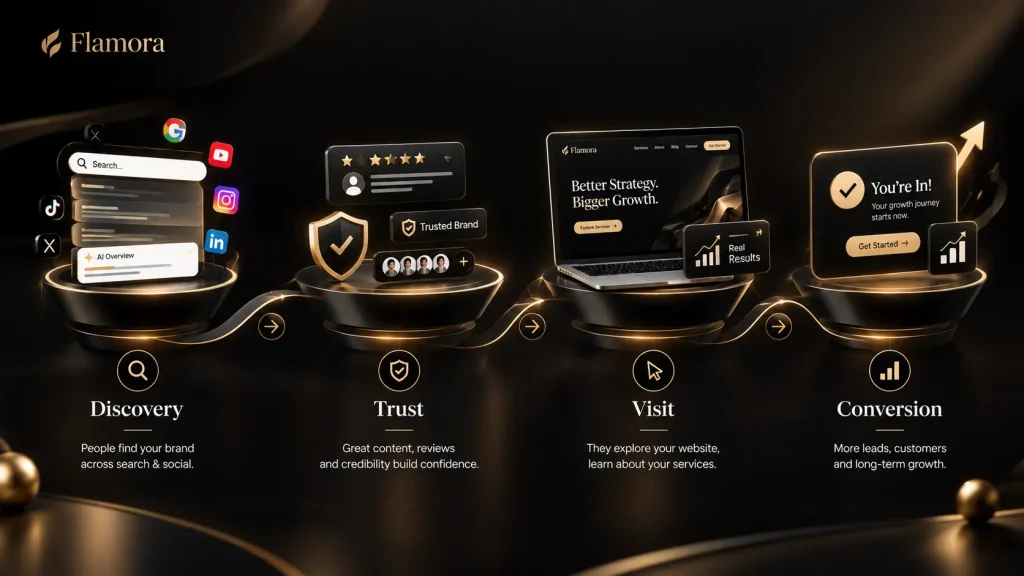
Therefore, it is possible to talk about the conversion funnel from acquisition to conversion:
Discovery → Trust → Visit → Conversion
A new perspective on SEO suggests that companies should focus on all stages of the funnel. Thus, apart from optimizing the website to get more traffic, firms should also work on their conversion rates.
Discovery: Help People Find Your Brand
The first stage of the new SEO funnel is called Discovery .
Before a customer can make a purchase, they need to first discover your brand.
While discovering businesses used to equal Google ranking, people can now discover businesses across a variety of digital platforms, such as:
- Search engines
- AI search experiences
- YouTube
- Social media
- Google Maps
- Reviews
- Online communities
- Industry websites
- Featured search results
As such, an SEO strategy should not only focus on ranking for a few chosen keywords — but instead think about how a business can be discovered via different channels in which its customers are present.
Improving discoverability
Aim to provide answers and value for the types of questions and problems your target customer has.
Make sure to optimise for:
- Keywords
- Intent
- Blog posts
- Local SEO
- Video content
- Mentions
- Topic clusters
- FAQs
Remember that the point of discovery is not to sell but to get found by customers.
Trust: Give People a Reason to Believe You
The mere act of finding your brand is not enough — people need a reason to trust you before they can take any purchasing action.
That is the job of the second stage in the SEO funnel — Trust .
Customers will frequently compare multiple options and research extensively before making any high-value purchase, such as a house or a car. However, even with lower-value items, many customers will consult reviews, social posts, case studies, testimonials and more to gain trust in a particular brand. Your website and content in general should answer the implicit question: “Why should I trust this brand?”
How SEO helps build trust
Your website and content can provide trust and reassurance to a potential customer by offering:
- Helpful and informative content.
- Authoritative information on a particular topic.
- Customer reviews and testimonials.
- Case studies.
The necessary information about your services and products.
Expert opinions.
Excellent About Us copy.
A strong brand presence.
Internal linking that recommends related content.
The building of trust rarely happens because of one article — it takes numerous interactions with a brand for a customer to feel certain about making a purchase.
The New SEO Funnel
Discovery → Trust → Visit → Conversion
SEO FUNNEL
FROM DISCOVERY TO CONVERSION
Discovery
People discover your brand across search, AI and social platforms.
Trust
Useful content, reviews and expertise turn visibility into credibility.
Visit
Interested users explore your website and important pages.
Conversion
Turn qualified visitors into enquiries, purchases and customers.
Visit: Turn Search Interest Into Website Engagement
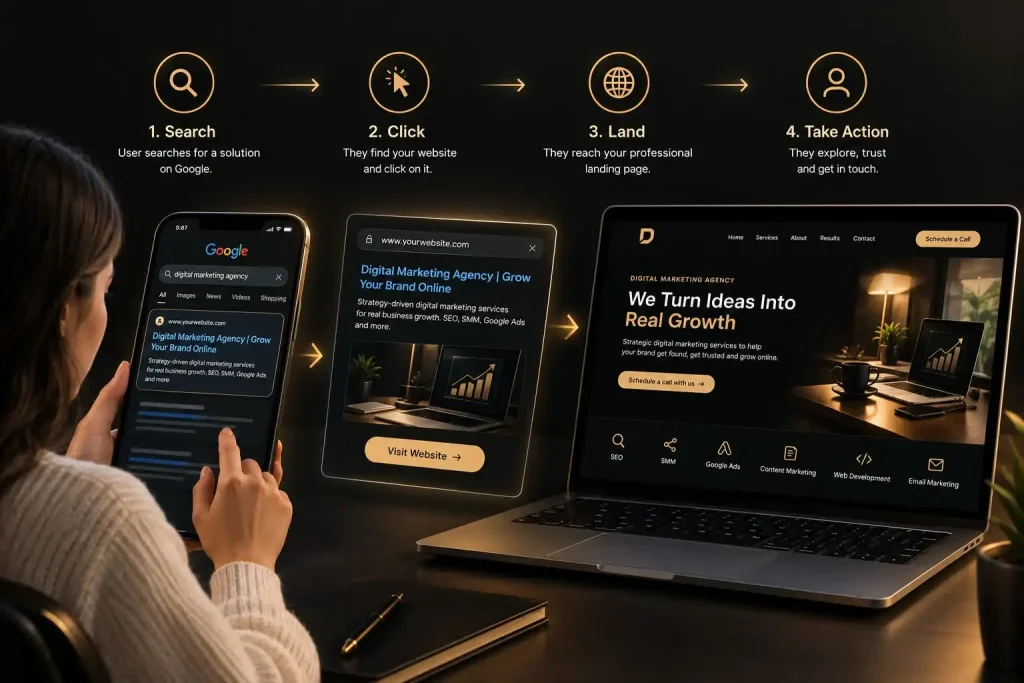
Once a person found your brand and started trusting you, the logical next step is the visit.
But to make them come to your website, you have to do more than just get them to click.
Your website will have to pick up the conversation from search and continue it.
For example, a person searches for:
“Digital marketing agency for small businesses.”
They find your brand in the search results and click on the link.
But if they land on a slow, confusing, badly-structured page that doesn’t tell them what you want it to tell them, they’re going to leave.
Therefore, your SEO landing experience should create:
- A scannable and descriptive headline
- Information relevant to the search query
- Easy-to-find and well-organized information
- Fast website performance
- Mobile responsiveness
- Visual appeal
- Descriptive service language
- Trust builders
- Related links
- Clear call-to-action
You want to create an experience similar to the search results but on your website.
Conversion: Turn Interest Into Action
The final stage is Conversion.
A conversion in most cases does not equal a sale.
Depending on the business, a conversion can be:
Filling out a contact form
Booking a consultation
Requesting a quote
Calling the business
Signing up for a newsletter
Downloading a resource
Starting a free trial
Purchasing a product
This is why SEO should not only be focused on driving traffic but on getting that traffic to convert.
A website that gets thousands of visitors but a couple of leads is not doing well.
The other website might get hundreds of visitors but convert most of them into sales.
The aim is to get relevant traffic and give these visitors a reason to convert.
Make it easy for people to convert by using:
Call-to-action buttons
Short forms
Strong value propositions
Service specific landing pages
Testimonials
FAQs
Pricing information where needed
Trust signals
Simple contact options
Do not make people look for what to do next. Lead them to the right place.
The New SEO Funnel in Action
The New SEO Funnel
Discovery → Trust → Visit → Conversion
Discovery
“I found this brand.”
People discover your brand through
search, AI, social media, video and maps.
Trust
“This brand seems credible
and understands my problem.”
Content, expertise, reviews and
testimonials build confidence.
Visit
“I'll check their website.”
The user explores your website,
service pages and product pages.
Conversion
“This looks like the right
solution for me.”
The visitor becomes a lead,
makes an enquiry or purchases.
“This sounds exactly like the right fix for my problems.”
That’s the difference between traffic-obsessed SEO and customer-obsessed SEO.
Classic SEO tends to focus on questions like
“How much traffic can we drive?”
While the new SEO funnel focuses on
“How do I turn search into sales and customers?”
SEO Metrics for Every Funnel Stage
| Funnel Stage | What to Measure |
|---|---|
| Discovery | Impressions, rankings, visibility, brand searches |
| Trust | Engagement, returning visitors, reviews, content interaction |
| Visit | Organic traffic, CTR, landing-page engagement |
| Conversion | Leads, enquiries, sales, conversion rate, revenue |
This gives businesses a more complete understanding of SEO performance.
A ranking report can tell you where you appear.
A funnel tells you what happens after people find you.
How to Build a New SEO Funnel Strategy
You should not need to completely reinvent your SEO strategy.
Instead, you should tie all of your existing SEO efforts into each step.
First: Building Discovery
Make sure to focus on researching your audience and building content around their search intent.
Second: Building Trust
This is about creating helpful content, testimonials, case studies and using consistent brand language across all platforms.
Third: Improving the Overall Experience of the Visit
Focus on improving website speed, mobile compatibility, overall ease of navigation and relevancy based on their search intent.
Finally: Optimizing for Conversions
Make sure to provide clear calls to action, contact forms consultations or other methods for the visitor to convert.
Why the New SEO Funnel Matters
SEO is becoming more and more integrated into the entire customer journey.
Someone might not go directly from searching for your brand to buying from you.
They could stumble upon your content,
watch your video,
read another article,
look at your social media,
visit your site,
compare you to your competitors,
and then come back and contact you
This is why SEO needs to facilitate multiple touchpoints throughout the journey and shouldn’t be treated as a one-click process.
The brands that recognize this phenomenon will be able to drive the best SEO strategy that would build relationships with customers, thus fueling retention and growth.
Frequently Asked Questions
What is the new SEO Funnel?
The new SEO funnel is the customer journey, which consists of four stages: Discovery, Trust, Visit, and Conversion. SEO Funnel is a new paradigm that shifts the focus from driving traffic to the website and increasing its visibility in search results to helping the customer find the brand, discover and gain trust in it, visit the site, and complete a desired action.
Why is discovery central to SEO?
Discovery is the first stage in SEO, and it determines whether prospective clients will see the brand and have an interest in it. In the modern environment of increased use of search engines and artificial intelligence, discovery also includes AI search, YouTube, social media, maps, reviews, and other resources. SEO helps in getting found both in the traditional way of search and discovery in new ways, increasing the visibility of the brand throughout the customer’s research process.
How can SEO build trust in a brand?
SEO can help to build trust by providing informative and relevant content. Moreover, SEO can facilitate trust in a brand by providing testimonials, reviews, cases, services, descriptions, articles, and other entries that provide the customer with information and help compare different companies and choose the most suitable one.
How can SEO turn visits into conversions?
To get more conversions, the SEO professional should ensure that the link used leads to the landing page that corresponds to the search query and provides the required information. Moreover, the page should have trust factors and encourage the visitor to take action. It can be done by adding CTA buttons, contact forms, service pages, and navigation. Finally, the last stage is to help in converting by getting the leads to the email, increasing the conversion rate, and getting the customers to complete the desired action.
What metrics are essential for tracking new SEO Funnel?
To track the new SEO Funnel, it is essential to measure the metrics that correspond to the stages of the Funnel. Therefore, for discovery, it includes impressions, rankings, and visibility, while trust refers to engagement, repeat visits, and content interaction. For visits, the metric is organic traffic and CTR, while for conversions, it is leads, enquiries, sales, conversion rate, and revenue.
Is SEO Funnel changing the rules of SEO? Why/Why not?
The SEO Funnel does not change the rules of SEO but adds to them and emphasizes the importance of different aspects. Therefore, traditional SEO practices remain relevant but are now viewed as a part of a greater whole. The link building, technical SEO, content creation, and other traditional SEO activities are now placed in the context of a customer’s journey and contribute to their own stages of the Funnel.
Conclusion
The new SEO funnel is not about driving traffic to the website anymore. It is about guiding the customers through the entire journey, from discovery to conversion.
Discovery is what makes your brand known to the audience.
Trust is what builds credibility with them.
Visit is when you can convey more information and persuade the customer.
Conversion makes them do what you want them to do: buy, subscribe, etc.
The funnel also redefines the metric system around SEO. Rankings, traffic, engagement are important, but the ultimate success should be defined by post-click or post-visit interactions. The SEO strategy has to go beyond the domain in the search results and impact the experience that people have on the website. A click is no longer the be-all and end-all of SEO, especially with the rise of AI searches, social media, video, reviews, and multiple touchpoints between the client and the website before a purchase intention.
That is why the future of SEO is not about visibility; it is about discovery, trust, visit, and conversion. It is about building relationships with customers through their digital experience. It is about changing the approach to SEO from just ranking higher to delivering value at multiple points in the journey. And it is a great opportunity for the SEO industry to rethink its role and transform the way companies engage with their customers.
For Flamora, it is about creating a new paradigm in SEO, which has the potential to help the clients achieve their goals and objectives in the digital space while delivering an exceptional experience to their customers.