
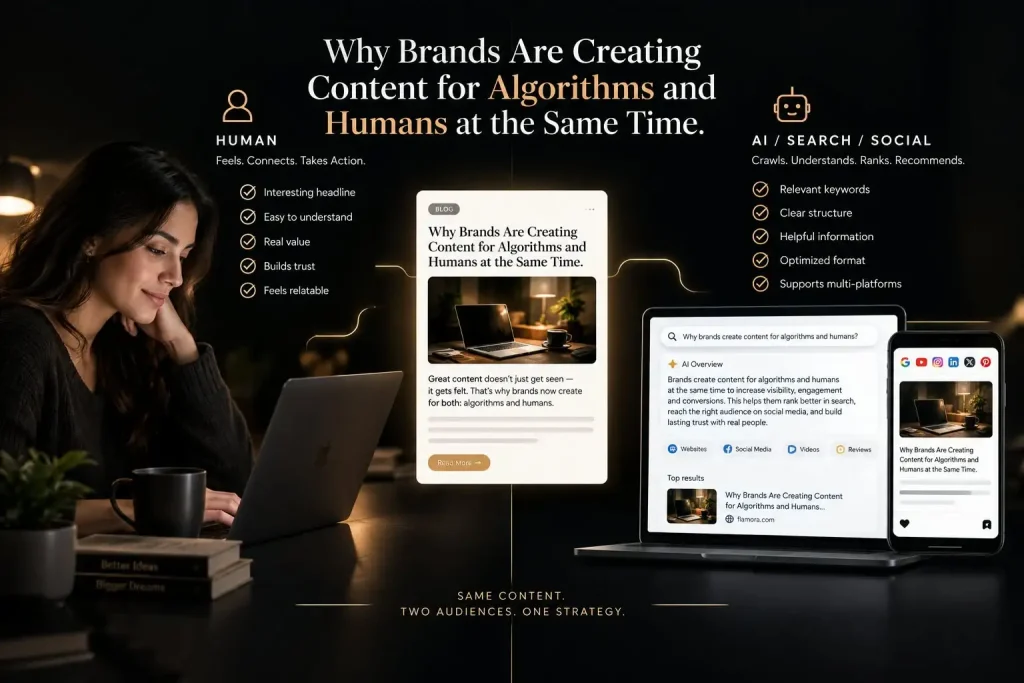
Why Brands Are Creating Content for Algorithms and Humans at the Same Time
Content marketing used to have it easy: create something of value, put it out there, and let people find it.
For now, discovering products and brands is no longer that simple.
Consumers find brands through Google, Instagram, YouTube, TikTok, Reddit, social feeds, artificial intelligence and algorithms, and more, but simultaneously, algorithms and artificial intelligence increasingly understand and interpret content, topics and decide what to bring to the fore.
That creates a whole new challenge for brands:
Their content must be of interest to people and understandable to technology.
But that doesn’t mean that keywords should be stuffed in or that texts should be written in a robot-like manner.
The aim is to create content that people like, understand, and trust, but also that can be clearly deciphered and discovered by digital systems.
The Audience Is No Longer Only Human
When a person reads a blog article, watches a Reel or looks at a product page, they are clearly part of the audience.
However, they are no longer the only audience members involved in the discovery process.
Search engines analyze pages. Social platforms classify content. Recommendation systems guess what users want to see. AI systems can collect, summarize and relate information on the web.
This means that content has two functions:
Human function:
Capture attention, communicate an idea and create value.
Machine function:
Make the topic, context, entities and meaning clear enough to be discovered and interpreted.
The important thing is that these functions should complement each other, not contradict each other.
1. Algorithms Decide What Gets Discovered
You can make an excellent piece of content, but if no one discovers it, it will have little effect.
Modern discovery mechanisms use a mixture of signals to determine what content is relevant to a particular user. On social platforms, these can include user interests, past engagement, and features and predicted relevance of content itself.
Search works fundamentally differently but the same principle applies:
Context is important.
Instead of a vague headline such as
“How to Grow Your Business”
try something more specific such as
“How Instagram Content Can Turn Followers Into Customers” .
The second headline gives both the reader and discovery algorithms far more context to work with.
Make Your Topic Obvious
Your content should make it easy to understand:
- What is this about?
- Who is it for?
- What problem does it solve?
- What questions does it answer?
- What makes the information useful?
Google’s current guidelines explicitly emphasize people-first content, original value, clear expertise and satisfying user experiences rather than content created primarily to manipulate rankings.
So optimizing for discovery doesn’t mean you should write for machines instead of people.
It means you should make your content easier to understand by both.
2. Humans Still Decide Whether Content Deserves Attention
Algorithms might be able to help you find someone who would be interested in your content.
They can’t convince them to spend time engaging with your content.
A person decides whether to
- stop scrolling
- read the headline
- watch the video
- continue reading
- share the content
- save the content
- visit the website
- trust the brand
- take any other actions
This is why content that is technically optimized but ultimately boring may end up being a disappointment.
Compare these two Instagram captions:
“5 Digital Marketing Strategies for Businesses”
“Your Content Gets Views. So Why Isn’t Anyone Buying?”
The first one is great in terms of keywords, but it doesn’t really spark curiosity. The second one asks a question and makes you think about your own situation. Similar situations can be seen in any space.
People Are More Engaged by Relevance Than Keywords
This doesn’t mean that keywords are unimportant. It does mean that good content is created by addressing an actual need with specific advice or information, rather than filling an article with keywords in the hopes that some level of relevance will be achieved by sheer volume.
Google’s guidance on people-first content specifically advises against creating content for the sake of keywords or massive quantities of generic content that has little value to anyone.
3.Structure Is Becoming More Important
Writing for people doesn’t mean that structure isn’t important.
In fact, using proper structure when writing content provides benefits to both humans and computers.
Proper structure could include
using clear headings to break up topics
using specific statements rather than hiding important information in blocks of text
descriptive titles that say exactly what the article is about
lists of information when appropriate
using supporting information such as examples, original research, statistics or quotes as needed
describing relevant concepts or audiences
This same type of structure can aid in content’s ability to be understood and used by digital tools. Microsoft Advertising’s 2026 article on AI discovery processes recommends a people-first approach with structure that makes the content easy to use for machines.
Don’t Turn Your Content Into a Robot
There is an important distinction to be made between
machine-readable
vs
machine-written
Your content can possess
- clear headings,
- descriptive language,
- logical structure,
- relevant entities,
- helpful FAQs,
- structured information,
and
- strong internal linking
all while still retaining its human voice
The point is not to de-personalize your content, but rather to make your expertise more easily found and consumed.
4. One Piece of Content Can Serve Multiple Discovery Channels
A modern content strategy should not assume that everyone discovers information in the same place.
Someone might discover your brand through a Reel.
Another person might find your blog through Google
Someone else might hear about you through a creator
Another user could encounter your brand while researching through an AI-powered search experience
This is why content should be created with multiple discovery environments in mind.
For example, one strong topic can become:
🔹Blog article
🔹Instagram carousel
🔹Reel
🔹YouTube Short
🔹LinkedIn post
🔹FAQ section
🔹Website resource
🔹Creator collaboration
The idea is not to copy-paste the same content everywhere.
Instead, adapt the core idea to the behavior of each platform.
Current social-media research also points toward discovery happening beyond a brand’s existing follower base, with creative quality and platform-specific content increasingly important to distribution.
One Idea. Everywhere Your Audience Is.
Create one strong idea and adapt it across multiple formats.
Blog
Deep, searchable content
LinkedIn Post
Professional insights
Instagram Carousel
Swipeable storytelling
Create Once.
Adapt Everywhere.
Turn one valuable idea into platform-ready content while keeping the core message consistent.
Instagram Reel
Visual short-form content
YouTube Short
Video discovery content
Direct audience connection
One strategy • Multiple touchpoints
More Reach • More Engagement • More Opportunities5. The Best Strategy Is Not “Human vs Algorithm” (The Most Important Strategic Thinking About Content)
The best strategic thinking about content is actually to stop thinking about content as being created for two different audiences – humans and algorithms.
Think about it this way:
Algorithms drive discovery.
Humans drive attention.
Useful content drives trust.
Trust drives action.
A great piece of content has all of these elements working in unison.
Human Content vs Algorithm-Friendly Content
| Area | Human-First Only | Algorithm-Aware + Human-First |
|---|---|---|
| Headline | Creative but sometimes vague | Clear + engaging |
| Structure | Designed mainly for readers | Easy for readers and systems to interpret |
| Keywords | Natural but inconsistent | Relevant and contextual |
| Content | Helpful | Helpful + discoverable |
| Formatting | Flexible | Clear headings, sections and supporting elements |
| Distribution | Focused on one channel | Adapted across discovery channels |
| AI/Search | Not considered | Content is structured for interpretation |
| Brand Voice | Strong | Strong and consistent |
| Goal | Human engagement | Discovery + engagement + trust |
The Two-Layer Content Model
HUMAN LAYER
Hook
Emotion
Story
Value
Trust
Action
DISCOVERY LAYER
Topic Clarity
Context
Structure
Search Signals
Platform Relevance
Machine Readability
ONE STRONG
CONTENT IDEA
Human Layer
Discovery Layer
CONTENT THAT GETS FOUND + CONTENT PEOPLE WANT TO CONSUME
What This Means for Brands
The future of content is not writing for algorithms as much as it is about writing for people intelligently.
That means writing in a natural, easily understandable way.
Organizing it so that each paragraph has a distinct and specific purpose.
Adding unique and valuable insights.
Understanding who you are writing for.
Writing in a way that is appropriate for the medium.
Making it accessible to the widest possible audience.
And above all, not writing about something because it is popular.
But rather, writing about topics that the audience is legitimately interested in and that your company has the ability to help them with.
Key Takeaways
Content now lives in a much more complex discovery environment — people are finding brands through search, social feeds, creators, recommendation systems and more — which means that discoverability is key, but that it’s not enough on its own.
The most effective content is going to balance a human touch with algorithmic precision, striking the right tone, presenting information in a way that’s easy to absorb, building toward a position — or even a clear argument — while delivering value and insight on a given subject. Google’s latest guidelines similarly stress the importance of creating original, useful, people-first content, as opposed to content that is created with the express purpose of manipulating rankings.
The aim is not to create content that is pleasing to an algorithm — the aim is to create content that an algorithm can find and that people will genuinely engage with.
Frequently Asked Questions
Is content now designed for algorithms?
No. Information should be primarily created for people, but the proper organization, contextualization and description can make it understandable and accessible for search engines, recommendation systems and AI.
Does SEO still have a place in human-first content?
Yes. SEO can be integrated into a human-first strategy, since Google officially states that SEO is compatible with people-first content, when it helps search engines to find and identify useful information.
Should brands be designing content differently for each platform?
No. A great idea can be transformed, presented and supported in different ways. However, the same article or post may not have the same effect if it is published several times on different resources or social networks.
Is AI-generated content fit for this approach?
AI can help with research, suggestions, editing and design, but information created with the participation of artificial intelligence may lack uniqueness, relevance and human expertise. Google guidelines emphasize quality and purposeful content, rather than the means used to create it.
What is more important, algorithms or people?
Both are important, since recommendation systems and search engines shape the distribution of content, but human interaction is key to engagement and conversions. A successful content strategy should focus on users while taking into account the conditions of algorithms.
Conclusion
The future of content is not humans versus algorithms
But rather, a recognition of the relationship between the two. Algorithms can help surface your content, but humans ultimately decide its value. Brands should therefore focus on creating compelling, well-structured, informative and authentic content that is discoverable and consumable by their target audiences, utilizing a range of approaches including those that favor algorithmic preferences.
The brands that succeed in this environment will not only increase their content production, but will improve their ability to create content that can be found, understood, remembered and trusted across an evolving ecosystem of platforms and technologies.
So, while you shouldn’t write content for the algorithm,
you should still strive to create content that somebody would want to consume and that people will choose to share.