
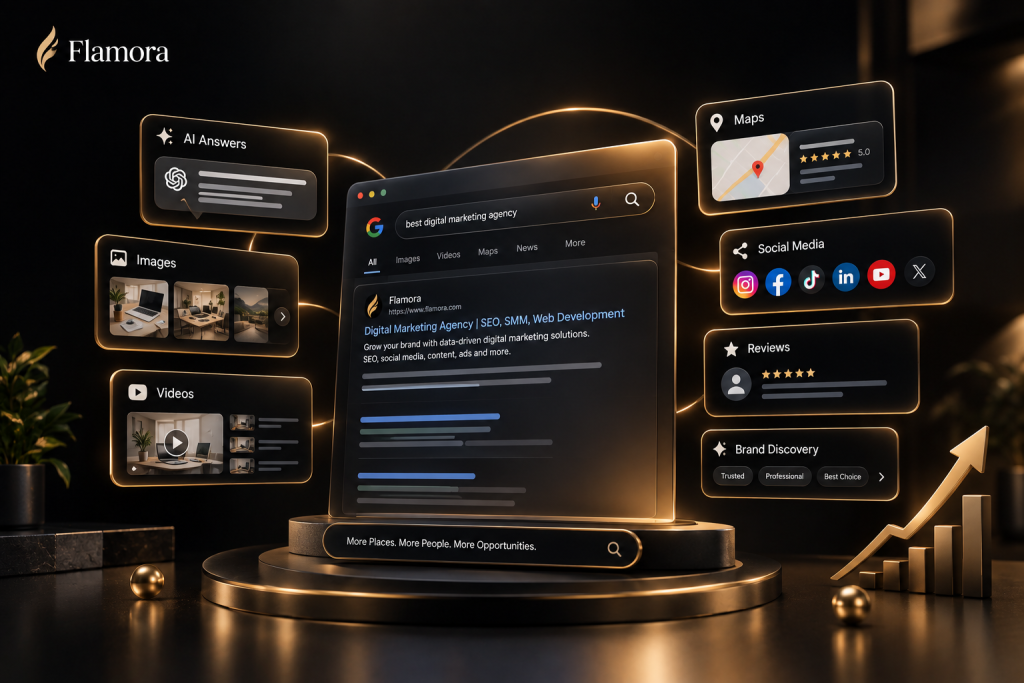
Why Ranking #1 Is No Longer the Only SEO Goal
Introduction
For a very long time, a big question in the SEO world was “Are you ranking number 1 on Google?” The reason why it was so important was that the higher your website showed up in the search engine results pages (SERP), the more traffic you would get to your website. This was seen as desirable because it meant more eyeballs on your site and more potential customers.
But people are becoming harder to please.
More and more discover new products and services through other means than traditional Google searches. People can now discover you through google’s AI, snippets, maps, videos, social media, forums, reviews, and many other places. And some searches are even answered directly on the SERP, meaning they never have to click on a website.
This doesn’t mean rankings aren’t important, they most definitely still are. But, they don’t tell you the whole story about your search visibility and presence. In this day and age, SEO is now about being able to influence the SERP at the right time to get eyes on your content, get people to trust you, and get them to convert in whatever way you want them to.
Why #1 Rankings Were Once the Main SEO Goal
Traditional SEO, which was largely focused on search engine rankings.
It was simple, really:
Higher Ranking = More Visibility = More Clicks = More Traffic = More Customers
So businesses would heavily invest into SEO practices that make them more visible and easier to find in the search results. Keyword research, content creation, backlink building, technical SEO and much more were all fair game and were used in an attempt to boost rankings.
But the environment grew increasingly competitive, and it became harder and harder to rank higher. And while this was an issue for many marketers, there is another, more pressing concern – modern search results are much more diverse, and feature multiple types of results:
- AI answers,
- Featured snippets,
- Local results,
- Images,
- Videos,
- People Also Ask,
- Product results
- News
and
- Social posts.
Therefore, ranking #1 might not be enough, if your result is buried on the second page under a multitude of other result types.
Search Results Are Becoming More Diverse
The Google SERP (search engine results page) is changing – the days of just 10 blue links are over. Increasingly, depending on the type of search, you will see a mixture of results including an AI answer box, video carousel, maps, images, FAQs, reviews, and more – before organic results even start.
This is forcing agencies and brands to rethink their SEO strategies. Instead of focusing on the question:
“How do we rank #1?”
the question should be:
“How can our brand be visible when people search for what we offer?”
Search Visibility Matters Beyond “Rankings”
Say I have two websites, Website A and Website B. Website A is ranking #1 for a certain keyword but is getting minimal traffic and enquiries. Website B is ranking #3 for the same keyword, but is appearing in a number of other search features, building brand awareness, and capturing qualified traffic. Which one is a better performer? Which one is going to drive more revenue from search?
Rankings in and of themselves are a vanity metric and should not be the only metric that matters to brands and businesses. That’s why we propose a multi-tiered SEO evaluation framework that looks at:
- Search visibility
- Organic traffic
- Qualified traffic
- Brand discovery
- Engagement
- Conversions
- Leads
- Revenue
- Search features
- Brand mentions
Zero-Click Searches Are Changing the Game
The traditional customer journey used to be: someone would perform a search, click on a result, and then make a decision based on what they found. But increasingly, people aren’t clicking – they’re getting the information they need right in the search result.
For example, if you search
“What is local SEO?” there is now a good chance you will not need to click through to a website in order to understand what local SEO is.
This can be a huge challenge to traditional SEO, since brands may be getting visibility without getting clicks. But instead of looking at it as a negative, brands should embrace it – by focusing on becoming a “go-to” destination for helpful, reliable information that can help customers make decisions.
Traditional SEO
Traditional SEO Journey
Modern Search Visibility
Modern Search Journey
/ Maps / Social
Discovery
Search Intent MattersMore Than Just Position
Not all keywords have equal value.
See how many people search this: “What is SEO ” versus “SEO agency small business.”
Now see the intent of the searcher – one seeks information, the other seeks to buy.
That #1 page for an informational keyword may be getting tens of thousands of impressions.
Meanwhile, a page buried on page two for a commercial keyword may be getting thousands of valuable leads.
Which means that in addition to intent, we may need to shift our focus to the searcher’s intention and next steps based on what they’re looking for.
Qualified Traffic Is MoreImportant Than Just More Quantity
A high increase in traffic is a great feeling – until you realise that those 50,000 website visitors are contributing to 20 total leads.
Meanwhile, on another site – 8,000 website visitors create 150 qualified leads.
Which means we’re measuring SEO performance incorrectly.
Not because quantity is important, but because quality is more important than quantity.
Your marketing strategy focuses on qualified leads, not total leads.
SEO needs to shift towards measurement and reporting tools that reflect this nuance:
- Qualified leads
- Conversion rate
- Opportunities
- Revenue
- Customers
- Engagement
- Returning website visitors
This means we stop measuring success by “more traffic” and start defining success by “how does it contributes to a bigger picture?”
Brand Visibility IsGaining More Attention
We may forget that people aren’t searching for companies.
They’re learning about them from:
- YouTube
- Maps
- AI
- Reviews
- Other company websites
- Community boards
And in various places before they even get to our website.
SEO tactics now involve brand visibility and “Search Everywhere Optimization”.
In other words, your potential customer browses a million places before they actually visit a business – we want to make sure they stumble upon our brand often enough that they know what we stand for when the time comes to take action.
Content Quality CanBe More Important Than Quantity
Putting out 100 blog posts a month sounds great, but this thinking misses the point that 10 well-written blog posts can get us more exposure and backlinks than 100 lower-quality posts ever will.
Quantity has nothing to do with it – your blog post can perform better and worse – depending on what the searcher is looking for and how the searcher uses the page. A great rule of thumb says what makes a piece of content great:
Answers a burning question
- Showcases your product’s strengths
- Includes examples
- Is easy to understand and digest
- Highlights your point
- Leads to another piece of content
- Links internally and outwardly
- Allows the reader to take action.
Instead of asking ourselves questions like “how many blog posts per week/month should we publish?”, we begin asking better questions about content quality and quantity.
Your Overall Business Success ShouldFrame Your Link Building Strategy
SEO stops being its own entity when it begins to affect other areas of the business and vice versa.
If lead generation is your ultimate marketing goal, your link building and other SEO tactics should focus on bringing more qualified prospects to the page that sells your service or product.
If brand awareness is what you want to achieve, your SEO strategy influences how familiar your target market will be with your brand.
If you sell products online and build an ecommerce store, your content and SEO strategy should influence people who can actually reach your page and convert.
A successful marketing strategy will begin to connect link building, content, quantity, and quality – in a way that serves a bigger purpose.
From Strategy to Business Growth
What Should You Measure Instead of Only Rankings?
| SEO Metric | What It Tells You |
|---|---|
| Keyword Rankings | Where your pages appear |
| Search Impressions | How often your pages are shown |
| Organic Traffic | How many users reach your website |
| CTR | How often users click your result |
| Engagement | How users interact with your content |
| Leads | Whether traffic creates opportunities |
| Conversions | Whether visitors take valuable actions |
| Revenue | Business value generated through SEO |
| Brand Searches | Whether awareness is growing |
The New SEO Goal: Be Visible, Valuable and Discoverable
The future of SEO is unlikely to involve the abandonment of rankings.
But it certainly involves the expansion of the definition of success.
A successful SEO strategy should be focused on making the brand:
Visible – discoverable by searchers
Relevant – related to the searcher’s needs
Useful – containing the information the searcher requires
Trustworthy – inspiring confidence in the brand
Discoverable – present in an environment where the searcher expects to find it
Actionable – providing a clear call to action for the searcher
This is a much broader definition of success than page-one rankings.
Frequently Asked Questions
Does ranking #1 on Google matter for SEO?
Ranking #1 can still be very valuable. The key is to recognize that the modern SERP (search engine results page) has many verticals and there are diverse ways for people to discover content – and they don’t necessarily click on #1. The main point is to assess your ranking positions along with impressions, clicks and other metrics related to the performance of your web pages.
What else matters more than ranking #1 on Google?
The importance of any particular metric depends on the goals of a business. If the primary goal is to acquire new leads through search, then the quantity and quality of leads should be the priority – not your position in search results. With that said, if the purpose is to build brand awareness, visibility in search (impressions and brand searches) is more important than anything else. The point is to measure and analyze the metrics relevant to your own goals.
Can a website earn customers without ranking #1 on Google?
The short answer is yes. Your site can rank for multiple keywords and key phrases unrelated to first-position rankings. In fact, you can get traffic, sales leads and visits to your physical store from a variety of sources – including zero-click SEO, local pack, video, image search, branded questions and dozens of other verticals where your brand may show up. What matters is the combined visibility across all channels and whether these lead to the desired customer action.
What is zero-click SEO?
Zero-click SEO is about optimizing your website so it delivers the information searchers are looking for. There are many ways to do that: local pack, Q&A sections, rich snippets, job listings and more. The bottom line is that Google can and will provide the information right there on the search engine results page. It’s good to optimize for zero-click searches and build brand equity.
Can a company continue to invest in keyword research and rank tracking?
The short answer is yes. Keyword research will continue to be important – and so will rank tracking. That said, it’s important not to fixate on any single metric, including keyword rankings. Inbound links are important quality signals for search engines, but quantity is not a reliable metric for measuring performance either. You should review a range of metrics, as described below, and use them as inputs for strategic decisions for your business.
How is search intent related to SEO?
Think about the intent behind every search query. Was the searcher looking for a product, a service, an idea or just casual information? Search intent is what determines context and relevance of a query, and the right type of content will drive the most relevant traffic to your website. The more relevant the content, the more likely people are to take the desired action.
How does AI impact SEO?
AI-powered search experience means people get answers without visiting any websites. In reality, anyone exploring topics will conduct their searches right within Google by asking follow-up questions for related topics. The implications are enormous – the ability to generate content the user wants and needs in a clear, compelling, consistent and trustworthy manner becomes more important than ever before. Google is rapidly embracing visual content and other formats – brand visibility across diverse verticals takes center stage.
What metrics will continue to drive SEO in 2026?
Metrics will play an increasingly important role in content creation and curation strategies. As mentioned earlier, there are too many metrics to consider. The ones that typically matter most are impressions, rankings, clicks (CTR), traffic, engagement, website performance, leads, sales and revenue. The bottom line is that any effective SEO strategy must be aligned behind specific business goals.
Will SEO continue to become less important due to the rise of AI?
SEO will continue to be more than keyword research. Search engine optimization will adapt to changing technologies, including artificial intelligence. Keywords and natural language queries will continue to be a part of the SEO strategy going forward – but the emphasis will shift to content marketing, AI-assisted discovery, brand visibility and website traffic.
What is the future of SEO?
SEO is evolving from ranking position optimization to greater emphasis on brand visibility, content marketing and website traffic quality. This means greater importance on intent, context and user-driven discovery in a multi-platform environment. Traditional SEO will continue to be relevant, but it will become much more involved in the management of overall brand visibility.
Conclusion
Ranking #1 can be useful, but SEO should not focus only on #1. Search has evolved from a list of links to an overarching ecosystem of discovery where both AI and people find information, products, experiences and more.
A page can be ranked #1, yet the result may not drive valuable results for a business. Likewise, a brand can rank outside of the top result across dozens of queries and earn greater visibility through the search ecosystem.
This is why SEO focuses on the full customer journey today.
From initial discovery to product research, evaluation, purchase and beyond.
The right question to ask for SEO is not “are we ranking #1?”
The question is “are we visible when customers search, delivering the information that they need to find and are we helping to grow the business?”
This is the question that brands need to answer as they think about their SEO strategy in 2026.