
Introduction: Marketing With Measurable Results
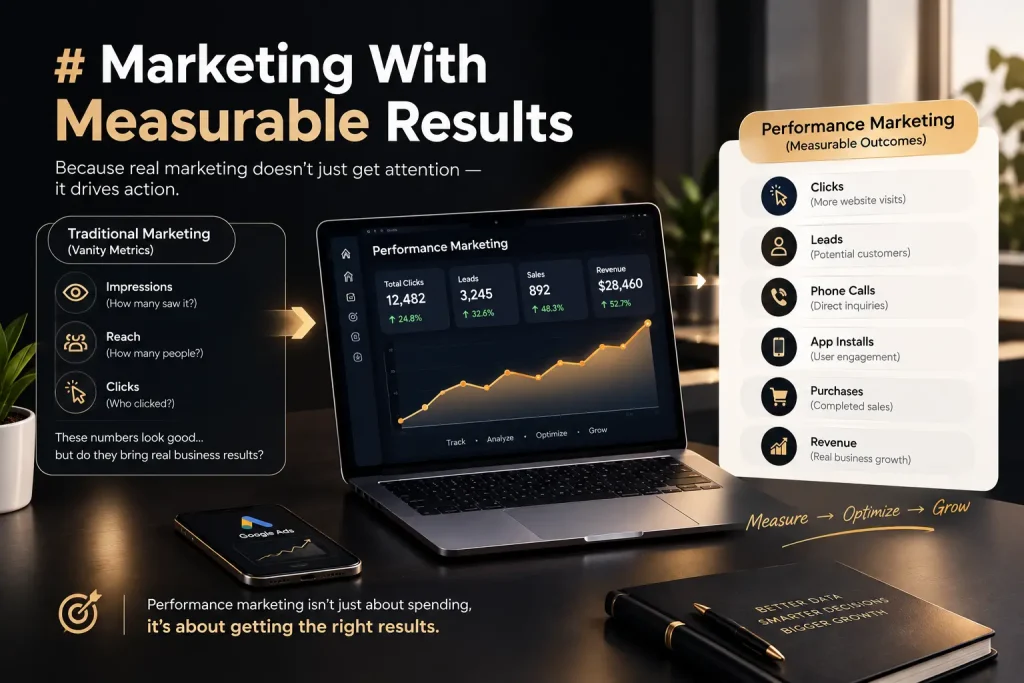
Businesses invest in marketing activities in order to obtain a particular result.
This result may be an increase in website traffic, obtaining leads, phone calls, application downloads, sales, or revenue.
However, spending money on any kind of marketing activity without guarantees and control of the results is short-sighted and unwise.
Performance marketing is a form of data-driven marketing in which the marketing campaign is developed and optimized according to certain metrics.
These metrics can include the number of clicks, leads, sales, purchases, and other actions that can be measured.
Google Ads offers a conversion tracking tool that allows you to track the effectiveness of your ads by analyzing the campaigns’, ads’, and keywords’ contribution to conversions.
By using performance marketing, businesses are focused on the actual conversion rather than just the number of impressions or page views.
In addition, instead of asking the question: “How many people saw my ad?” I prefer to ask the following: “What did people see my ad do?”
What Is Performance Marketing?
Performance marketing is a type of digital marketing which focuses on making measurable actions and using them for campaign planning, optimization and analysis of results.
Depending on the business model, the metric could be any of these:
• Website purchases
• Qualified leads
• Form submissions
• Phone calls
• App downloads
• Product inquiries
• Bookings
• Sign-ups
• Online sales
The main idea is to have a certain goal which would be achieved through a marketing campaign.
For example, e-commerce businesses would typically track website purchases and revenue, while a company offering services would rather focus on generating qualified leads and arranging meetings. The important thing is to have a clear objective which will later be used as a metric.
How Does Performance Marketing Work?
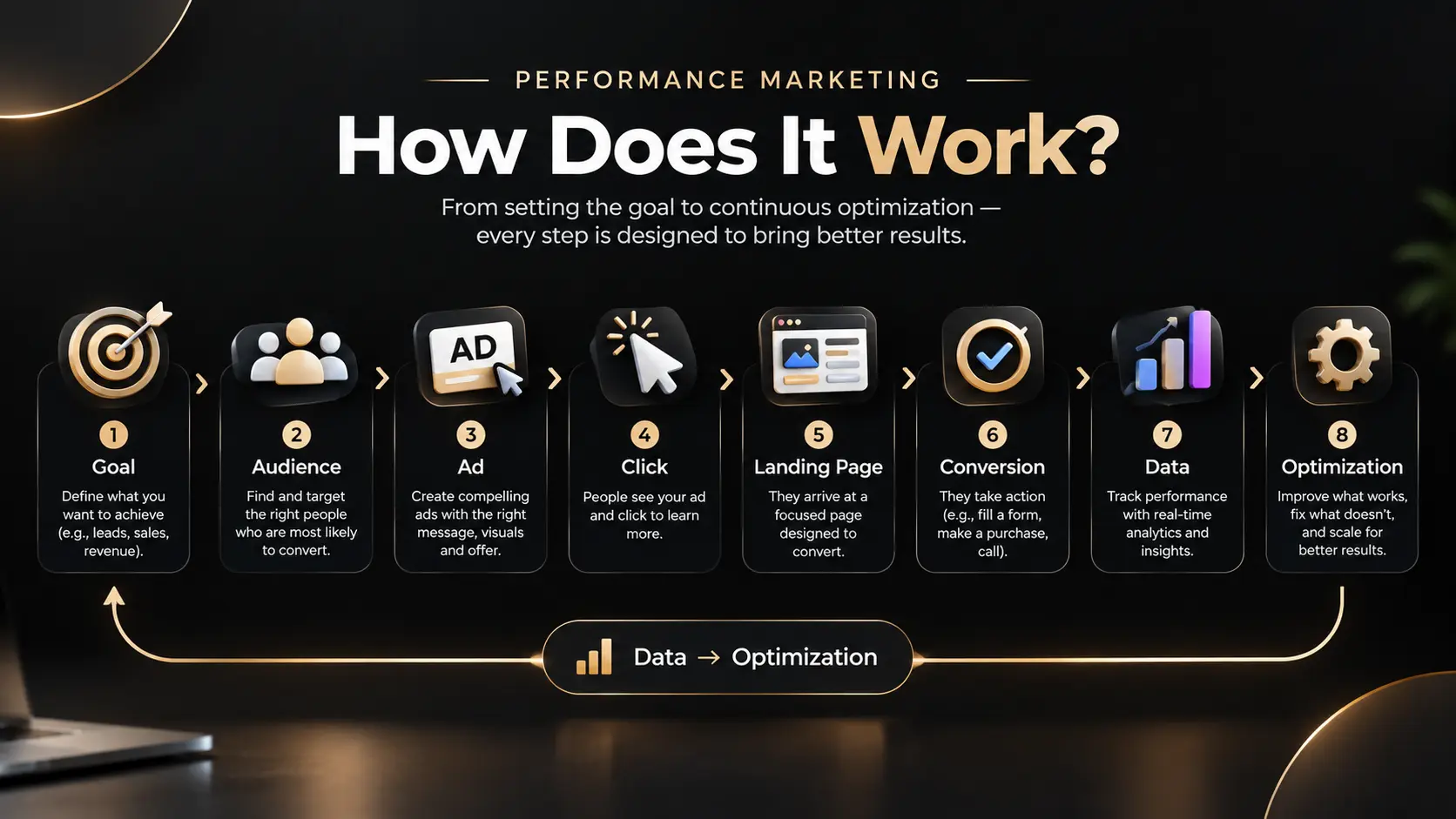
Performance Marketing typically involves in a continual cycle of:
Goal → Audience → Campaign → Click → Landing Page → Conversion → Measurement → Optimization
1. Set Goal
The first thing that has to be decided is the purpose that the advertisement needs to serve.
E.g.,
the generation of 100 qualified leads.
2. Audience
Define the target audience that is most likely to become a customer.
Consider their location, interests, searches, and demographics. Think of prior interactions and purchase intent.
3. Channel
Choose the channel/s on which the advertisements will run based on the target audience and specific business goal/s.
4. Campaign
The advertisements are then built along with the strategy, targeting options, budget, and landing page experience.
5. Conversion Tracking
It is essential to track each conversion that occurs on the landing page, from phone calls and purchases to any desired subscription or lead generation form.
6. Measure & Analyze
Evaluate the campaign’s performance and understand how it drives conversions.
7. Optimize
Optimize the advertisements, targeting, landing pages, budget/s and overall campaign structure for continual improvement.
Instead of a one time advertisement, this makes for a never ending campaign of continual optimization.
Traditional Marketing vs. Performance Marketing
| Traditional Marketing | Performance Marketing |
|---|---|
| Often focused on reach and awareness | Focused on measurable outcomes |
| Results can be harder to attribute | Results can be tracked using conversion data |
| Limited real-time optimization | Campaigns can be adjusted regularly |
| Examples include print, TV and billboards | Examples include Google Ads, Meta Ads and paid digital campaigns |
| Broad audience targeting is common | Audience targeting can be more specific |
| Measurement may rely heavily on estimated reach | Uses metrics such as conversions, CPA and ROAS |
| Campaign changes can be slower | Digital campaigns can be tested and optimized quickly |
Performance Marketing Channels
- Capturing existing demand
- Connecting relevant searches
- Lead generation & traffic
- Product sales & retargeting
- Brand discovery
- Product introductions
- Solution demonstrations
- Video conversions
- B2B lead generation
- SaaS & software growth
- Professional recruitment
- Re-engaging past visitors
- Recovering cart drop-offs
- Increasing conversions
1. Google Ads
Google Ads can help reach customers when they are looking for products, services or solutions.
Businesses can measure actions such as purchases, sign-ups, calls and other conversions.
Google Ads can therefore be useful for capturing existing demand and connecting relevant searches with business offerings.
2. Meta Ads
Meta advertising can help businesses reach audiences across platforms such as Facebook and Instagram.
It can be used for objectives such as:
• Lead generation
• Website traffic
• Product sales
• Retargeting
• Brand discovery
Creative testing is especially important because users interact with visual content quickly.
3. YouTube Advertising
Video advertising can be used to introduce products, explain services, demonstrate solutions and support conversions.
Businesses can combine video creative with audience targeting and measurable campaign objectives.
4. LinkedIn Ads
LinkedIn can be particularly relevant for businesses targeting professional audiences.
It can support:
• B2B lead generation
• Professional services
• Software businesses
• Recruitment
• Industry-specific campaigns
5. Remarketing
Remarketing focuses on people who have already interacted with a website, product or brand.
For example, someone may visit an online store without purchasing.
A remarketing campaign can help bring that person back to the website.
Performance Marketing Metrics You Should Know
Performance marketing revolves around its measurement.
Below are some of the essential performance marketing metrics:
CTR – Click-Through Rate
CTR stands for ‘Click-Through Rate’. It implies the ratio of individuals clicking through an advertisement on a website to the number of impressions.
One would consider a higher CTR to mean good as it suggests that the advertisements are relevant enough to entice an individual to click through.
However, one must evaluate CTR in conjunction with other metrics.
CPC – Cost Per Click
CPC stands for ‘Cost Per Click’. It implies the amount that an advertiser would pay for a click.
Typically, businesses would use this to evaluate how much they would have to spend on average for a click and in turn measure the volume of traffic they would drive to their website.
CPL – Cost Per Lead
CPL stands for ‘Cost Per Lead’. It implies the amount spent by advertisers on average for generating a sales lead and is particularly useful for service-based businesses.
CPA – Cost Per Acquisition
CPA stands for ‘Cost Per Acquisition’. It implies the amount spent by advertisers on average for generating a specific conversion.
An example of the calculation for CPA is as below:
Ad Spend / Conversions = CPA
ROAS – Return on Ad Spend
ROAS stands for ‘Return on Ad Spend’. It implies the ratio of revenue against the money spent on advertisements.
An example of the calculation for ROAS is as below:
Ad Revenue of ₹40,000 / ₹10,000 Ad Spend = ROAS of 4:1
ROAS is a great metric to analyze the revenue generated, but businesses need to consider other factors such as their margin, the lifetime value of a customer and more.
Conversion rate
Conversion rate is a metric that analyzes how often customers complete a specific action after engaging with a company’s marketing campaign.
According to Google, “Conversion tracking helps you measure the value of your Google Ads by showing you how many people carry out specific actions such as visiting a page or calling after seeing your ad.”
Why Conversion Tracking Is So Important
Without accurate measurement, it is hard to tell what is working and driving results for your business.
Conversion tracking helps you understand which:
• Campaigns are driving results
• Ads are generating valuable actions
• Keywords are working and driving conversions
• Landing pages work best
• Which audiences react best to your campaigns
Google’s current advertising guidance also emphasizes the importance of having a strong data foundation and the use of measurement and tools such as enhanced conversions and offline conversion imports to understand advertising performance.
This is why performance marketing is not just about running ads.
But also about:
Run → Measure → Learn → Optimize → Scale
How AI Is Changing Performance Marketing In 2026
Artificial intelligence is becoming more significant in digital advertising.
It can assist marketers in various ways, including:
Analyzing audiences
Optimizing campaigns
Bid management
🎯 Variations of creative
🎯 Campaign analysis
🎯 Forecasting
🎯 Personalization
🎯 Data processing
Google has also been developing measurement and AI-related advertising, and its September 2026 updates prioritized first-party data and multiple signals and measurement designed for the AI era.
However, automation does not eliminate the need for strategies.
Marketers still need to determine what products are available, who the target audience is, what unique value proposition is required, what conversion is desired, what message should be communicated, and how much money is needed to sustain the business.
Performance Marketing Funnel
How to Build a Performance Marketing Strategy
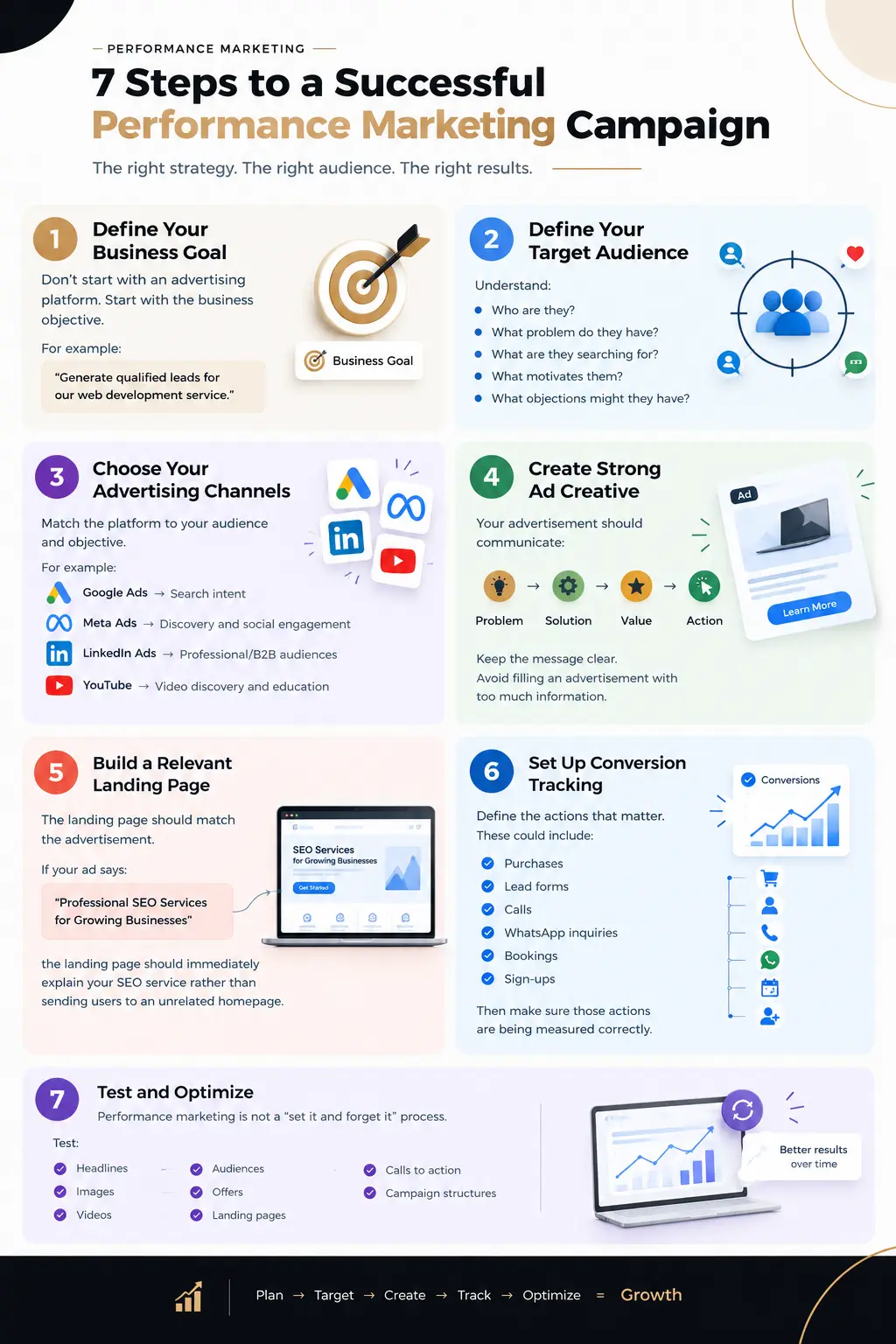
## Step 1: Select the advertising objective
Do not select the advertising platform.
First, clarify the business objective;
For example,
“Generate qualified leads for our web development service.”
—
## Step 2: Determine the target audience
Specify the target audience in detail:
• who are these people,
• what interests do they have,
• what problem are they trying to solve,
• what they want,
• what they need,
• what objections they have,
etc.
—
## Step 3: Select advertising platforms
Choose advertising platforms based on your advertising objective and audience. For example,
• Google Ads suitable for targeting search intent,
• Meta suitable for discovery,
• LinkedIn for professionals,
• YouTube for video discovery,
etc.
—
## Step 4: Write ad copy
The copy of the ad should be informative and indicate what problem the business solves, how it does that, what benefits are, and what the call to action is. Do not overload the ad with information.
—
## Step 5: Create a landing page
Create a relevant landing page for the selected advertising platform, in which detailed information about the company and the service offered is indicated.
For example,
if the advertisement says “Professional SEO services” the landing page should indicate the details of the SEO services rather than a general description of the company.
—
## Step 6: Install tracking of advertising results
Clarify what advertising results are considered desired, for example:
• this can be purchases made,
• the submission of an application,
• a phone call,
• WhatsApp message,
• a booking,
• or another action.
Install tracking advertising results so that all desired actions can be seen.
—
## Step 7: Testing and Optimization
Performance marketing is an iterative process; testing different combinations is usually necessary to get good results. You will need to test various versions of headlines, images, video, target audiences, advertised offers, landing pages, calls to action, and many other elements. Use the results of the tests to optimize the advertising campaign.
Common Performance Marketing Mistakes
Only Focus on Clicks
Clicks are indeed helpful, but they can also mislead you to think that you are making sales when you are not.
Only Focusing on Conversions
Without being able to track valuable behaviors, it will be hard for you to know what is happening in terms of campaign success.
Sending All Your Ads to Your Homepage
It is better to have a separate page for each advertisement, so they can have a more relevant and appropriate landing page.
Testing Too Many Elements at Once
Having too many changes at once can make it hard for you to identify what is the reason for a campaign’s success or failure.
Worrying About Vanity Metrics
Likes, Impressions, and Clicks should not be the ultimate metric for a successful campaign.
While these are great engagement metrics, they should not be a company’s ultimate metric of campaign success.
Performance Marketing vs Digital Marketing
Performance marketing is a type of digital marketing. The types of digital marketing include:
SEO
Social Media Marketing
Content Marketing
Email Marketing
Performance Marketing
Google Ads
Web Development
Video Marketing
Performance marketing is a specific type of digital marketing that is more focused on the results of the promotion, such as conversions and impressions, and is related to the growth of a company from these promotions. This is important because not every marketing activity is focused on increasing a company in the short term. For example, SEO will improve organic reach and visibility, while a performance activity will directly increase conversions and sales.
Benefits of Performance Marketing
Measurable Results
Businesses can define and measure specific actions.
Data-Driven Decisions
Campaign data can be used to make decisions to optimize the performance.
Better Budget Insights
Businesses can assess the value of the ad spending.
Flexible Optimization
Digital campaigns can be optimized flexibly according to their results.
Targeted Advertising
Businesses can target their advertisements according to relevant signals and the campaign’s specifications.
Scalable Marketing
If a campaign demonstrates a sustainable performance level, a business can consider scaling the campaign to increase the marketing’s budget.
Is Performance Marketing Right for Every Business?
Performance marketing will be beneficial for most companies, but the strategy should be tied to their business model, audience, offer, sales cycle, and measurement infrastructure.
• Before launching a campaign, one should define
their goals,
• what will be considered a conversion,
• the target audience,
• customer acquisition cost,
• the average customer value,
• if they can track conversions,
• whether the landing page is ready,
• and how much money can be spent on testing.
A well-defined strategy is more important than simply increasing the budget.
Performance Marketing in 2026
Performance marketing is becoming increasingly intertwined with automation, AI, first party data, and advanced measurement.
But the basics remain the same;
Don’t just spend the money on ads, measure what happens next.
A successful performance marketing system is a combination of strategy + creative + targeting + tracking + data + optimization.
Having those systems in place allows companies to make better advertising decisions and improve their performance continually.
Frequently Asked Questions
What is performance marketing?
Performance marketing styles are the specific types of marketing activity in which online campaigns are planned and assessed based on quantified measures, such as clicks, leads, sales, purchases or other desired actions.
What are the main performance marketing channels?
The main performance marketing channels are Google, Meta, YouTube, LinkedIn, remarketing and other paid digital marketing channels.
What is the difference between performance marketing and digital marketing?
Digital marketing is an umbrella term for SEO, social media, content, email, paid advertising and other online marketing activities. In contrast, performance marketing focuses on the measured results of particular campaigns.
What is ROAS?
ROAS or Return on Ad Spend reflects how much revenue advertising campaigns bring compared to the amount spent on them.
What is CPA?
CPA or Cost Per Acquisition is a metric that describes how much organizations spend on advertising per one acquired customer or other desired action.
Why is conversion tracking important?
Conversion tracking allows businesses to see which ads, campaigns, keywords, etc., drive customers to take valuable actions, such as purchases or newsletter subscriptions.
Can small businesses use performance marketing?
Small businesses can use performance marketing if they set clear goals, define the target audience, set up the marketing budget, create the landing page and track conversions.
Conclusion
Performance marketing changes the game for companies that want to advertise.
It focuses on tying marketing activity to its impact on specific actions.
The general approach is as follows:
define the objective,
reach the necessary audience,
construct the right message,
measure,
analyze,
optimize the marketing campaign,
and
make sustainable steps forward.
In the environment of digital platforms where each click can generate data for analysis, performance marketing helps companies build the right product for the identified audience and optimize the marketing campaign. The key point is that companies should focus less on clicks and more on the actual conversion rate.