
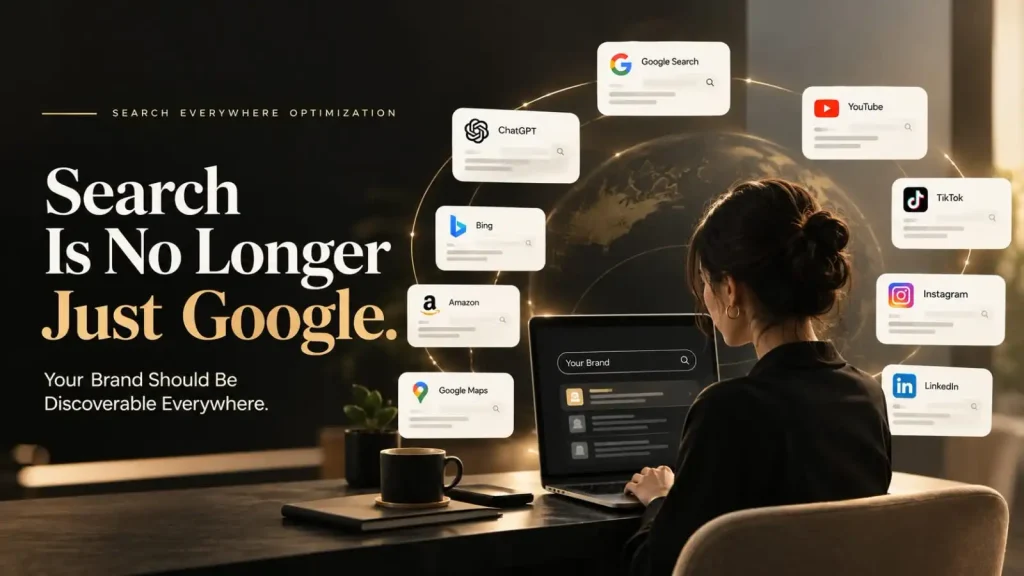
Search Is No Longer Just Google
Years ago, when people talked about search, they typically meant Google.
However, nowadays there are multiple avenues for people to find information, products and brands.
They can use Google, or turn to YouTube, Instagram, TikTok, LinkedIn, Reddit, maps, AI-assisted search platforms or any number of other resources to find exactly what they are looking for.
This creates a new opportunity for brands to be found by people searching in any of these venues which is why Search Everywhere Optimization is important.
What Is Search Everywhere Optimization?
Search Everywhere Optimization refers to the practice of optimizing a brand’s presence in all of the different platforms where their target audience searches for information.
Traditional SEO focuses only on search engines.
Search Everywhere Optimization works on a more expansive view of the places where people search.
These include:
🔍 Google and other search engines
🔍 AI-based search
🔍 Social media search
🔍 YouTube
🔍 Google Business Profile and maps
🔍 Online communities
🔍 Industry directories and platforms
🔍 Product or service marketplaces
The aim is to make a brand easily found across the digital landscape in the modern age.
Why Is Search Everywhere Important?
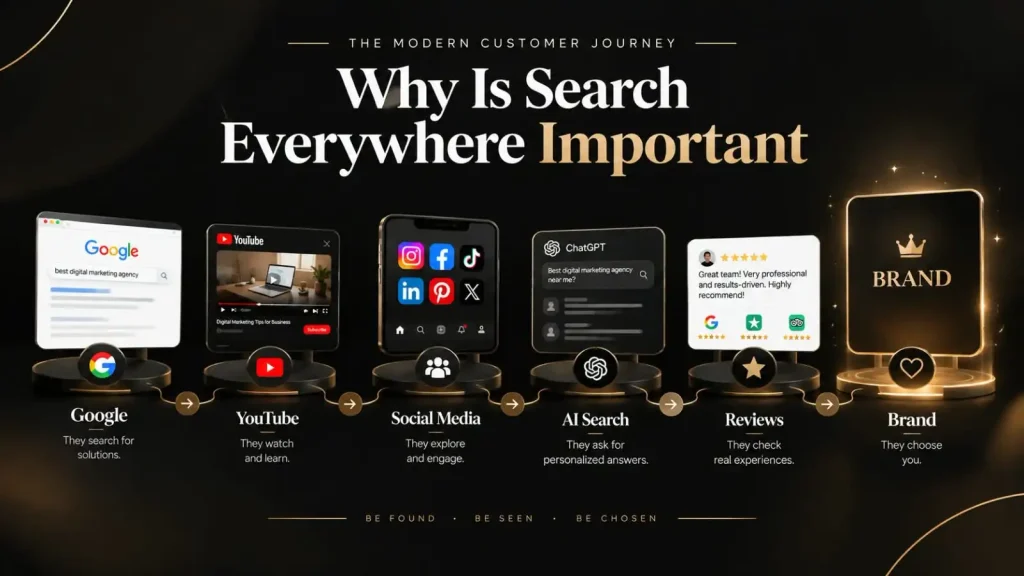
People do not always take the same journey when researching a product or service.
Someone might:
Google a problem, watch a YouTube video, check Instagram, read reviews, ask an AI tool, search for the brand
So, if your brand is not showing up on one of these platforms, you might be missing out on that potential customer.
Having your brand on different platforms provides more exposure and avenues for customers to discover, become familiar with, and trust your brand.
Search Everywhere vs Traditional SEO
| Traditional SEO | Search Everywhere Optimization |
|---|---|
| Mainly focuses on search engines | → Focuses on multiple discovery platforms |
| Website is the main asset | → Brand presence across platforms |
| Keyword-focused | → Search intent + platform behavior |
| Organic rankings are important | → Visibility across multiple touchpoints |
| Google is often the primary focus | → Search can happen anywhere |
Search Everywhere Optimization does not replace SEO.
Instead, SEO becomes one important part of a broader visibility strategy.
Where Should Your Brand Be Discoverable?
1. Search Engines
Your website needs to be optimized for relevant searches.
Focus on generating valuable content, technical SEO, search intent and creating a great user experience.
2. AI-Powered Search
AI is becoming another avenue for people to find information.
Brands need to create clear, trustworthy, and valuable content that AI systems can rely upon for its expertise, services and topics.
3. Social Media Search
Social networks such as Instagram, TikTok, LinkedIn and other social networks are also discovery channels.
Make sure to use relevant topics, clear captions, valuable content and consistent branding information.
4. YouTube
People use YouTube to seek tutorials, reviews, explanations and solutions.
Educational content can allow your brand to engage with people earlier in the decision-making journey.
5. Local Search
For local businesses, platforms such as Google Maps and Google Business Profile can be important discovery points.
Having accurate information, reviews, photos and services can give potential customers an idea of what your business offers before reaching out to you.
How to Build a Search Everywhere Strategy
Step 1: Know Where your Audience Searches
Identify where your customers go to look for information.
Do they use Google, YouTube, social media or AI tools?
Step 2: Build Around Questions, Problems And Interests
Produce content around real-world issues and not just keywords.
Step 3: Optimise For Platforms
You do not need to replicate the same content everywhere.
Take one piece of content, and change it into a blog, short-form videos for social media, a post on a forum, a YouTube video, a FAQ entry, an infographic, etc.
Step 4: Consistent Brand Image
Make sure that your brand name, service line, messaging and important information are kept consistent across relevant platforms.
Step 5: Measure Beyond Website Traffic
• Depending on the strategy, measure:
• Increase in search visibility,
• brand searches,
• social discovery, video views,
• profile visits,
• engagement,
• leads and conversions
One Topic, Multiple Search Opportunities
A single topic can provide multiple discovery opportunities.
For example, a digital marketing agency could think about how to improve online visibility.
From that one idea, the company could create the following pieces of content:
Google: SEO blog
YouTube: How-to video
Instagram: Educational carousel
LinkedIn: Industry insight
AI Search: Detailed expert content
FAQ: Direct answers to common questions
One idea can therefore support visibility across several platforms
Blog
YouTube Video
Instagram Carousel
LinkedIn Post
FAQ
AI-Ready Content
Common Mistakes to Avoid
Search Everywhere Optimization does not mean being active everywhere.
Avoid:
Creating low quality content everywhere.
• Posting the same content everywhere.
• Ignoring your website.
• Prioritizing rankings.
• Only focusing on keywords.
• Neglecting brand building.
• Only measuring traffic.
The goal is not to be everywhere, but rather to be findable where your users are.
Frequently Asked Questions
Is Search Everywhere Optimization the same thing as SEO?
No, SEO is a part of Search Everywhere Optimization but it focuses mostly on improving the presence in search engines, whereas we believe in a more holistic approach to improving the presence across search engines, AI assistants, social media, video platforms and other discovery sources.
Why should brands optimize for multiple platforms?
Consumers research their purchases across multiple sources, therefore the ability to be found in different discovery channels increases your chances of being found by the consumer.
Does Search Everywhere Optimization replace SEO?
No, SEO is still an important part of the process, but it is a part of a bigger picture.
How can small businesses leverage this strategy?
Small businesses can utilize the strategy by working on their website, Google Business Profile, social media, local search, content and video platforms.
Does every brand need to be on every platform?
No, brands should concentrate on the platforms which are relevant to their consumers and their product or service.
How long does it take to build up visibility in search results?
It is different for every business, website, blog or video search result. It really depends on the competitiveness of the niche, the quality and quantity of the content and how long the publisher has been publishing or creating videos. Some things can be implemented fairly quickly, while other tactics require more time to build up.
Conclusion
Search is no longer confined to one search engine.
People are discovering brands via Google, AI search, social media, YouTube, local search and other digital platforms
That means modern brands need to think beyond traditional rankings
Search Everywhere Optimization focuses on creating a connected digital presence that meets users where they are.